<?xml version="1.0" encoding="UTF-8"?>
<page>
  <sourceCitations></sourceCitations>
  <contentStorage>postgres</contentStorage>
  <sameNames></sameNames>
  <basedOn></basedOn>
  <title>knowledge</title>
  <description>Read people, places, events, organizations, works, and concepts through sourced relations.</description>
  <url>/es/index-466.html</url>
  <entities>
    <entity>
      <perspectives></perspectives>
      <customFields></customFields>
      <rankingTiers></rankingTiers>
      <rankingColumns></rankingColumns>
      <rankingEntries></rankingEntries>
      <id>person_cn_q701742</id>
      <type>person</type>
      <title>张举</title>
      <slug>zhang-ju</slug>
      <aliases>
        <alias>Zhang Ju</alias>
      </aliases>
      <previousSlugs>
        <slug>zhang-ju-q701742</slug>
      </previousSlugs>
      <summary>张举（？—189年），中国人物。</summary>
      <status>published</status>
      <categories>
        <category>category-history</category>
        <category>category-people</category>
        <category>category-historical-figures</category>
      </categories>
      <tags>
        <tag>tag-ancient-china</tag>
      </tags>
      <sources>
        <source>
          <id>wikidata</id>
          <title>Wikidata Q701742</title>
          <url>https://www.wikidata.org/wiki/Q701742</url>
        </source>
        <source>
          <id>zhwiki</id>
          <title>张举 (东汉)（维基百科）</title>
          <url>https://zh.wikipedia.org/wiki/%E5%BC%B5%E8%88%89_(%E6%9D%B1%E6%BC%A2)</url>
        </source>
      </sources>
      <createdAt>2026-10-25T00:00:00+08:00</createdAt>
      <updatedAt>2026-10-29T17:16:35+08:00</updatedAt>
      <updatedBy>user:admin</updatedBy>
      <revision>5</revision>
      <body>## 生平&#xA;&#xA;张举（生卒年不详），渔阳人，东汉末年人物，本为泰山太守。中平四年（187年），张纯因未获车骑将军张温重用而心怀不满，联络张举与乌桓大人丘力居等起兵反汉，劫掠蓟中，杀护乌桓校尉公綦稠、右北平太守刘政、辽东太守阳终等，聚众十余万屯于肥如，寇略幽、冀二州，张举自称天子。中平五年（188年），公孙瓒奉命讨伐，与叛军战于石门，先胜后因孤军深入被丘力居围困，损失惨重。中平六年（189年），幽州牧刘虞以恩信招降丘力居，并悬赏张纯、张举，张纯为门客所杀，张举逃奔塞外，自此下落不明。《三国演义》中张举自缢的情节是小说虚构。[^zhwiki]&#xA;&#xA;## 基本信息&#xA;&#xA;- 所属朝代或国家：中国[^wikidata]&#xA;&#xA;## 演义及游戏中的形象&#xA;&#xA;- [[person_cnv_q701742_q70806|张举]]（《三国演义》人物）</body>
      <url>/people/zhang-ju.html</url>
      <lang>es</lang>
      <fallback>true</fallback>
      <availableLangs>
        <lang>zh</lang>
        <lang>en</lang>
      </availableLangs>
      <death>
        <year>189</year>
        <display>189年</display>
      </death>
      <occupations></occupations>
      <disambiguation>东汉</disambiguation>
      <personCategory>历史人物</personCategory>
      <creators></creators>
      <relatedTerms></relatedTerms>
    </entity>
    <entity>
      <perspectives></perspectives>
      <customFields></customFields>
      <rankingTiers></rankingTiers>
      <rankingColumns></rankingColumns>
      <rankingEntries></rankingEntries>
      <id>person_cn_q701552</id>
      <type>person</type>
      <title>韩遂</title>
      <slug>han-sui</slug>
      <aliases>
        <alias>Han Sui</alias>
      </aliases>
      <previousSlugs>
        <slug>han-sui-q701552</slug>
      </previousSlugs>
      <summary>韩遂（？—215年），中国人物。</summary>
      <status>published</status>
      <categories>
        <category>category-history</category>
        <category>category-people</category>
        <category>category-historical-figures</category>
      </categories>
      <tags>
        <tag>tag-ancient-china</tag>
      </tags>
      <sources>
        <source>
          <id>wikidata</id>
          <title>Wikidata Q701552</title>
          <url>https://www.wikidata.org/wiki/Q701552</url>
        </source>
        <source>
          <id>zhwiki</id>
          <title>韩遂（维基百科）</title>
          <url>https://zh.wikipedia.org/wiki/%E9%9F%A9%E9%81%82</url>
        </source>
      </sources>
      <createdAt>2026-10-25T00:00:00+08:00</createdAt>
      <updatedAt>2026-10-29T17:16:34+08:00</updatedAt>
      <updatedBy>user:admin</updatedBy>
      <revision>6</revision>
      <body>## 生平&#xA;&#xA;韩遂（？—215年），原名韩约，字文约，金城郡人，东汉末年凉州军阀。曾建议大将军何进尽诛宦官，不被采纳，遂返回凉州。中平元年（184年），韩约被羌人叛军劫持为人质，被迫加入叛军，与边章同为首领，改名韩遂；中平三年（186年）杀边章、北宫伯玉等，自拥十余万众，进围陇西，寇掠三辅，朝廷数度征讨不能制。董卓乱政后，韩遂与马腾结为兄弟；初平三年（192年）后归顺朝廷，任镇西将军。其后他与马腾失和相攻，关中由钟繇镇抚调解。建安十六年（211年），韩遂与马超等关中诸将起兵反曹，在潼关、渭南一带为曹操击破，败走凉州。建安二十年（215年），韩遂为部下所杀，首级被送往曹操处，一说病死后被斩首，享年七十余岁。[^zhwiki]&#xA;&#xA;## 历史成就&#xA;&#xA;韩遂割据凉州前后三十余年，是汉末关西军阀中存续最久者。荀彧曾评关中将帅“唯韩遂、马超最强”。其叛服无常、与马腾时合时战的历程，是汉末凉州长期动乱与中央权威衰落的一个缩影。[^zhwiki]&#xA;&#xA;## 基本信息&#xA;&#xA;- 所属朝代或国家：中国[^wikidata]&#xA;&#xA;## 演义及游戏中的形象&#xA;&#xA;- [[person_cn_q123701573|韩遂]]（《三国演义》人物）</body>
      <url>/people/han-sui.html</url>
      <lang>es</lang>
      <fallback>true</fallback>
      <availableLangs>
        <lang>zh</lang>
        <lang>en</lang>
      </availableLangs>
      <birth>
        <year>101</year>
        <precision>year</precision>
      </birth>
      <death>
        <year>215</year>
        <display>215年</display>
      </death>
      <occupations>
        <occupation>军人</occupation>
      </occupations>
      <personCategory>历史人物</personCategory>
      <creators></creators>
      <relatedTerms></relatedTerms>
    </entity>
    <entity>
      <perspectives></perspectives>
      <customFields></customFields>
      <rankingTiers></rankingTiers>
      <rankingColumns></rankingColumns>
      <rankingEntries></rankingEntries>
      <id>person_cn_q701507</id>
      <type>person</type>
      <title>刘伯承</title>
      <slug>liu-bocheng</slug>
      <aliases>
        <alias>Liu Bocheng</alias>
      </aliases>
      <previousSlugs>
        <slug>liu-bocheng-q701507</slug>
      </previousSlugs>
      <summary>刘伯承（1892年12月4日—1986年12月7日），中华人民共和国元帅。</summary>
      <status>published</status>
      <categories>
        <category>category-history</category>
        <category>category-people</category>
        <category>category-historical-figures</category>
      </categories>
      <tags>
        <tag>tag-ancient-china</tag>
      </tags>
      <sources>
        <source>
          <id>wikidata</id>
          <title>Wikidata Q701507</title>
          <url>https://www.wikidata.org/wiki/Q701507</url>
        </source>
        <source>
          <id>zhwiki</id>
          <title>刘伯承（维基百科）</title>
          <url>https://zh.wikipedia.org/wiki/%E5%88%98%E4%BC%AF%E6%89%BF</url>
        </source>
      </sources>
      <createdAt>2026-10-25T00:00:00+08:00</createdAt>
      <updatedAt>2026-10-29T17:16:33+08:00</updatedAt>
      <updatedBy>user:admin</updatedBy>
      <revision>6</revision>
      <body>## 生平&#xA;&#xA;刘伯承（1892年—1986年），四川开县（今重庆市开州区）人。早年投身川军，参加护国、护法战争，1916年在丰都战斗中右眼负伤致残。1926年加入中国共产党，与朱德、陈毅等发动泸顺起义；1927年参加南昌起义，任中共前敌委员会参谋团参谋长，其后赴苏联伏龙芝军事学院学习，1930年回国。土地革命战争时期任红军学校校长兼政委、红军总参谋长等职，长征中指挥强渡金沙江，在彝海与彝族首领小叶丹结盟，并指挥强渡大渡河。抗日战争时期任八路军第一二九师师长，与政委邓小平开辟晋冀鲁豫抗日根据地，所部世称“刘邓大军”，参加百团大战。解放战争时期历任晋冀鲁豫军区、中原军区、第二野战军司令员，指挥千里跃进大别山，与华东野战军共同指挥淮海战役，渡江后进军大西南。中华人民共和国成立后任西南军政委员会主席、中国人民解放军军事学院院长兼政委，1955年被授予元帅军衔；1958年因所谓“教条主义”受到批判，此后逐渐淡出军界。1986年10月7日在北京病逝。[^zhwiki]&#xA;&#xA;## 历史成就&#xA;&#xA;刘伯承是中国人民解放军的缔造者之一、杰出军事家。他长期主持军事院校建设，创办解放军军事学院并陆续创立海、空、炮兵等系，奠定了人民解放军指挥院校体系；他翻译苏军教材、撰写军事论著，重视以“任务、敌情、我情、地形、时间”五要素（“五行”）筹划作战。1989年被中央军委确定为中国人民解放军军事家之一。[^zhwiki]&#xA;&#xA;## 基本信息&#xA;&#xA;- 简介：中华人民共和国元帅[^wikidata]&#xA;- 所属朝代或国家：中华人民共和国、清朝、中华民国[^wikidata]&#xA;- 出生地：[[place_cn_500154|开州区]][^wikidata]</body>
      <url>/people/liu-bocheng.html</url>
      <lang>es</lang>
      <fallback>true</fallback>
      <availableLangs>
        <lang>zh</lang>
        <lang>en</lang>
      </availableLangs>
      <birth>
        <year>1892</year>
        <month>12</month>
        <day>4</day>
        <display>1892年12月4日</display>
      </birth>
      <death>
        <year>1986</year>
        <month>12</month>
        <day>7</day>
        <display>1986年12月7日</display>
      </death>
      <occupations>
        <occupation>军人</occupation>
        <occupation>政治人物</occupation>
      </occupations>
      <nativePlace>开州区</nativePlace>
      <personCategory>历史人物</personCategory>
      <creators></creators>
      <relatedTerms></relatedTerms>
    </entity>
    <entity>
      <perspectives></perspectives>
      <customFields></customFields>
      <rankingTiers></rankingTiers>
      <rankingColumns></rankingColumns>
      <rankingEntries></rankingEntries>
      <id>person_cn_q701527</id>
      <type>person</type>
      <title>黄祖</title>
      <slug>huang-zu</slug>
      <aliases>
        <alias>Huang Zu</alias>
      </aliases>
      <previousSlugs>
        <slug>huang-zu-q701527</slug>
      </previousSlugs>
      <summary>黄祖（？—208年），东汉人物。</summary>
      <status>published</status>
      <categories>
        <category>category-history</category>
        <category>category-people</category>
        <category>category-historical-figures</category>
      </categories>
      <tags>
        <tag>tag-ancient-china</tag>
      </tags>
      <sources>
        <source>
          <id>wikidata</id>
          <title>Wikidata Q701527</title>
          <url>https://www.wikidata.org/wiki/Q701527</url>
        </source>
        <source>
          <id>zhwiki</id>
          <title>黄祖（维基百科）</title>
          <url>https://zh.wikipedia.org/wiki/%E9%BB%83%E7%A5%96</url>
        </source>
      </sources>
      <createdAt>2026-10-25T00:00:00+08:00</createdAt>
      <updatedAt>2026-10-29T17:16:32+08:00</updatedAt>
      <updatedBy>user:admin</updatedBy>
      <revision>6</revision>
      <body>## 生平&#xA;&#xA;黄祖（？—208年），东汉末年荆州牧刘表部将，长期任江夏太守，镇守荆州东境。初平三年（192年），孙坚奉袁术命攻刘表，黄祖迎战败退，其部将吕公在岘山一带伏击，以落石击杀孙坚。建安三年（198年），黄祖斩杀屡屡轻侮他的名士祢衡。建安四年（199年），孙策进军沙羡，大破黄祖军，黄祖妻儿被俘、只身逃走。建安八年（203年），孙权讨伐黄祖，黄祖败走，部将甘宁射杀吴将凌操，黄祖得以脱险。建安十三年（208年），孙权再度进攻江夏，吴军攻破黄祖封锁，黄祖逃窜中被孙权军骑兵冯则斩杀。[^zhwiki]&#xA;&#xA;## 基本信息&#xA;&#xA;- 所属朝代或国家：东汉[^wikidata]&#xA;&#xA;## 演义及游戏中的形象&#xA;&#xA;- [[person_cn_q123680589|黄祖]]（《三国演义》人物）</body>
      <url>/people/huang-zu.html</url>
      <lang>es</lang>
      <fallback>true</fallback>
      <availableLangs>
        <lang>zh</lang>
        <lang>en</lang>
      </availableLangs>
      <birth>
        <year>200</year>
        <precision>year</precision>
      </birth>
      <death>
        <year>208</year>
        <display>208年</display>
      </death>
      <occupations>
        <occupation>军人</occupation>
      </occupations>
      <personCategory>历史人物</personCategory>
      <creators></creators>
      <relatedTerms></relatedTerms>
    </entity>
    <entity>
      <perspectives></perspectives>
      <customFields></customFields>
      <rankingTiers></rankingTiers>
      <rankingColumns></rankingColumns>
      <rankingEntries></rankingEntries>
      <id>person_cn_q701313</id>
      <type>person</type>
      <title>陈诚</title>
      <slug>chen-cheng</slug>
      <aliases>
        <alias>Chen Cheng</alias>
      </aliases>
      <previousSlugs>
        <slug>chen-cheng-q701313</slug>
      </previousSlugs>
      <summary>陈诚（1897年1月4日—1965年3月5日），中华民国第2、3任副总统，第5、7任行政院院长。</summary>
      <status>published</status>
      <categories>
        <category>category-history</category>
        <category>category-people</category>
        <category>category-historical-figures</category>
      </categories>
      <tags>
        <tag>tag-ancient-china</tag>
      </tags>
      <sources>
        <source>
          <id>wikidata</id>
          <title>Wikidata Q701313</title>
          <url>https://www.wikidata.org/wiki/Q701313</url>
        </source>
        <source>
          <id>zhwiki</id>
          <title>陈诚（维基百科）</title>
          <url>https://zh.wikipedia.org/wiki/%E9%99%B3%E8%AA%A0</url>
        </source>
      </sources>
      <createdAt>2026-10-25T00:00:00+08:00</createdAt>
      <updatedAt>2026-10-29T17:16:30+08:00</updatedAt>
      <updatedBy>user:admin</updatedBy>
      <revision>6</revision>
      <body>## 生平&#xA;&#xA;陈诚（1898年—1965年），字辞修，浙江青田人。1922年毕业于保定军官学校第八期炮科，1924年到黄埔军校任炮兵教官，东征中指挥炮兵屡立战功，受蒋介石赏识，有“三炮起家”之称。此后历任团长、师长，1930年任国民革命军第十八军军长；以第十一师、第十八军为班底的部队系统，人称“土木系”。抗日战争时期任第九战区司令长官、湖北省政府主席等职，后任军政部部长、国防部参谋总长。1949年赴台湾，任台湾省政府主席，推行“三七五减租”等土地改革；其后两度出任行政院院长，1954年起任副总统，并主持石门水库建设委员会。1965年3月5日在台北病逝。[^zhwiki]&#xA;&#xA;## 历史成就&#xA;&#xA;陈诚是国民党党、政、军首要人物之一，蒋介石嫡系军事集团的中坚。到台湾后，他在整编来台部队、改革币制、稳定金融、推行土地改革与规划地方自治等方面多有建树，史家评价其对台湾社会与经济影响深远；国民党内则称他为“蒋介石的替身”“第二号人物”。[^zhwiki]&#xA;&#xA;## 基本信息&#xA;&#xA;- 简介：中华民国第2、3任副总统，第5、7任行政院院长[^wikidata]&#xA;- 所属朝代或国家：中华民国、清朝[^wikidata]&#xA;- 出生地：[[place_cn_331121|青田县]][^wikidata]</body>
      <url>/people/chen-cheng.html</url>
      <lang>es</lang>
      <fallback>true</fallback>
      <availableLangs>
        <lang>zh</lang>
        <lang>en</lang>
      </availableLangs>
      <birth>
        <year>1897</year>
        <month>1</month>
        <day>4</day>
        <display>1897年1月4日</display>
      </birth>
      <death>
        <year>1965</year>
        <month>3</month>
        <day>5</day>
        <display>1965年3月5日</display>
      </death>
      <occupations>
        <occupation>军人</occupation>
        <occupation>政治人物</occupation>
      </occupations>
      <nativePlace>青田县</nativePlace>
      <personCategory>历史人物</personCategory>
      <creators></creators>
      <relatedTerms></relatedTerms>
    </entity>
    <entity>
      <perspectives></perspectives>
      <customFields></customFields>
      <rankingTiers></rankingTiers>
      <rankingColumns></rankingColumns>
      <rankingEntries></rankingEntries>
      <id>person_cn_q701037</id>
      <type>person</type>
      <title>王昭君</title>
      <slug>wang-zhaojun</slug>
      <aliases>
        <alias>Wang Zhaojun</alias>
      </aliases>
      <previousSlugs>
        <slug>wang-zhaojun-q701037</slug>
      </previousSlugs>
      <summary>王昭君（公元前49年—18年），西汉宫女，和亲匈奴。</summary>
      <status>published</status>
      <categories>
        <category>category-history</category>
        <category>category-people</category>
        <category>category-historical-figures</category>
      </categories>
      <tags>
        <tag>tag-ancient-china</tag>
      </tags>
      <sources>
        <source>
          <id>wikidata</id>
          <title>Wikidata Q701037</title>
          <url>https://www.wikidata.org/wiki/Q701037</url>
        </source>
        <source>
          <id>zhwiki</id>
          <title>王昭君（维基百科）</title>
          <url>https://zh.wikipedia.org/wiki/%E7%8E%8B%E6%98%AD%E5%90%9B</url>
        </source>
      </sources>
      <createdAt>2026-10-25T00:00:00+08:00</createdAt>
      <updatedAt>2026-10-29T17:16:29+08:00</updatedAt>
      <updatedBy>user:admin</updatedBy>
      <revision>6</revision>
      <body>## 生平&#xA;&#xA;王昭君（前51年—前15年），名嬙，字昭君，南郡秭归（今湖北兴山）人，汉元帝时以良家子选入掖庭为宫女。竟宁元年（前33年），匈奴呼韩邪单于入朝请娶汉女，元帝将昭君赐予单于，《后汉书》称其入宫数岁不得见御、主动请行；单于封其为宁胡阏氏，生子伊屠智牙师。前31年呼韩邪单于去世，汉成帝诏命昭君遵从胡俗，复嫁继位的复株累若鞮单于，生二女。前15年昭君去世，葬于青冢（今内蒙古呼和浩特南）。后世笔记又有画工毛延寿索贿不成、故意丑画昭君的传说，并非正史记载。[^zhwiki]&#xA;&#xA;## 历史成就&#xA;&#xA;昭君出塞是汉匈关系史上的标志性事件。此后数十年间汉匈维持友好往来，边境少有战事，昭君对促进汉匈和好与双方交流作出了贡献。她的事迹成为后世诗词、戏曲、小说反复咏叹的题材，题咏诗作逾千首，并与貂蝉、西施、杨玉环并称中国古代四大美人。[^zhwiki]&#xA;&#xA;## 基本信息&#xA;&#xA;- 简介：西汉宫女，和亲匈奴[^wikidata]&#xA;- 所属朝代或国家：汉朝、匈奴、西汉[^wikidata]&#xA;- 出生地：[[place_cn_420526|兴山县]][^wikidata]</body>
      <url>/people/wang-zhaojun.html</url>
      <lang>es</lang>
      <fallback>true</fallback>
      <availableLangs>
        <lang>zh</lang>
        <lang>en</lang>
      </availableLangs>
      <birth>
        <year>-49</year>
        <display>公元前49年</display>
      </birth>
      <death>
        <year>18</year>
        <display>18年</display>
      </death>
      <occupations>
        <occupation>诗人</occupation>
        <occupation>政治人物</occupation>
        <occupation>女神</occupation>
        <occupation>宫女</occupation>
      </occupations>
      <nativePlace>兴山县</nativePlace>
      <personCategory>历史人物</personCategory>
      <creators></creators>
      <relatedTerms></relatedTerms>
    </entity>
    <entity>
      <perspectives></perspectives>
      <customFields></customFields>
      <rankingTiers></rankingTiers>
      <rankingColumns></rankingColumns>
      <rankingEntries></rankingEntries>
      <id>person_cn_q706766</id>
      <type>person</type>
      <title>王双</title>
      <slug>wang-shuang</slug>
      <aliases>
        <alias>Wang Shuang</alias>
      </aliases>
      <previousSlugs>
        <slug>wang-shuang-q706766</slug>
      </previousSlugs>
      <summary>王双（？—228年），曹魏、东汉人物。</summary>
      <status>published</status>
      <categories>
        <category>category-history</category>
        <category>category-people</category>
        <category>category-historical-figures</category>
      </categories>
      <tags>
        <tag>tag-ancient-china</tag>
      </tags>
      <sources>
        <source>
          <id>wikidata</id>
          <title>Wikidata Q706766</title>
          <url>https://www.wikidata.org/wiki/Q706766</url>
        </source>
        <source>
          <id>zhwiki</id>
          <title>王双 (曹真部将)（维基百科）</title>
          <url>https://zh.wikipedia.org/wiki/%E7%8E%8B%E5%8F%8C_(%E6%9B%B9%E7%9C%9F%E9%83%A8%E5%B0%86)</url>
        </source>
      </sources>
      <createdAt>2026-10-25T00:00:00+08:00</createdAt>
      <updatedAt>2026-10-29T17:16:27+08:00</updatedAt>
      <updatedBy>user:admin</updatedBy>
      <revision>5</revision>
      <body>## 生平&#xA;&#xA;王双（？—228年），曹魏将领，为曹真部下，正史对他的记载极少。太和二年（228年）冬，诸葛亮率军围攻陈仓，二十余日未能攻下，又因魏国援军将至、蜀军粮草已尽而撤退；王双领兵追击，与蜀军交战，兵败被杀。小说《三国演义》把他塑造成陇西狄道人、字子全，身长九尺、使六十八斤大刀与流星锤的虎威将军，连斩蜀将谢雄、龚起，最后被魏延斩于马下——这些都是小说的虚构，与正史无涉。[^zhwiki]&#xA;&#xA;## 基本信息&#xA;&#xA;- 所属朝代或国家：曹魏、东汉[^wikidata]&#xA;&#xA;## 演义及游戏中的形象&#xA;&#xA;- [[person_cnv_q706766_q70806|王双]]（《三国演义》人物）</body>
      <url>/people/wang-shuang.html</url>
      <lang>es</lang>
      <fallback>true</fallback>
      <availableLangs>
        <lang>zh</lang>
        <lang>en</lang>
      </availableLangs>
      <death>
        <year>228</year>
        <display>228年</display>
      </death>
      <occupations>
        <occupation>军事领袖</occupation>
      </occupations>
      <disambiguation>曹真部将</disambiguation>
      <personCategory>历史人物</personCategory>
      <creators></creators>
      <relatedTerms></relatedTerms>
    </entity>
    <entity>
      <perspectives></perspectives>
      <customFields></customFields>
      <rankingTiers></rankingTiers>
      <rankingColumns></rankingColumns>
      <rankingEntries></rankingEntries>
      <id>person_cn_q706172</id>
      <type>person</type>
      <title>段祺瑞</title>
      <slug>duan-qirui</slug>
      <aliases>
        <alias>Duan Qirui</alias>
      </aliases>
      <previousSlugs>
        <slug>duan-qirui-q706172</slug>
      </previousSlugs>
      <summary>段祺瑞（1865年3月6日—1936年11月2日），清朝、中华民国人物。</summary>
      <status>published</status>
      <categories>
        <category>category-history</category>
        <category>category-people</category>
        <category>category-historical-figures</category>
      </categories>
      <tags>
        <tag>tag-ancient-china</tag>
      </tags>
      <sources>
        <source>
          <id>wikidata</id>
          <title>Wikidata Q706172</title>
          <url>https://www.wikidata.org/wiki/Q706172</url>
        </source>
        <source>
          <id>zhwiki</id>
          <title>段祺瑞（维基百科）</title>
          <url>https://zh.wikipedia.org/wiki/%E6%AE%B5%E7%A5%BA%E7%91%9E</url>
        </source>
      </sources>
      <createdAt>2026-10-25T00:00:00+08:00</createdAt>
      <updatedAt>2026-10-29T17:16:25+08:00</updatedAt>
      <updatedBy>user:admin</updatedBy>
      <revision>6</revision>
      <body>## 生平&#xA;&#xA;段祺瑞（1865年—1936年），字芝泉，安徽合肥人，祖籍江西饶州。1885年以优异成绩考入天津武备学堂炮兵科，毕业后被派赴德国学习军事、在克虏伯兵工厂实习。回国后他协助袁世凯在小站练兵，主管炮兵训练，与冯国璋、王士珍并称“北洋三杰”，段被称为“北洋之虎”。1911年武昌起义后，他被召回任清军第二军军统，随后领衔联名发出通电，要求清帝退位、赞成共和，史称“共和双电”。此后他历任参谋总长、国务卿、国务总理等职，成为皖系领袖；1917年他力主对德宣战，又在张勋复辟后于马厂誓师将其平定。1920年直皖战争中皖系溃败，段祺瑞辞职退隐。1924年他出任中华民国临时执政，1926年三一八惨案后被冯玉祥赶下台，此后隐居天津、上海，1936年11月2日病逝。著有《正道居集》。[^zhwiki]&#xA;&#xA;## 历史成就&#xA;&#xA;段祺瑞反对帝制，主张责任内阁制与武力统一，在清帝退位、再造共和的过程中起到关键作用。他主政期间力主参加第一次世界大战，使中国成为战胜国并加入国际联盟，又迫使外蒙古取消自治。他长期主持新军训练与学务，对北洋军的养成影响深远；但其武力统一政策与三一八惨案中军警镇压请愿学生的行为，也使他备受争议。[^zhwiki]&#xA;&#xA;## 基本信息&#xA;&#xA;- 所属朝代或国家：清朝、中华民国[^wikidata]&#xA;- 出生地：[[place_cn_340123|肥西县]][^wikidata]</body>
      <url>/people/duan-qirui.html</url>
      <lang>es</lang>
      <fallback>true</fallback>
      <availableLangs>
        <lang>zh</lang>
        <lang>en</lang>
      </availableLangs>
      <birth>
        <year>1865</year>
        <month>3</month>
        <day>6</day>
        <display>1865年3月6日</display>
      </birth>
      <death>
        <year>1936</year>
        <month>11</month>
        <day>2</day>
        <display>1936年11月2日</display>
      </death>
      <occupations>
        <occupation>政治人物</occupation>
      </occupations>
      <nativePlace>肥西县</nativePlace>
      <personCategory>历史人物</personCategory>
      <creators></creators>
      <relatedTerms></relatedTerms>
    </entity>
    <entity>
      <perspectives></perspectives>
      <customFields></customFields>
      <rankingTiers></rankingTiers>
      <rankingColumns></rankingColumns>
      <rankingEntries></rankingEntries>
      <id>person_cn_q705872</id>
      <type>person</type>
      <title>林森</title>
      <slug>lin-sen</slug>
      <aliases>
        <alias>Lin Sen</alias>
      </aliases>
      <previousSlugs>
        <slug>lin-sen-q705872</slug>
      </previousSlugs>
      <summary>林森（1868年3月16日—1943年8月1日），中华民国国民政府主席。</summary>
      <status>published</status>
      <categories>
        <category>category-history</category>
        <category>category-people</category>
        <category>category-historical-figures</category>
      </categories>
      <tags>
        <tag>tag-ancient-china</tag>
      </tags>
      <sources>
        <source>
          <id>wikidata</id>
          <title>Wikidata Q705872</title>
          <url>https://www.wikidata.org/wiki/Q705872</url>
        </source>
        <source>
          <id>zhwiki</id>
          <title>林森（维基百科）</title>
          <url>https://zh.wikipedia.org/wiki/%E6%9E%97%E6%A3%AE</url>
        </source>
      </sources>
      <createdAt>2026-10-25T00:00:00+08:00</createdAt>
      <updatedAt>2026-10-29T17:16:22+08:00</updatedAt>
      <updatedBy>user:admin</updatedBy>
      <revision>6</revision>
      <body>## 生平&#xA;&#xA;林森（1868年—1943年），字子超，福建闽县人。早年入美国教会学校培元学校与鹤龄英华书院，1884年到台北电报局任职，台湾割让后参加刘永福的黑旗军抗日，失败后返回福州；1902年到上海江海关任职，1905年加入同盟会。辛亥革命时任江西九江军政府民政长，后任南京临时参议院议长、首届国会全院委员长。二次革命失败后流亡日本，1917年随孙中山南下护法，历任非常会议参议院议长、护法军政府外交部长、大本营建设部部长等职；1925年参与西山会议派活动。1931年12月被推选为国民政府主席，此后连任长达十二年，抗战期间随国民政府迁往重庆。1943年5月12日，他在重庆乘车时为避让车辆撞上路树，脑部受创引发脑溢血，8月1日逝世，享年75岁，以国葬之礼安葬于重庆林园。[^zhwiki]&#xA;&#xA;## 历史成就&#xA;&#xA;林森长期担任国民政府主席，因实权掌握在军事委员会委员长蒋介石手中，被视为虚位元首，但他以国家元首身份完成了多项具有象征意义的大事：主持南京中山陵完工与孙中山遗体移葬；珍珠港事变后代表中国对德、意、日三国宣战，并致力于废除自清代以来与英、美等国签订的不平等条约；汪精卫政权遥奉他为国民政府主席时，他发表严正声明痛斥汪政权、不予承认。1944年，国民政府将他的家乡闽侯县改名为林森县以作纪念（1950年恢复原名）。[^zhwiki]&#xA;&#xA;## 基本信息&#xA;&#xA;- 简介：中华民国国民政府主席[^wikidata]&#xA;- 所属朝代或国家：清朝、中华民国[^wikidata]&#xA;- 出生地：[[place_cn_350121|闽侯县]][^wikidata]</body>
      <url>/people/lin-sen.html</url>
      <lang>es</lang>
      <fallback>true</fallback>
      <availableLangs>
        <lang>zh</lang>
        <lang>en</lang>
      </availableLangs>
      <birth>
        <year>1868</year>
        <month>3</month>
        <day>16</day>
        <display>1868年3月16日</display>
      </birth>
      <death>
        <year>1943</year>
        <month>8</month>
        <day>1</day>
        <display>1943年8月1日</display>
      </death>
      <occupations>
        <occupation>政治人物</occupation>
      </occupations>
      <nativePlace>闽侯县</nativePlace>
      <personCategory>历史人物</personCategory>
      <creators></creators>
      <relatedTerms></relatedTerms>
    </entity>
    <entity>
      <perspectives></perspectives>
      <customFields></customFields>
      <rankingTiers></rankingTiers>
      <rankingColumns></rankingColumns>
      <rankingEntries></rankingEntries>
      <id>person_cn_q705769</id>
      <type>person</type>
      <title>韩暹</title>
      <slug>han-xian</slug>
      <aliases>
        <alias>Han Xian</alias>
      </aliases>
      <previousSlugs>
        <slug>han-xian-q705769</slug>
      </previousSlugs>
      <summary>韩暹（？—197年），东汉人物。</summary>
      <status>published</status>
      <categories>
        <category>category-history</category>
        <category>category-people</category>
        <category>category-historical-figures</category>
      </categories>
      <tags>
        <tag>tag-ancient-china</tag>
      </tags>
      <sources>
        <source>
          <id>wikidata</id>
          <title>Wikidata Q705769</title>
          <url>https://www.wikidata.org/wiki/Q705769</url>
        </source>
        <source>
          <id>zhwiki</id>
          <title>韩暹（维基百科）</title>
          <url>https://zh.wikipedia.org/wiki/%E9%9F%93%E6%9A%B9</url>
        </source>
      </sources>
      <createdAt>2026-10-25T00:00:00+08:00</createdAt>
      <updatedAt>2026-10-29T17:16:21+08:00</updatedAt>
      <updatedBy>user:admin</updatedBy>
      <revision>6</revision>
      <body>## 生平&#xA;&#xA;韩暹（？—197年），东汉末年河东白波军的首领之一。兴平二年（195年），杨奉与李傕交战，紧急召来河东故友白波帅韩暹、胡才、李乐一同抵抗，护送汉献帝东归洛阳。建安元年（196年），韩暹进攻董承，迫使董承逃往张杨处；献帝回到洛阳后，升韩暹为大将军、领司隶校尉，假节钺，与董承同留洛阳护卫。曹操迎献帝迁都许县，韩暹出兵阻拦被击败，逃奔袁术。建安二年（197年），袁术派大将张勋、桥蕤与韩暹等人进攻吕布，吕布说服韩暹阵前倒戈，大破张勋；其后韩暹与杨奉在徐州、扬州一带纵兵掳掠，杨奉被刘备设计杀死，韩暹欲北归并州，途经抒秋县时被县令张宣所杀。[^zhwiki]&#xA;&#xA;## 基本信息&#xA;&#xA;- 所属朝代或国家：东汉[^wikidata]&#xA;&#xA;## 演义及游戏中的形象&#xA;&#xA;- [[person_cn_q123752165|韩暹]]（《三国演义》人物）</body>
      <url>/people/han-xian.html</url>
      <lang>es</lang>
      <fallback>true</fallback>
      <availableLangs>
        <lang>zh</lang>
        <lang>en</lang>
      </availableLangs>
      <birth>
        <year>101</year>
        <precision>year</precision>
      </birth>
      <death>
        <year>197</year>
        <display>197年</display>
      </death>
      <occupations>
        <occupation>军人</occupation>
      </occupations>
      <personCategory>历史人物</personCategory>
      <creators></creators>
      <relatedTerms></relatedTerms>
    </entity>
    <entity>
      <perspectives></perspectives>
      <customFields></customFields>
      <rankingTiers></rankingTiers>
      <rankingColumns></rankingColumns>
      <rankingEntries></rankingEntries>
      <id>person_cn_q699365</id>
      <type>person</type>
      <title>吴敬梓</title>
      <slug>wu-jingzi</slug>
      <aliases>
        <alias>Wu Jingzi</alias>
      </aliases>
      <previousSlugs>
        <slug>wu-jingzi-q699365</slug>
      </previousSlugs>
      <summary>吴敬梓（1701年—1754年1月11日），清朝人物。</summary>
      <status>published</status>
      <categories>
        <category>category-history</category>
        <category>category-people</category>
        <category>category-historical-figures</category>
      </categories>
      <tags>
        <tag>tag-ancient-china</tag>
      </tags>
      <sources>
        <source>
          <id>wikidata</id>
          <title>Wikidata Q699365</title>
          <url>https://www.wikidata.org/wiki/Q699365</url>
        </source>
        <source>
          <id>zhwiki</id>
          <title>吴敬梓（维基百科）</title>
          <url>https://zh.wikipedia.org/wiki/%E5%90%B4%E6%95%AC%E6%A2%93</url>
        </source>
      </sources>
      <createdAt>2026-10-25T00:00:00+08:00</createdAt>
      <updatedAt>2026-10-29T17:16:20+08:00</updatedAt>
      <updatedBy>user:admin</updatedBy>
      <revision>6</revision>
      <body>## 生平&#xA;&#xA;吴敬梓（1701年—1754年），字敏轩，号粒民，安徽全椒人，出身科第世家，曾祖吴国对为顺治年间探花。他十八岁考中秀才，此后科场不顺；父亲去世后，因性情豁达、急朋友之急而耗散家产，又遭族人夺产，家道中落。雍正十一年（1733年）移居江宁（今南京）秦淮河畔。乾隆元年（1736年）被荐应博学鸿词科，以病辞谢不赴。晚年生活困顿，靠卖文和朋友接济度日，乾隆十九年（1754年）客死扬州。[^zhwiki]&#xA;&#xA;## 历史成就&#xA;&#xA;吴敬梓耗费近二十年写成《儒林外史》，以写实笔法刻画科举制度下读书人的群像，揭露科举与礼教之弊，被誉为中国古典讽刺小说的典范。他还具有超前于时代的妇女观，如赞同寡妇再嫁、鼓励受压迫的妇女反抗。另有诗文集《文木山房集》传世。[^zhwiki]&#xA;&#xA;## 基本信息&#xA;&#xA;- 所属朝代或国家：清朝[^wikidata]&#xA;- 出生地：[[place_cn_341124|全椒县]][^wikidata]&#xA;&#xA;## 著作&#xA;&#xA;- [[work_cn_q1218689|《儒林外史》]]</body>
      <url>/people/wu-jingzi.html</url>
      <lang>es</lang>
      <fallback>true</fallback>
      <availableLangs>
        <lang>zh</lang>
        <lang>en</lang>
      </availableLangs>
      <birth>
        <year>1701</year>
        <display>1701年</display>
      </birth>
      <death>
        <year>1754</year>
        <month>1</month>
        <day>11</day>
        <display>1754年1月11日</display>
      </death>
      <occupations>
        <occupation>作家</occupation>
        <occupation>诗人</occupation>
        <occupation>散文家</occupation>
      </occupations>
      <nativePlace>全椒县</nativePlace>
      <personCategory>历史人物</personCategory>
      <creators></creators>
      <relatedTerms></relatedTerms>
    </entity>
    <entity>
      <perspectives></perspectives>
      <customFields></customFields>
      <rankingTiers></rankingTiers>
      <rankingColumns></rankingColumns>
      <rankingEntries></rankingEntries>
      <id>person_cn_q698177</id>
      <type>person</type>
      <title>李贽</title>
      <slug>li-zhi</slug>
      <aliases>
        <alias>Li Zhi</alias>
      </aliases>
      <previousSlugs>
        <slug>li-zhi-q698177</slug>
      </previousSlugs>
      <summary>李贽（1527年—1602年5月6日），明朝中期思想家、史学家、文学家。</summary>
      <status>published</status>
      <categories>
        <category>category-history</category>
        <category>category-people</category>
        <category>category-historical-figures</category>
      </categories>
      <tags>
        <tag>tag-ancient-china</tag>
      </tags>
      <sources>
        <source>
          <id>wikidata</id>
          <title>Wikidata Q698177</title>
          <url>https://www.wikidata.org/wiki/Q698177</url>
        </source>
        <source>
          <id>zhwiki</id>
          <title>李贽（维基百科）</title>
          <url>https://zh.wikipedia.org/wiki/%E6%9D%8E%E8%B4%BD</url>
        </source>
      </sources>
      <createdAt>2026-10-25T00:00:00+08:00</createdAt>
      <updatedAt>2026-10-29T17:16:18+08:00</updatedAt>
      <updatedBy>user:admin</updatedBy>
      <revision>6</revision>
      <body>## 生平&#xA;&#xA;李贽（1527年—1602年），初姓林，名载贽，后改姓李，名贽，字宏甫，号卓吾，福建泉州晋江人，出身航海贸易世家。嘉靖三十一年（1552年）中举人后不再应进士试，历任河南共城教谕、国子监博士、礼部司务、南京刑部员外郎等低级官职，万历五年（1577年）出任云南姚安知府，万历八年（1580年）任满辞官。此后寄居湖广黄安耿氏兄弟家，后迁麻城芝佛院，剃发而不受戒，以著书讲学为业十余年，与汤显祖等文人及来华传教士利玛窦均有交往。万历二十九年（1601年）芝佛院被焚毁；万历三十年（1602年），礼科给事中张问达劾其“敢倡乱道、惑世诬民”，朝廷下令逮治并焚毁其著作，李贽在狱中自刎而死。[^zhwiki]&#xA;&#xA;## 历史成就&#xA;&#xA;李贽是泰州学派传人、晚明思想界最具争议的人物。他提出“童心说”，主张文章著述须出于绝假纯真的童心；公开宣称“不以孔子之是非为是非”，贬斥程朱理学为伪道学，主张“穿衣吃饭即是人伦物理”，肯定人的私欲与功利追求，在士大夫中引发强烈反响。史学方面著《藏书》《续藏书》，对历代人物别立褒贬；《焚书》《续焚书》集中体现其反传统思想。他又评点《水浒传》《西厢记》，推高小说、戏曲的文学地位。其思想对汤显祖等晚明文人影响深远，后世评价两极。[^zhwiki]&#xA;&#xA;## 基本信息&#xA;&#xA;- 简介：明朝中期思想家、史学家、文学家[^wikidata]&#xA;- 所属朝代或国家：明朝[^wikidata]&#xA;- 出生地：[[place_cn_350582|晋江市]][^wikidata]</body>
      <url>/people/li-zhi.html</url>
      <lang>es</lang>
      <fallback>true</fallback>
      <availableLangs>
        <lang>zh</lang>
        <lang>en</lang>
      </availableLangs>
      <birth>
        <year>1527</year>
        <display>1527年</display>
      </birth>
      <death>
        <year>1602</year>
        <month>5</month>
        <day>6</day>
        <display>1602年5月6日</display>
      </death>
      <occupations>
        <occupation>教师</occupation>
        <occupation>哲学家</occupation>
      </occupations>
      <nativePlace>晋江市</nativePlace>
      <personCategory>历史人物</personCategory>
      <creators></creators>
      <relatedTerms></relatedTerms>
    </entity>
    <entity>
      <perspectives></perspectives>
      <customFields></customFields>
      <rankingTiers></rankingTiers>
      <rankingColumns></rankingColumns>
      <rankingEntries></rankingEntries>
      <id>person_cn_q704101</id>
      <type>person</type>
      <title>韩玄</title>
      <slug>han-xuan</slug>
      <aliases>
        <alias>Han Xuan</alias>
      </aliases>
      <previousSlugs>
        <slug>han-xuan-q704101</slug>
      </previousSlugs>
      <summary>韩玄（151年—209年），东汉人物。</summary>
      <status>published</status>
      <categories>
        <category>category-history</category>
        <category>category-people</category>
        <category>category-historical-figures</category>
      </categories>
      <tags>
        <tag>tag-ancient-china</tag>
      </tags>
      <sources>
        <source>
          <id>wikidata</id>
          <title>Wikidata Q704101</title>
          <url>https://www.wikidata.org/wiki/Q704101</url>
        </source>
        <source>
          <id>zhwiki</id>
          <title>韩玄（维基百科）</title>
          <url>https://zh.wikipedia.org/wiki/%E9%9F%93%E7%8E%84</url>
        </source>
      </sources>
      <createdAt>2026-10-25T00:00:00+08:00</createdAt>
      <updatedAt>2026-10-29T17:16:18+08:00</updatedAt>
      <updatedBy>user:admin</updatedBy>
      <revision>5</revision>
      <body>## 生平&#xA;&#xA;韩玄，东汉末年长沙太守。建安十三年（208年）赤壁之战后，刘备南征荆州四郡，武陵太守金旋、长沙太守韩玄、桂阳太守赵范、零陵太守刘度相继望风归降，兵不血刃。正史关于韩玄的记载仅此而已；归降之后，他仍然担任长沙太守，只是受讨虏将军黄忠管辖，成为蜀汉的官员。小说《三国演义》把韩玄写成性急嗜杀、因疑忌黄忠而被魏延所杀，这一死法出自《三国志平话》以来的文学虚构，与正史记载不同。[^zhwiki]&#xA;&#xA;## 基本信息&#xA;&#xA;- 所属朝代或国家：东汉[^wikidata]&#xA;&#xA;## 演义及游戏中的形象&#xA;&#xA;- [[person_cn_q124209643|韩玄]]（《三国演义》人物）</body>
      <url>/people/han-xuan.html</url>
      <lang>es</lang>
      <fallback>true</fallback>
      <availableLangs>
        <lang>zh</lang>
        <lang>en</lang>
      </availableLangs>
      <birth>
        <year>151</year>
        <display>151年</display>
      </birth>
      <death>
        <year>209</year>
        <display>209年</display>
      </death>
      <occupations>
        <occupation>政治人物</occupation>
      </occupations>
      <personCategory>历史人物</personCategory>
      <creators></creators>
      <relatedTerms></relatedTerms>
    </entity>
    <entity>
      <perspectives></perspectives>
      <customFields></customFields>
      <rankingTiers></rankingTiers>
      <rankingColumns></rankingColumns>
      <rankingEntries></rankingEntries>
      <id>person_cn_q703659</id>
      <type>person</type>
      <title>陈兰</title>
      <slug>chen-lan</slug>
      <aliases>
        <alias>Chen Lan</alias>
      </aliases>
      <previousSlugs>
        <slug>chen-lan-q703659</slug>
      </previousSlugs>
      <summary>陈兰（？—209年），中国人物。</summary>
      <status>published</status>
      <categories>
        <category>category-history</category>
        <category>category-people</category>
        <category>category-historical-figures</category>
      </categories>
      <tags>
        <tag>tag-ancient-china</tag>
      </tags>
      <sources>
        <source>
          <id>wikidata</id>
          <title>Wikidata Q703659</title>
          <url>https://www.wikidata.org/wiki/Q703659</url>
        </source>
        <source>
          <id>zhwiki</id>
          <title>陈兰 (东汉)（维基百科）</title>
          <url>https://zh.wikipedia.org/wiki/%E9%99%B3%E8%98%AD_(%E6%9D%B1%E6%BC%A2)</url>
        </source>
      </sources>
      <createdAt>2026-10-25T00:00:00+08:00</createdAt>
      <updatedAt>2026-10-29T17:16:16+08:00</updatedAt>
      <updatedBy>user:admin</updatedBy>
      <revision>6</revision>
      <body>## 生平&#xA;&#xA;陈兰（？—209年），《资治通鉴》作陈简，东汉末年袁术的部将，与雷薄一同屯兵于灊山。建安四年（199年），袁术在江淮搜刮殆尽、欲北上投奔时，为陈兰等人拒绝，留住三日后离去，不久病死。建安五年（200年）后，陈兰与梅乾、雷绪等各聚众数万，活动于江淮之间，曹操所置扬州刺史刘馥以怀柔方式应对。建安十四年（209年），陈兰与梅成据六县叛变曹操，曹操命张辽率军讨伐，又命臧霸攻打孙权部将韩当，使孙权不能救援；陈兰本欲依恃灊山险道固守，张辽进军山下安营，强行突破，将其斩杀。[^zhwiki]&#xA;&#xA;## 基本信息&#xA;&#xA;- 所属朝代或国家：中国[^wikidata]&#xA;&#xA;## 演义及游戏中的形象&#xA;&#xA;- [[person_cn_q123786696|陈兰]]（《三国演义》人物）</body>
      <url>/people/chen-lan.html</url>
      <lang>es</lang>
      <fallback>true</fallback>
      <availableLangs>
        <lang>zh</lang>
        <lang>en</lang>
      </availableLangs>
      <birth>
        <year>150</year>
        <precision>year</precision>
      </birth>
      <death>
        <year>209</year>
        <display>209年</display>
      </death>
      <occupations></occupations>
      <disambiguation>东汉</disambiguation>
      <personCategory>历史人物</personCategory>
      <creators></creators>
      <relatedTerms></relatedTerms>
    </entity>
    <entity>
      <perspectives></perspectives>
      <customFields></customFields>
      <rankingTiers></rankingTiers>
      <rankingColumns></rankingColumns>
      <rankingEntries></rankingEntries>
      <id>person_cn_q702914</id>
      <type>person</type>
      <title>刘琦</title>
      <slug>liu-qi</slug>
      <aliases>
        <alias>Liu Qi</alias>
      </aliases>
      <previousSlugs>
        <slug>liu-qi-q702914</slug>
      </previousSlugs>
      <summary>刘琦（？—209年），汉朝人物。</summary>
      <status>published</status>
      <categories>
        <category>category-history</category>
        <category>category-people</category>
        <category>category-historical-figures</category>
      </categories>
      <tags>
        <tag>tag-ancient-china</tag>
      </tags>
      <sources>
        <source>
          <id>wikidata</id>
          <title>Wikidata Q702914</title>
          <url>https://www.wikidata.org/wiki/Q702914</url>
        </source>
        <source>
          <id>zhwiki</id>
          <title>刘琦 (东汉)（维基百科）</title>
          <url>https://zh.wikipedia.org/wiki/%E5%8A%89%E7%90%A6_(%E6%9D%B1%E6%BC%A2)</url>
        </source>
      </sources>
      <createdAt>2026-10-25T00:00:00+08:00</createdAt>
      <updatedAt>2026-10-29T17:16:12+08:00</updatedAt>
      <updatedBy>user:admin</updatedBy>
      <revision>6</revision>
      <body>## 生平&#xA;&#xA;刘琦（？—209年），荆州牧刘表的长子，早年很受刘表喜爱。刘表后妻蔡氏为其侄女嫁与刘琮，便偏爱刘琮而厌恶刘琦，联合蔡瑁、张允等屡向刘表进谗言，刘琦渐被疏远。刘琦向诸葛亮请教自安之术，初时不得要领，后以“上屋抽梯”之法求教，诸葛亮以申生在内而危、重耳在外而安作答，刘琦遂自请出任江夏太守，避开襄阳的倾轧。建安十三年（208年）刘表病重，刘琦从江夏赶回探视，被蔡瑁、张允阻于门外，不得相见，只得流涕而去。刘表死后刘琮降曹，刘琦在江夏迎刘备至夏口，使刘备在荆州有了立足之地。赤壁之战后，刘备上表奏刘琦为荆州刺史；建安十四年（209年）刘琦病逝，其部众转而拥戴刘备继任荆州刺史。[^zhwiki]&#xA;&#xA;## 基本信息&#xA;&#xA;- 所属朝代或国家：汉朝[^wikidata]&#xA;&#xA;## 演义及游戏中的形象&#xA;&#xA;- [[person_cn_q124063054|刘琦]]（《三国演义》人物）</body>
      <url>/people/liu-qi.html</url>
      <lang>es</lang>
      <fallback>true</fallback>
      <availableLangs>
        <lang>zh</lang>
        <lang>en</lang>
      </availableLangs>
      <birth>
        <year>101</year>
        <precision>year</precision>
      </birth>
      <death>
        <year>209</year>
        <display>209年</display>
      </death>
      <occupations>
        <occupation>政治人物</occupation>
      </occupations>
      <disambiguation>东汉</disambiguation>
      <personCategory>历史人物</personCategory>
      <creators></creators>
      <relatedTerms></relatedTerms>
    </entity>
    <entity>
      <perspectives></perspectives>
      <customFields></customFields>
      <rankingTiers></rankingTiers>
      <rankingColumns></rankingColumns>
      <rankingEntries></rankingEntries>
      <id>person_cn_q713656</id>
      <type>person</type>
      <title>李蒙</title>
      <slug>li-meng</slug>
      <aliases>
        <alias>Li Meng</alias>
      </aliases>
      <previousSlugs>
        <slug>li-meng-q713656</slug>
      </previousSlugs>
      <summary>李蒙（？—195年），东汉人物。</summary>
      <status>published</status>
      <categories>
        <category>category-history</category>
        <category>category-people</category>
        <category>category-historical-figures</category>
      </categories>
      <tags>
        <tag>tag-ancient-china</tag>
      </tags>
      <sources>
        <source>
          <id>wikidata</id>
          <title>Wikidata Q713656</title>
          <url>https://www.wikidata.org/wiki/Q713656</url>
        </source>
        <source>
          <id>zhwiki</id>
          <title>李蒙 (东汉)（维基百科）</title>
          <url>https://zh.wikipedia.org/wiki/%E6%9D%8E%E8%92%99_(%E4%B8%9C%E6%B1%89)</url>
        </source>
      </sources>
      <createdAt>2026-10-25T00:00:00+08:00</createdAt>
      <updatedAt>2026-10-29T17:16:12+08:00</updatedAt>
      <updatedBy>user:admin</updatedBy>
      <revision>6</revision>
      <body>## 生平&#xA;&#xA;李蒙（？—195年），东汉末年人，董卓部下将领。他曾与徐荣四处出兵虏掠，徐荣在梁东与孙坚交战时即属此列。初平三年（192年），董卓被杀、牛辅败亡后，李蒙与樊稠响应李傕的号召，率军攻入长安，杀死王允，迫走吕布，参与把持朝政。其后李傕与樊稠争权相攻，兴平二年（195年），李蒙与樊稠在一次会议中被胡封（胡才）杀害。[^zhwiki]&#xA;&#xA;## 基本信息&#xA;&#xA;- 所属朝代或国家：东汉[^wikidata]&#xA;&#xA;## 演义及游戏中的形象&#xA;&#xA;- [[person_cn_q123693798|李蒙]]（《三国演义》人物）</body>
      <url>/people/li-meng.html</url>
      <lang>es</lang>
      <fallback>true</fallback>
      <availableLangs>
        <lang>zh</lang>
        <lang>en</lang>
      </availableLangs>
      <birth>
        <year>150</year>
        <precision>year</precision>
      </birth>
      <death>
        <year>195</year>
        <display>195年</display>
      </death>
      <occupations></occupations>
      <disambiguation>东汉</disambiguation>
      <personCategory>历史人物</personCategory>
      <creators></creators>
      <relatedTerms></relatedTerms>
    </entity>
    <entity>
      <perspectives></perspectives>
      <customFields></customFields>
      <rankingTiers></rankingTiers>
      <rankingColumns></rankingColumns>
      <rankingEntries></rankingEntries>
      <id>person_cn_q702993</id>
      <type>person</type>
      <title>曹性</title>
      <slug>cao-xing</slug>
      <aliases>
        <alias>Cao Xing</alias>
      </aliases>
      <previousSlugs>
        <slug>cao-xing-q702993</slug>
      </previousSlugs>
      <summary>曹性（？—198年），东汉人物。</summary>
      <status>published</status>
      <categories>
        <category>category-history</category>
        <category>category-people</category>
        <category>category-historical-figures</category>
      </categories>
      <tags>
        <tag>tag-ancient-china</tag>
      </tags>
      <sources>
        <source>
          <id>wikidata</id>
          <title>Wikidata Q702993</title>
          <url>https://www.wikidata.org/wiki/Q702993</url>
        </source>
        <source>
          <id>zhwiki</id>
          <title>曹性（维基百科）</title>
          <url>https://zh.wikipedia.org/wiki/%E6%9B%B9%E6%80%A7</url>
        </source>
      </sources>
      <createdAt>2026-10-25T00:00:00+08:00</createdAt>
      <updatedAt>2026-10-29T17:16:11+08:00</updatedAt>
      <updatedBy>user:admin</updatedBy>
      <revision>6</revision>
      <body>## 生平&#xA;&#xA;曹性，东汉末年吕布部将，原为郝萌的部曲。据裴松之注引《英雄记》的记载（此事不见于《三国志》正文），建安元年（196年）郝萌受袁术引诱谋反，夜间攻打吕布治所；曹性与郝萌格斗，斩伤郝萌一臂，自己也受伤，高顺赶到斩杀郝萌，救下曹性。平叛之后，曹性向吕布告发陈宫与郝萌同谋，并称自己曾屡次劝阻郝萌而不被采纳；吕布因陈宫地位重要未予追究，反称赞曹性“你是健儿啊”，把原属郝萌的兵权交给他统领。此后曹性不见于史书记载。《三国演义》中曹性射伤夏侯惇左眼、旋被夏侯惇所杀的情节，是小说家的艺术加工。[^zhwiki]&#xA;&#xA;## 基本信息&#xA;&#xA;- 所属朝代或国家：东汉[^wikidata]&#xA;&#xA;## 演义及游戏中的形象&#xA;&#xA;- [[person_cn_q123735568|曹性]]（《三国演义》人物）</body>
      <url>/people/cao-xing.html</url>
      <lang>es</lang>
      <fallback>true</fallback>
      <availableLangs>
        <lang>zh</lang>
        <lang>en</lang>
      </availableLangs>
      <birth>
        <year>200</year>
        <precision>year</precision>
      </birth>
      <death>
        <year>198</year>
        <display>198年</display>
      </death>
      <occupations>
        <occupation>军人</occupation>
      </occupations>
      <personCategory>历史人物</personCategory>
      <creators></creators>
      <relatedTerms></relatedTerms>
    </entity>
    <entity>
      <perspectives></perspectives>
      <customFields>
        <field>
          <key>notice_subject</key>
          <value>交通管理</value>
        </field>
        <field>
          <key>notice_issuer</key>
          <value>北京市公安局交通管理局</value>
        </field>
        <field>
          <key>notice_effective_date</key>
          <value>2026-05-11</value>
        </field>
        <field>
          <key>notice_issued_date</key>
          <value>2026-04-22</value>
        </field>
        <field>
          <key>notice_document_number</key>
          <value>2026年第12号</value>
        </field>
        <field>
          <key>notice_publication_date</key>
          <value>2026-04-27</value>
        </field>
      </customFields>
      <rankingTiers></rankingTiers>
      <rankingColumns></rankingColumns>
      <rankingEntries></rankingEntries>
      <id>work_beijing_traffic_notice_743995945</id>
      <type>work</type>
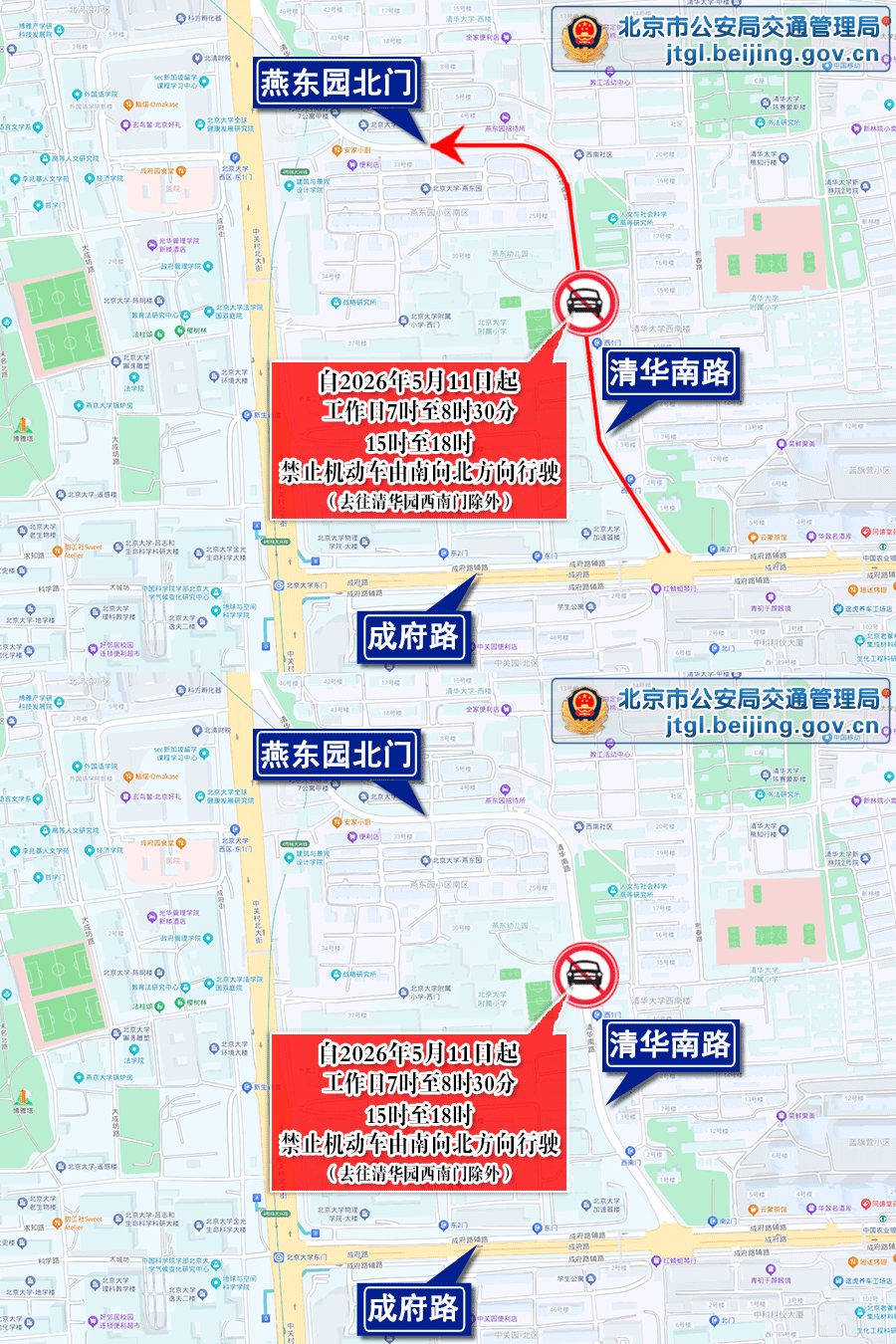
      <title>关于调整海淀区清华南路（燕东园北门至成府路段）交通管理措施的通告</title>
      <slug>beijing-traffic-notice-2026-04-27</slug>
      <aliases></aliases>
      <previousSlugs>
        <slug>beijing-traffic-notice-743995945</slug>
      </previousSlugs>
      <summary>调整清华南路燕东园北门至成府路段南向北机动车禁行时段。</summary>
      <status>published</status>
      <categories>
        <category>category-road-transport</category>
      </categories>
      <tags></tags>
      <sources>
        <source>
          <id>official</id>
          <title>关于调整海淀区清华南路（燕东园北门至成府路段）交通管理措施的通告</title>
          <author>北京市公安局交通管理局</author>
          <date>2026-04-27</date>
          <url>https://jtgl.beijing.gov.cn/jgj/jgxx/gsgg/jttg/bjsgajgajtgljtg/743995945/index.html</url>
        </source>
        <source>
          <id>map1</id>
          <title>原通告配图1</title>
          <author>北京市公安局交通管理局</author>
          <url>https://jtgl.beijing.gov.cn/jgj/jgxx/gsgg/jttg/bjsgajgajtgljtg/743995945/2026043010203920010.gif</url>
        </source>
      </sources>
      <createdAt>2026-10-28T00:00:00+08:00</createdAt>
      <updatedAt>2026-10-29T17:16:10+08:00</updatedAt>
      <updatedBy>user:admin</updatedBy>
      <revision>4</revision>
      <body>自2026年5月11日起，海淀区清华南路（燕东园北门至成府路段）机动车由南向北禁行时段由每日7时至8时30分、16时至18时，调整为工作日7时至8时30分、15时至18时；前往清华园西南门的机动车除外。[^official]&#xA;&#xA;![清华南路交通管理示意图](https://jtgl.beijing.gov.cn/jgj/jgxx/gsgg/jttg/bjsgajgajtgljtg/743995945/2026043010203920010.gif)[^map1]&#xA;&#xA;北京市公安局交通管理局&#xA;&#xA;2026年4月22日</body>
      <url>/works/beijing-traffic-notice-2026-04-27.html</url>
      <lang>es</lang>
      <fallback>true</fallback>
      <availableLangs>
        <lang>zh</lang>
      </availableLangs>
      <occupations></occupations>
      <workKind>announcement</workKind>
      <published>
        <year>2026</year>
        <month>4</month>
        <day>27</day>
        <precision>day</precision>
        <display>2026年4月27日</display>
      </published>
      <creators></creators>
      <relatedTerms></relatedTerms>
    </entity>
    <entity>
      <perspectives></perspectives>
      <customFields></customFields>
      <rankingTiers></rankingTiers>
      <rankingColumns></rankingColumns>
      <rankingEntries></rankingEntries>
      <id>person_cn_q713589</id>
      <type>person</type>
      <title>段珪</title>
      <slug>duan-gui</slug>
      <aliases>
        <alias>Duan Gui</alias>
      </aliases>
      <previousSlugs>
        <slug>duan-gui-q713589</slug>
      </previousSlugs>
      <summary>段珪（？—189年），中国人物。</summary>
      <status>published</status>
      <categories>
        <category>category-history</category>
        <category>category-people</category>
        <category>category-historical-figures</category>
      </categories>
      <tags>
        <tag>tag-ancient-china</tag>
      </tags>
      <sources>
        <source>
          <id>wikidata</id>
          <title>Wikidata Q713589</title>
          <url>https://www.wikidata.org/wiki/Q713589</url>
        </source>
        <source>
          <id>zhwiki</id>
          <title>段珪（维基百科）</title>
          <url>https://zh.wikipedia.org/wiki/%E6%AE%B5%E7%8F%AA</url>
        </source>
      </sources>
      <createdAt>2026-10-25T00:00:00+08:00</createdAt>
      <updatedAt>2026-10-29T17:16:09+08:00</updatedAt>
      <updatedBy>user:admin</updatedBy>
      <revision>6</revision>
      <body>## 生平&#xA;&#xA;段珪（？—189年），济阴人，东汉宦官，“十常侍”之一。早年段珪与宦官侯览在济阴置立田业，其仆从宾客侵扰百姓、劫掠行旅，被济北相滕延捕杀；段珪、侯览向桓帝哭诉，滕延反被免官。灵帝时，段珪位居中常侍，封侯贵宠。中平六年（189年），大将军何进谋诛宦官，先入长乐宫请何太后下诏。张让、段珪因何进在灵帝下葬时称疾不出、如今却矫健入宫而生疑，派人窃听得知其谋，于是由段珪、毕岚领兵埋伏宫中，假太后之命召何进再入宫，将其斩杀。事后段珪等矫诏任命许相为司隶校尉、樊陵为河南尹，又掷出何进之头宣称其谋反伏诛。何进部曲吴匡与虎贲中郎将袁术等攻入皇宫，段珪、张让挟持何太后、少帝刘辩与陈留王刘协出逃；何太后被尚书卢植救下，段珪等挟二帝逃至小平津，被洛阳中部掾闵贡追及。闵贡厉声斥责，段珪、张让自知无路，向少帝叩头作别，随即投黄河而死。[^zhwiki]&#xA;&#xA;## 基本信息&#xA;&#xA;- 所属朝代或国家：中国[^wikidata]&#xA;&#xA;## 演义及游戏中的形象&#xA;&#xA;- [[person_cn_q123577036|段珪]]（《三国演义》人物）</body>
      <url>/people/duan-gui.html</url>
      <lang>es</lang>
      <fallback>true</fallback>
      <availableLangs>
        <lang>zh</lang>
        <lang>en</lang>
      </availableLangs>
      <birth>
        <year>150</year>
        <precision>year</precision>
      </birth>
      <death>
        <year>189</year>
        <display>189年</display>
      </death>
      <occupations></occupations>
      <personCategory>历史人物</personCategory>
      <creators></creators>
      <relatedTerms></relatedTerms>
    </entity>
    <entity>
      <perspectives></perspectives>
      <customFields></customFields>
      <rankingTiers></rankingTiers>
      <rankingColumns></rankingColumns>
      <rankingEntries></rankingEntries>
      <id>person_cn_q702740</id>
      <type>person</type>
      <title>曹豹</title>
      <slug>cao-bao</slug>
      <aliases>
        <alias>Cao Bao</alias>
      </aliases>
      <previousSlugs>
        <slug>cao-bao-q702740</slug>
      </previousSlugs>
      <summary>曹豹（？—196年），东汉人物。</summary>
      <status>published</status>
      <categories>
        <category>category-history</category>
        <category>category-people</category>
        <category>category-historical-figures</category>
      </categories>
      <tags>
        <tag>tag-ancient-china</tag>
      </tags>
      <sources>
        <source>
          <id>wikidata</id>
          <title>Wikidata Q702740</title>
          <url>https://www.wikidata.org/wiki/Q702740</url>
        </source>
        <source>
          <id>zhwiki</id>
          <title>曹豹（维基百科）</title>
          <url>https://zh.wikipedia.org/wiki/%E6%9B%B9%E8%B1%B9</url>
        </source>
      </sources>
      <createdAt>2026-10-25T00:00:00+08:00</createdAt>
      <updatedAt>2026-10-29T17:16:04+08:00</updatedAt>
      <updatedBy>user:admin</updatedBy>
      <revision>6</revision>
      <body>## 生平&#xA;&#xA;曹豹（？—196年？），东汉末年人，原为徐州牧陶谦的部将。193年曹操为父报仇攻打陶谦时，曹豹与刘备屯于郯城东面抵御曹军。兴平元年（194年）陶谦病死，临终嘱托刘备主事徐州，曹豹遂归属刘备，任下邳相。建安元年（196年），刘备与袁术相持于盱眙、淮阴，留张飞守下邳；曹豹与张飞内斗，坚营自守，并遣人招吕布袭取下邳。吕布乘虚入城，俘获刘备的妻子及部属家人，曹豹则被张飞所杀，下邳落入吕布之手。[^zhwiki]&#xA;&#xA;## 基本信息&#xA;&#xA;- 所属朝代或国家：东汉[^wikidata]&#xA;&#xA;## 演义及游戏中的形象&#xA;&#xA;- [[person_cn_q123705040|曹豹]]（《三国演义》人物）</body>
      <url>/people/cao-bao.html</url>
      <lang>es</lang>
      <fallback>true</fallback>
      <availableLangs>
        <lang>zh</lang>
        <lang>en</lang>
      </availableLangs>
      <birth>
        <year>200</year>
        <precision>year</precision>
      </birth>
      <death>
        <year>196</year>
        <display>196年</display>
      </death>
      <occupations>
        <occupation>军人</occupation>
      </occupations>
      <personCategory>历史人物</personCategory>
      <creators></creators>
      <relatedTerms></relatedTerms>
    </entity>
    <entity>
      <perspectives></perspectives>
      <customFields></customFields>
      <rankingTiers></rankingTiers>
      <rankingColumns></rankingColumns>
      <rankingEntries></rankingEntries>
      <id>person_cn_q711457</id>
      <type>person</type>
      <title>李汝珍</title>
      <slug>li-ruzhen</slug>
      <aliases>
        <alias>Li Ruzhen</alias>
      </aliases>
      <previousSlugs>
        <slug>li-ruzhen-q711457</slug>
      </previousSlugs>
      <summary>李汝珍（1763年—1830年），清朝人物。</summary>
      <status>published</status>
      <categories>
        <category>category-history</category>
        <category>category-people</category>
        <category>category-historical-figures</category>
      </categories>
      <tags>
        <tag>tag-ancient-china</tag>
      </tags>
      <sources>
        <source>
          <id>wikidata</id>
          <title>Wikidata Q711457</title>
          <url>https://www.wikidata.org/wiki/Q711457</url>
        </source>
        <source>
          <id>zhwiki</id>
          <title>李汝珍（维基百科）</title>
          <url>https://zh.wikipedia.org/wiki/%E6%9D%8E%E6%B1%9D%E7%8F%8D</url>
        </source>
      </sources>
      <createdAt>2026-10-25T00:00:00+08:00</createdAt>
      <updatedAt>2026-10-29T17:16:01+08:00</updatedAt>
      <updatedBy>user:admin</updatedBy>
      <revision>6</revision>
      <body>## 生平&#xA;&#xA;李汝珍（1763年—1830年），字松石，号松石道人，直隶顺天大兴（今北京）人，清代小说家。他一生经历乾隆、嘉庆、道光三朝，科场不得意。乾隆四十七年（1782年），十九岁的李汝珍随兄长李汝璜到海州板浦（今江苏连云港海州区），师事著名学者凌廷堪，并结识许乔林、许桂林等文友；后来因水患捐官得县丞一职。他博学多才，“于学无所不窥，尤通音韵”，于文学、诗词、经学、字学、医学、算学乃至象纬、篆隶无不涉猎。嘉庆二十三年（1818年），他写成长篇小说《镜花缘》——此书前后耗费近二十年心血、三易其稿，原拟写二百回，最终完成一百回。李汝珍于道光十年（1830年）去世。[^zhwiki]&#xA;&#xA;## 历史成就&#xA;&#xA;李汝珍的主要成就是长篇小说《镜花缘》。该书以武则天时秀才唐敖、林之洋、多九公海外游历为主线，寄寓才学与讽喻，被视为清代才学小说的代表作之一，布局缜密、首尾呼应。同时他精研音韵学，著有《李氏音鉴》《字母五声图》，围棋方面著有《受子谱》。今江苏连云港板浦镇设有李汝珍纪念馆。[^zhwiki]&#xA;&#xA;## 基本信息&#xA;&#xA;- 所属朝代或国家：清朝[^wikidata]&#xA;- 出生地：[[place_beijing|北京市]][^wikidata]&#xA;&#xA;## 著作&#xA;&#xA;- [[work_cn_q1075013|《镜花缘》]]</body>
      <url>/people/li-ruzhen.html</url>
      <lang>es</lang>
      <fallback>true</fallback>
      <availableLangs>
        <lang>zh</lang>
        <lang>en</lang>
      </availableLangs>
      <birth>
        <year>1763</year>
        <display>1763年</display>
      </birth>
      <death>
        <year>1830</year>
        <display>1830年</display>
      </death>
      <occupations>
        <occupation>作家</occupation>
      </occupations>
      <nativePlace>北京市</nativePlace>
      <personCategory>历史人物</personCategory>
      <creators></creators>
      <relatedTerms></relatedTerms>
    </entity>
    <entity>
      <perspectives></perspectives>
      <customFields></customFields>
      <rankingTiers></rankingTiers>
      <rankingColumns></rankingColumns>
      <rankingEntries></rankingEntries>
      <id>person_cn_q702301</id>
      <type>person</type>
      <title>刘鹗</title>
      <slug>liu-e</slug>
      <aliases>
        <alias>Liu E</alias>
      </aliases>
      <previousSlugs>
        <slug>liu-e-q702301</slug>
      </previousSlugs>
      <summary>刘鹗（1857年—1909年8月23日），清朝人物。</summary>
      <status>published</status>
      <categories>
        <category>category-history</category>
        <category>category-people</category>
        <category>category-historical-figures</category>
      </categories>
      <tags>
        <tag>tag-ancient-china</tag>
      </tags>
      <sources>
        <source>
          <id>wikidata</id>
          <title>Wikidata Q702301</title>
          <url>https://www.wikidata.org/wiki/Q702301</url>
        </source>
        <source>
          <id>zhwiki</id>
          <title>刘鹗（维基百科）</title>
          <url>https://zh.wikipedia.org/wiki/%E5%88%98%E9%B9%97</url>
        </source>
      </sources>
      <createdAt>2026-10-25T00:00:00+08:00</createdAt>
      <updatedAt>2026-10-29T17:16:00+08:00</updatedAt>
      <updatedBy>user:admin</updatedBy>
      <revision>6</revision>
      <body>## 生平&#xA;&#xA;刘鹗（1857年—1909年），字铁云，祖籍江苏丹徒，幼年随父移居淮安。青年时不走科举正途，广泛研习水利、算学、医学、金石、天文、音律、训诂等学问，1880年师从太谷学派李广昕。他曾开烟草店、行医、与人合开石昌书局，都以失败告终。1887年，刘鹗投东河总督吴大澂，任河图局提调官，历时三年编成《豫直鲁三省黄河图》五册；此后赴山西开采煤矿，陆续兴办实业。1900年八国联军攻入北京，他从俄军处贱价购入太仓粮转卖赈济饥民，反被劾“私售仓粟”；1908年又因在浦口购地被构陷，与袁世凯的旧怨也牵连其中，被发配新疆迪化，次年因脑溢血病逝，归葬淮安。[^zhwiki]&#xA;&#xA;## 历史成就&#xA;&#xA;刘鹗的长篇小说《老残游记》是晚清四大谴责小说之一，深刻描摹晚清时弊，描写技法受到胡适盛赞。他向王懿荣后人购藏大量殷商甲骨，编成《铁云藏龟》，是第一部甲骨文著录书，为后来的甲骨文研究奠定基础。他在水利、数学方面也多有著述，如《治河七说》《治河续说》《历代黄河变迁图考》《勾股天元草》等。[^zhwiki]&#xA;&#xA;## 基本信息&#xA;&#xA;- 所属朝代或国家：清朝[^wikidata]&#xA;- 出生地：[[place_cn_321112|丹徒区]][^wikidata]&#xA;&#xA;## 著作&#xA;&#xA;- [[work_cn_q2424209|《老残游记》]]</body>
      <url>/people/liu-e.html</url>
      <lang>es</lang>
      <fallback>true</fallback>
      <availableLangs>
        <lang>zh</lang>
        <lang>en</lang>
      </availableLangs>
      <birth>
        <year>1857</year>
        <display>1857年</display>
      </birth>
      <death>
        <year>1909</year>
        <month>8</month>
        <day>23</day>
        <display>1909年8月23日</display>
      </death>
      <occupations>
        <occupation>作家</occupation>
        <occupation>诗人</occupation>
        <occupation>政治人物</occupation>
        <occupation>企业家</occupation>
      </occupations>
      <nativePlace>丹徒区</nativePlace>
      <personCategory>历史人物</personCategory>
      <creators></creators>
      <relatedTerms></relatedTerms>
    </entity>
    <entity>
      <perspectives></perspectives>
      <customFields></customFields>
      <rankingTiers></rankingTiers>
      <rankingColumns></rankingColumns>
      <rankingEntries></rankingEntries>
      <id>person_cn_q711445</id>
      <type>person</type>
      <title>韩胤</title>
      <slug>han-yin</slug>
      <aliases>
        <alias>Han Yin</alias>
      </aliases>
      <previousSlugs>
        <slug>han-yin-q711445</slug>
      </previousSlugs>
      <summary>韩胤（？—197年），中国人物。</summary>
      <status>published</status>
      <categories>
        <category>category-history</category>
        <category>category-people</category>
        <category>category-historical-figures</category>
      </categories>
      <tags>
        <tag>tag-ancient-china</tag>
      </tags>
      <sources>
        <source>
          <id>wikidata</id>
          <title>Wikidata Q711445</title>
          <url>https://www.wikidata.org/wiki/Q711445</url>
        </source>
        <source>
          <id>zhwiki</id>
          <title>韩胤（维基百科）</title>
          <url>https://zh.wikipedia.org/wiki/%E9%9F%93%E8%83%A4</url>
        </source>
      </sources>
      <createdAt>2026-10-25T00:00:00+08:00</createdAt>
      <updatedAt>2026-10-29T17:15:59+08:00</updatedAt>
      <updatedBy>user:admin</updatedBy>
      <revision>5</revision>
      <body>## 生平&#xA;&#xA;韩胤（？—197年），东汉末年袁术的部下。建安二年（197年），袁术欲与吕布结为姻亲以求援助，为自己的儿子向吕布求娶其女，吕布答应。袁术派韩胤为使者，带着称帝的议号文告前往徐州，并迎娶吕布之女。沛相陈珪担心袁术、吕布两家结亲后徐州、扬州合纵，将成国家之患，于是劝说吕布悔婚：吕布之女已在途中，又被追回。吕布随即扣押韩胤，将他戴上刑具送往许都，在许市枭首示众。[^zhwiki]&#xA;&#xA;## 基本信息&#xA;&#xA;- 所属朝代或国家：中国[^wikidata]&#xA;&#xA;## 演义及游戏中的形象&#xA;&#xA;- [[person_cn_q123815773|韩胤]]（《三国演义》人物）</body>
      <url>/people/han-yin.html</url>
      <lang>es</lang>
      <fallback>true</fallback>
      <availableLangs>
        <lang>zh</lang>
        <lang>en</lang>
      </availableLangs>
      <death>
        <year>197</year>
        <display>197年</display>
      </death>
      <occupations>
        <occupation>政治人物</occupation>
      </occupations>
      <personCategory>历史人物</personCategory>
      <creators></creators>
      <relatedTerms></relatedTerms>
    </entity>
    <entity>
      <perspectives></perspectives>
      <customFields></customFields>
      <rankingTiers></rankingTiers>
      <rankingColumns></rankingColumns>
      <rankingEntries></rankingEntries>
      <id>person_cn_q711062</id>
      <type>person</type>
      <title>郭胜</title>
      <slug>guo-sheng</slug>
      <aliases>
        <alias>Guo Sheng</alias>
      </aliases>
      <previousSlugs>
        <slug>guo-sheng-q711062</slug>
      </previousSlugs>
      <summary>郭胜（？—189年），东汉人物。</summary>
      <status>published</status>
      <categories>
        <category>category-history</category>
        <category>category-people</category>
        <category>category-historical-figures</category>
      </categories>
      <tags>
        <tag>tag-ancient-china</tag>
      </tags>
      <sources>
        <source>
          <id>wikidata</id>
          <title>Wikidata Q711062</title>
          <url>https://www.wikidata.org/wiki/Q711062</url>
        </source>
        <source>
          <id>zhwiki</id>
          <title>郭胜 (东汉)（维基百科）</title>
          <url>https://zh.wikipedia.org/wiki/%E9%83%AD%E8%83%9C_(%E4%B8%9C%E6%B1%89)</url>
        </source>
      </sources>
      <createdAt>2026-10-25T00:00:00+08:00</createdAt>
      <updatedAt>2026-10-29T17:15:55+08:00</updatedAt>
      <updatedBy>user:admin</updatedBy>
      <revision>6</revision>
      <body>## 生平&#xA;&#xA;郭胜（？—189年），南阳人，东汉宦官，灵帝时“十常侍”之一，位居中常侍，封侯贵宠。郭胜与大将军何进是同乡，何皇后入宫得宠多得到他的帮助，因此何氏对他颇为倚重。中平六年（189年），何进与上军校尉蹇硕发生冲突，郭胜站在何进一边，使何进得以顺利捕杀蹇硕。同年袁绍率兵入宫诛杀宦官，郭胜死于这场变乱之中。[^zhwiki]&#xA;&#xA;## 基本信息&#xA;&#xA;- 所属朝代或国家：东汉[^wikidata]&#xA;&#xA;## 演义及游戏中的形象&#xA;&#xA;- [[person_cn_q123577595|郭胜]]（《三国演义》人物）</body>
      <url>/people/guo-sheng.html</url>
      <lang>es</lang>
      <fallback>true</fallback>
      <availableLangs>
        <lang>zh</lang>
        <lang>en</lang>
      </availableLangs>
      <birth>
        <year>150</year>
        <precision>year</precision>
      </birth>
      <death>
        <year>189</year>
        <display>189年</display>
      </death>
      <occupations></occupations>
      <disambiguation>东汉</disambiguation>
      <personCategory>历史人物</personCategory>
      <creators></creators>
      <relatedTerms></relatedTerms>
    </entity>
    <entity>
      <perspectives></perspectives>
      <customFields></customFields>
      <rankingTiers></rankingTiers>
      <rankingColumns></rankingColumns>
      <rankingEntries></rankingEntries>
      <id>person_cn_q709979</id>
      <type>person</type>
      <title>胡汉民</title>
      <slug>hu-han-min</slug>
      <aliases>
        <alias>Hu Han-min</alias>
      </aliases>
      <previousSlugs>
        <slug>hu-han-min-q709979</slug>
      </previousSlugs>
      <summary>胡汉民（1879年12月9日—1936年5月12日），清朝、中华民国人物。</summary>
      <status>published</status>
      <categories>
        <category>category-history</category>
        <category>category-people</category>
        <category>category-historical-figures</category>
      </categories>
      <tags>
        <tag>tag-ancient-china</tag>
      </tags>
      <sources>
        <source>
          <id>wikidata</id>
          <title>Wikidata Q709979</title>
          <url>https://www.wikidata.org/wiki/Q709979</url>
        </source>
        <source>
          <id>zhwiki</id>
          <title>胡汉民（维基百科）</title>
          <url>https://zh.wikipedia.org/wiki/%E8%83%A1%E6%BC%A2%E6%B0%91</url>
        </source>
      </sources>
      <createdAt>2026-10-25T00:00:00+08:00</createdAt>
      <updatedAt>2026-10-29T17:15:54+08:00</updatedAt>
      <updatedBy>user:admin</updatedBy>
      <revision>6</revision>
      <body>## 生平&#xA;&#xA;胡汉民（1879年12月9日—1936年5月12日），原名衍鸿，字展堂，号不匱室主，广东番禺人，祖籍江西吉安庐陵，出身客家家庭，是中国国民党元老和早期主要领导人之一。胡汉民早年丧父母，家境困窘，曾代人应试中举。1902年以官费生赴日本留学，先入宏文学院，后入法政大学，与汪精卫、朱执信、廖仲恺等同窗。1905年同盟会在东京成立，胡汉民任评议部议员，并担任《民报》编辑。此后他奔走于南洋、香港、广东之间，参与策划潮州黄冈、惠州七女湖等多次起义，并主持同盟会南方支部，策动1910年广州新军起义。1911年武昌起义后，胡汉民出任广东都督；孙中山回国后，他任南京临时政府秘书长。1913年被袁世凯免去广东都督职，二次革命失败后随孙中山赴日本，参与组建中华革命党。1917年后随孙中山在广州护法，历任交通总长、总参议、文官长、大本营总参议等职；1924年国民党一大当选中央执行委员，同年孙中山北上，胡汉民代行大元帅职、兼广东省长，留守广州。1925年孙中山逝世后，胡汉民与汪精卫、廖仲恺同为党内最具实力者；廖仲恺遇刺案中胡汉民一度被疑被拘，随后被派赴苏联考察。1927年他支持蒋介石清党，合作组建南京国民政府，其后出任立法院院长。1931年因反对蒋介石召开国民会议制定约法，被蒋软禁于南京汤山，史称“汤山事件”；获释后南下广州，成为南方实力派领袖，持“抗日、剿共、反蒋”主张。1935年赴欧洲考察，年底在法国被选为国民党中央常务委员会主席。1936年1月回国留居广州，5月9日与友人弈棋时突发脑溢血，5月12日病逝，国民政府为其举行国葬。[^zhwiki]&#xA;&#xA;## 历史成就&#xA;&#xA;胡汉民是孙中山革命事业的核心辅弼之一：同盟会时期主编《民报》，为革命派的理论宣传重镇；历任广东都督、南京临时政府秘书长、护法军政府要职与南京国民政府立法院院长，是国民党前期右派的代表人物。他在思想上主张“地公主义”，认为资本垄断源于土地垄断，主张以地价税所得投资生产事业、将大资本收归国有，建立国家资本主义经济体制。胡汉民还以书法名世，精于隶书，与吴稚晖、谭延闿、于右任并誉为“民国四大书法家”，著有《胡汉民先生文集》《不匱室诗钞》等。[^zhwiki]&#xA;&#xA;## 基本信息&#xA;&#xA;- 所属朝代或国家：清朝、中华民国[^wikidata]&#xA;- 出生地：[[place_cn_440113|番禺区]][^wikidata]</body>
      <url>/people/hu-han-min.html</url>
      <lang>es</lang>
      <fallback>true</fallback>
      <availableLangs>
        <lang>zh</lang>
        <lang>en</lang>
      </availableLangs>
      <birth>
        <year>1879</year>
        <month>12</month>
        <day>9</day>
        <display>1879年12月9日</display>
      </birth>
      <death>
        <year>1936</year>
        <month>5</month>
        <day>12</day>
        <display>1936年5月12日</display>
      </death>
      <occupations>
        <occupation>政治人物</occupation>
        <occupation>艺术家</occupation>
        <occupation>政党领袖</occupation>
      </occupations>
      <nativePlace>番禺区</nativePlace>
      <personCategory>历史人物</personCategory>
      <creators></creators>
      <relatedTerms></relatedTerms>
    </entity>
    <entity>
      <perspectives></perspectives>
      <customFields></customFields>
      <rankingTiers></rankingTiers>
      <rankingColumns></rankingColumns>
      <rankingEntries></rankingEntries>
      <id>person_cn_q708162</id>
      <type>person</type>
      <title>赵忠</title>
      <slug>zhao-zhong</slug>
      <aliases>
        <alias>Zhao Zhong</alias>
      </aliases>
      <previousSlugs>
        <slug>zhao-zhong-q708162</slug>
      </previousSlugs>
      <summary>赵忠（？—189年），东汉人物。</summary>
      <status>published</status>
      <categories>
        <category>category-history</category>
        <category>category-people</category>
        <category>category-historical-figures</category>
      </categories>
      <tags>
        <tag>tag-ancient-china</tag>
      </tags>
      <sources>
        <source>
          <id>wikidata</id>
          <title>Wikidata Q708162</title>
          <url>https://www.wikidata.org/wiki/Q708162</url>
        </source>
        <source>
          <id>zhwiki</id>
          <title>赵忠 (东汉)（维基百科）</title>
          <url>https://zh.wikipedia.org/wiki/%E8%B5%B5%E5%BF%A0_(%E4%B8%9C%E6%B1%89)</url>
        </source>
      </sources>
      <createdAt>2026-10-25T00:00:00+08:00</createdAt>
      <updatedAt>2026-10-29T17:15:50+08:00</updatedAt>
      <updatedBy>user:admin</updatedBy>
      <revision>6</revision>
      <body>## 生平&#xA;&#xA;赵忠（？—189年），冀州安平人，东汉宦官，灵帝时“十常侍”之一。赵忠在桓帝时已为小黄门；永兴元年（153年），其父去世后以金缕玉衣下葬，逾越法度，冀州刺史朱穆派人发墓劾验，桓帝反而将朱穆收押。延熹二年（159年），赵忠参与诛杀外戚梁冀，受封都乡侯。灵帝即位后，赵忠任中常侍、封列侯，备受宠信：熹平元年（172年）窦太后去世，他曾奉命主持朝会；光和四年（181年）大长秋曹节去世，赵忠继领大长秋，权势更盛。灵帝曾说“张让是我父，赵忠是我母”，一时朝臣上书斥责宦官专权者，多为赵忠所害，吕强、张钧等皆死于其手。他还建议灵帝征收“修宫捐”等赋税，宅邸逾制，被视为东汉末年政局败坏、黄巾之乱爆发的主因之一。中平三年（186年）他一度出任车骑将军，不久解职。中平六年（189年）灵帝去世，何进与蹇硕冲突时，赵忠等助何进捕杀蹇硕；其后何进谋诛宦官，赵忠等人先发制人，在宫中伏杀何进，并矫诏任命许相、樊陵。袁绍率兵攻入南宫后，赵忠在朱雀阙下被捕杀。[^zhwiki]&#xA;&#xA;## 基本信息&#xA;&#xA;- 所属朝代或国家：东汉[^wikidata]&#xA;&#xA;## 演义及游戏中的形象&#xA;&#xA;- [[person_cn_q123576133|赵忠]]（《三国演义》人物）</body>
      <url>/people/zhao-zhong.html</url>
      <lang>es</lang>
      <fallback>true</fallback>
      <availableLangs>
        <lang>zh</lang>
        <lang>en</lang>
      </availableLangs>
      <birth>
        <year>150</year>
        <precision>year</precision>
      </birth>
      <death>
        <year>189</year>
        <display>189年</display>
      </death>
      <occupations></occupations>
      <disambiguation>东汉</disambiguation>
      <personCategory>历史人物</personCategory>
      <creators></creators>
      <relatedTerms></relatedTerms>
    </entity>
    <entity>
      <perspectives></perspectives>
      <customFields></customFields>
      <rankingTiers></rankingTiers>
      <rankingColumns></rankingColumns>
      <rankingEntries></rankingEntries>
      <id>person_cn_q697046</id>
      <type>person</type>
      <title>吴佩孚</title>
      <slug>wu-peifu</slug>
      <aliases>
        <alias>Wu Peifu</alias>
      </aliases>
      <previousSlugs>
        <slug>wu-peifu-q697046</slug>
      </previousSlugs>
      <summary>吴佩孚（1874年—1939年12月4日），中国军阀。</summary>
      <status>published</status>
      <categories>
        <category>category-history</category>
        <category>category-people</category>
        <category>category-historical-figures</category>
      </categories>
      <tags>
        <tag>tag-ancient-china</tag>
      </tags>
      <sources>
        <source>
          <id>wikidata</id>
          <title>Wikidata Q697046</title>
          <url>https://www.wikidata.org/wiki/Q697046</url>
        </source>
        <source>
          <id>zhwiki</id>
          <title>吴佩孚（维基百科）</title>
          <url>https://zh.wikipedia.org/wiki/%E5%90%B4%E4%BD%A9%E5%AD%9A</url>
        </source>
      </sources>
      <createdAt>2026-10-25T00:00:00+08:00</createdAt>
      <updatedAt>2026-10-29T17:15:48+08:00</updatedAt>
      <updatedBy>user:admin</updatedBy>
      <revision>6</revision>
      <body>## 生平&#xA;&#xA;吴佩孚（1874年4月22日—1939年12月4日），字子玉，山东蓬莱人，出身商人家庭。他年轻时考中秀才，后因得罪地方仕绅离乡，1898年投笔从戎，入北洋武备学堂、保定陆军速成学堂学习。日俄战争前夕，他受日本方面招募刺探俄军情报，曾被俄军逮捕又在押送途中逃脱，战后获赠勋章。1906年后他隶属袁世凯新军曹锟所部第三镇（后改第三师），1911年随军镇压山西革命军有功，逐渐成为曹锟的主力助手。护法战争中，吴佩孚率军入湖南作战，攻岳州、陷长沙、占衡阳，战功居首，获授“孚威将军”；随后他与护法军议和停战，又联名通电反对段祺瑞、反对安福国会选举总统，与段祺瑞公开顶撞，声名大起。1920年直皖战争中直系获胜，吴佩孚任直鲁豫巡阅副使，驻军洛阳；1921年任两湖巡阅使，进兵湖北；1922年第一次直奉战争中击退张作霖，成为北洋军阀中最具实力的首领之一。1923年2月，他镇压京汉铁路工人大罢工，酿成“二七惨案”；同年曹锟贿选为大总统。1924年第二次直奉战争爆发，吴佩孚任讨逆军总司令，因冯玉祥发动北京政变、奉军入关而败北。1925年冬，他在汉口组织十四省讨贼联军，自任总司令，与奉系再度联合击败冯玉祥的国民军。1926年北伐军进军两湖，吴佩孚在贺胜桥等地督战，主力被击溃，遂率残部辗转退入四川，依附杨森、刘存厚。1931年后他寓居北平，公开谴责日本扶植的伪满洲国；日本占领北平后，特务头目土肥原贤二亲自登门拉拢他出山，被他拒绝。1939年，他因拔牙后伤口感染引发败血症，12月4日在北平病逝。[^zhwiki]&#xA;&#xA;## 历史成就&#xA;&#xA;吴佩孚是北洋时期直系军阀的核心人物：直皖战争、第一次直奉战争后，他一度成为左右北京政局最有分量的军事强人，主张恢复法统、南北议和。他治军、作战在北洋将领中号称善战，但发动军阀混战、镇压二七罢工也饱受时论谴责。晚年他拒绝与日本侵略者合作，保持了民族气节；逝世后，国民政府追赠他为陆军一级上将，并下令褒扬。[^zhwiki]&#xA;&#xA;## 基本信息&#xA;&#xA;- 简介：中国军阀[^wikidata]&#xA;- 所属朝代或国家：清朝、中华民国[^wikidata]&#xA;- 出生地：[[place_cn_370614|蓬莱区]][^wikidata]</body>
      <url>/people/wu-peifu.html</url>
      <lang>es</lang>
      <fallback>true</fallback>
      <availableLangs>
        <lang>zh</lang>
        <lang>en</lang>
      </availableLangs>
      <birth>
        <year>1874</year>
        <display>1874年</display>
      </birth>
      <death>
        <year>1939</year>
        <month>12</month>
        <day>4</day>
        <display>1939年12月4日</display>
      </death>
      <occupations>
        <occupation>军人</occupation>
        <occupation>政治人物</occupation>
      </occupations>
      <nativePlace>蓬莱区</nativePlace>
      <personCategory>历史人物</personCategory>
      <creators></creators>
      <relatedTerms></relatedTerms>
    </entity>
    <entity>
      <perspectives></perspectives>
      <customFields></customFields>
      <rankingTiers></rankingTiers>
      <rankingColumns></rankingColumns>
      <rankingEntries></rankingEntries>
      <id>person_cn_q553236</id>
      <type>person</type>
      <title>岑昏</title>
      <slug>cen-hun</slug>
      <aliases>
        <alias>Cen Hun</alias>
      </aliases>
      <previousSlugs>
        <slug>cen-hun-q553236</slug>
      </previousSlugs>
      <summary>岑昏（？—280年），中国历史人物。</summary>
      <status>published</status>
      <categories>
        <category>category-history</category>
        <category>category-people</category>
        <category>category-historical-figures</category>
      </categories>
      <tags>
        <tag>tag-ancient-china</tag>
      </tags>
      <sources>
        <source>
          <id>wikidata</id>
          <title>Wikidata Q553236</title>
          <url>https://www.wikidata.org/wiki/Q553236</url>
        </source>
        <source>
          <id>zhwiki</id>
          <title>岑昏（维基百科）</title>
          <url>https://zh.wikipedia.org/wiki/%E5%B2%91%E6%98%8F</url>
        </source>
      </sources>
      <createdAt>2026-10-25T00:00:00+08:00</createdAt>
      <updatedAt>2026-10-29T17:15:46+08:00</updatedAt>
      <updatedBy>user:admin</updatedBy>
      <revision>5</revision>
      <body>## 生平&#xA;&#xA;岑昏（？—280年），南阳郡棘阳县人，三国时期东吴官员，吴末帝孙皓的佞臣。他是东汉征南大将军岑彭、名士岑晊的后代，父亲岑轲在孙吴时曾任太守，岑昏在兄弟六人中排行第二。岑昏巴结孙皓得宠，官至九卿之一的卫尉；他喜好大兴土木，把人民的劳苦置之不顾，不过也曾率领公卿以下百余人叩头请命，救下了被孙皓发怒拘捕的中书令张尚。天纪四年（280年），晋朝伐吴大军节节胜利，东吴群臣数百人叩头请求孙皓杀掉岑昏，孙皓被迫答应，群臣随即把岑昏逮捕处死；孙皓事后反悔，派使者追回成命时，岑昏已经被杀了。[^zhwiki]&#xA;&#xA;## 基本信息&#xA;&#xA;&#xA;## 演义及游戏中的形象&#xA;&#xA;- [[person_cn_q124735880|岑昏]]（《三国演义》人物）</body>
      <url>/people/cen-hun.html</url>
      <lang>es</lang>
      <fallback>true</fallback>
      <availableLangs>
        <lang>zh</lang>
        <lang>en</lang>
      </availableLangs>
      <death>
        <year>280</year>
        <display>280年</display>
      </death>
      <occupations>
        <occupation>政治人物</occupation>
      </occupations>
      <personCategory>历史人物</personCategory>
      <creators></creators>
      <relatedTerms></relatedTerms>
    </entity>
    <entity>
      <perspectives></perspectives>
      <customFields></customFields>
      <rankingTiers></rankingTiers>
      <rankingColumns></rankingColumns>
      <rankingEntries></rankingEntries>
      <id>person_cn_q544432</id>
      <type>person</type>
      <title>康生</title>
      <slug>kang-sheng</slug>
      <aliases>
        <alias>Kang Sheng</alias>
      </aliases>
      <previousSlugs>
        <slug>kang-sheng-q544432</slug>
      </previousSlugs>
      <summary>康生（1898年11月4日—1975年12月16日），中华人民共和国、清朝人物。</summary>
      <status>published</status>
      <categories>
        <category>category-history</category>
        <category>category-people</category>
        <category>category-historical-figures</category>
      </categories>
      <tags>
        <tag>tag-ancient-china</tag>
      </tags>
      <sources>
        <source>
          <id>wikidata</id>
          <title>Wikidata Q544432</title>
          <url>https://www.wikidata.org/wiki/Q544432</url>
        </source>
        <source>
          <id>zhwiki</id>
          <title>康生（维基百科）</title>
          <url>https://zh.wikipedia.org/wiki/%E5%BA%B7%E7%94%9F</url>
        </source>
      </sources>
      <createdAt>2026-10-25T00:00:00+08:00</createdAt>
      <updatedAt>2026-10-29T17:15:43+08:00</updatedAt>
      <updatedBy>user:admin</updatedBy>
      <revision>6</revision>
      <body>## 生平&#xA;&#xA;康生（1898年—1975年12月16日），原名张宗可，字少卿，山东诸城人，出身书香世家，自幼接触文艺，擅长书法绘画。1924年他赴上海大学学习，1925年加入中国共产党，历任上海总工会干事、江苏省委组织部部长等职。四一二事件后，他化名赵容从事地下工作；1930年曾被捕后获释，1931年起与周恩来、陈云等人负责中共中央特科的情报与保卫工作。1933年他被派驻莫斯科，任中共驻共产国际代表团副团长，与团长王明关系密切，其间取俄文名“康斯坦丁”，音译即“康生”；在苏共肃反期间，他参与王明主持的肃反办公室工作，将一些中共留苏人员打成“托派”分子，使他们受到残酷迫害。1937年11月康生回到延安，先后任中央党校校长、中共中央社会部兼中央情报部部长，协助毛泽东发动延安整风，在整风中大搞逼供信，把大批党员打成特务、叛徒，制造了大量冤案；中共七大后他一度失势，转而从事土地改革调研并长期养病。1956年康生复出，历任中央政治局候补委员、中央书记处书记，主持《毛泽东选集》第四卷编辑与《九评苏共》的起草等理论工作；1962年他指责小说《刘志丹》是“利用小说搞反党活动”，炮制冤案，牵连六万余人，被认为是文化大革命的先声。文化大革命爆发后，康生任中央文革小组顾问，跻身中共中央政治局常委，先后制造“六十一人叛徒集团案”“内人党事件”等冤案，迫害大批干部群众；1973年他当选为中共中央副主席。1975年12月16日，康生因前列腺癌在北京逝世。[^zhwiki]&#xA;&#xA;## 历史成就&#xA;&#xA;康生长达数十年主管中共的情报、保卫与审查工作，从中央特科、中央社会部到中央调查部，他是中共秘密战线的主要负责人之一；在意识形态与理论方面，他主持编辑《毛泽东选集》第四卷、领导起草《九评苏共》，在党内理论工作中一度居于主导地位。文化大革命结束后，中共中央根据中央纪律检查委员会的审查报告，于1980年认定康生在文革期间“直接参与林彪、江青等人篡党夺权的反革命阴谋活动，犯下严重罪行”，将他开除党籍、撤销悼词，其骨灰被迁出八宝山革命公墓；最高人民法院特别法庭将他列为“林彪、江青反革命集团案”主犯，因其已经死亡，不再追究刑事责任。在个人才艺方面，康生以书法、绘画和戏曲修养著称，精于版本、校勘之学，曾发表《聊斋志异》版本考证论文，被认为是中国共产党领导人中艺术造诣最突出者之一；但他在文革抄家风潮中掠取了大量图书文物，1979年故宫博物院曾举办“康生窃取文物展览”，展出其窃取的文物数千件。[^zhwiki]&#xA;&#xA;## 基本信息&#xA;&#xA;- 所属朝代或国家：中华人民共和国、清朝、中华民国[^wikidata]&#xA;- 出生地：[[place_cn_370782|诸城市]][^wikidata]</body>
      <url>/people/kang-sheng.html</url>
      <lang>es</lang>
      <fallback>true</fallback>
      <availableLangs>
        <lang>zh</lang>
        <lang>en</lang>
      </availableLangs>
      <birth>
        <year>1898</year>
        <month>11</month>
        <day>4</day>
        <display>1898年11月4日</display>
      </birth>
      <death>
        <year>1975</year>
        <month>12</month>
        <day>16</day>
        <display>1975年12月16日</display>
      </death>
      <occupations>
        <occupation>政治人物</occupation>
      </occupations>
      <nativePlace>诸城市</nativePlace>
      <personCategory>历史人物</personCategory>
      <creators></creators>
      <relatedTerms></relatedTerms>
    </entity>
    <entity>
      <perspectives></perspectives>
      <customFields></customFields>
      <rankingTiers></rankingTiers>
      <rankingColumns></rankingColumns>
      <rankingEntries></rankingEntries>
      <id>person_cn_q5367740</id>
      <type>person</type>
      <title>吴兰</title>
      <slug>wu-lan</slug>
      <aliases>
        <alias>Wu Lan</alias>
      </aliases>
      <previousSlugs>
        <slug>wu-lan-q5367740</slug>
      </previousSlugs>
      <summary>吴兰（？—218年），中国历史人物。</summary>
      <status>published</status>
      <categories>
        <category>category-history</category>
        <category>category-people</category>
        <category>category-historical-figures</category>
      </categories>
      <tags>
        <tag>tag-ancient-china</tag>
      </tags>
      <sources>
        <source>
          <id>wikidata</id>
          <title>Wikidata Q5367740</title>
          <url>https://www.wikidata.org/wiki/Q5367740</url>
        </source>
        <source>
          <id>zhwiki</id>
          <title>吴兰 (东汉)（维基百科）</title>
          <url>https://zh.wikipedia.org/wiki/%E5%90%B3%E8%98%AD_(%E6%9D%B1%E6%BC%A2)</url>
        </source>
      </sources>
      <createdAt>2026-10-25T00:00:00+08:00</createdAt>
      <updatedAt>2026-10-29T17:15:42+08:00</updatedAt>
      <updatedBy>user:admin</updatedBy>
      <revision>5</revision>
      <body>## 生平&#xA;&#xA;吴兰（？—218年），东汉末年刘备麾下将军。建安二十二年（217年），刘备与曹操争夺汉中，派张飞、马超、吴兰等屯驻下辩；曹操派曹洪前来征讨，以曹休为骑都尉参赞军事，曹洪也把军务委托给曹休。建安二十三年（218年）春，刘备又派吴兰、雷铜等人进入武都，张飞屯兵固山，声言要截断曹军后路。曹休判断张飞若真断后路必会潜行伏兵，眼下虚张声势说明尚未得手，主张先击破吴兰，吴兰一破张飞自会撤退；曹洪采纳此议，与张既在下辩大破吴兰军，斩杀其将任夔、雷铜等人。吴兰败走，后被阴平氐人强端所杀，首级被传送到长安。[^zhwiki]&#xA;&#xA;## 基本信息&#xA;&#xA;&#xA;## 演义及游戏中的形象&#xA;&#xA;- [[person_cn_q124342068|吴兰]]（《三国演义》人物）</body>
      <url>/people/wu-lan.html</url>
      <lang>es</lang>
      <fallback>true</fallback>
      <availableLangs>
        <lang>zh</lang>
        <lang>en</lang>
      </availableLangs>
      <death>
        <year>218</year>
        <display>218年</display>
      </death>
      <occupations>
        <occupation>武将</occupation>
      </occupations>
      <disambiguation>东汉</disambiguation>
      <personCategory>历史人物</personCategory>
      <creators></creators>
      <relatedTerms></relatedTerms>
    </entity>
    <entity>
      <perspectives></perspectives>
      <customFields></customFields>
      <rankingTiers></rankingTiers>
      <rankingColumns></rankingColumns>
      <rankingEntries></rankingEntries>
      <id>person_cn_q6697537</id>
      <type>person</type>
      <title>贾思勰</title>
      <slug>jia-sixie</slug>
      <aliases>
        <alias>Jia Sixie</alias>
      </aliases>
      <previousSlugs>
        <slug>jia-sixie-q6697537</slug>
      </previousSlugs>
      <summary>贾思勰，中国历史人物。</summary>
      <status>published</status>
      <categories>
        <category>category-history</category>
        <category>category-people</category>
        <category>category-historical-figures</category>
      </categories>
      <tags>
        <tag>tag-ancient-china</tag>
      </tags>
      <sources>
        <source>
          <id>wikidata</id>
          <title>Wikidata Q6697537</title>
          <url>https://www.wikidata.org/wiki/Q6697537</url>
        </source>
        <source>
          <id>zhwiki</id>
          <title>贾思勰（维基百科）</title>
          <url>https://zh.wikipedia.org/wiki/%E8%B4%BE%E6%80%9D%E5%8B%B0</url>
        </source>
      </sources>
      <createdAt>2026-10-25T00:00:00+08:00</createdAt>
      <updatedAt>2026-10-29T17:15:40+08:00</updatedAt>
      <updatedBy>user:admin</updatedBy>
      <revision>5</revision>
      <body>## 生平&#xA;&#xA;贾思勰，齐郡益都县（今山东省寿光市西南）人，北魏农学家，生卒年不详，曾官至高阳郡太守。他生活的时代，华北农业因长期战乱而荒废，贾思勰精通农业科学，致力于总结、复兴北方的农业生产技术，并将旱地农业技术加以体系化。[^zhwiki]&#xA;&#xA;## 历史成就&#xA;&#xA;贾思勰于北魏末年写成《齐民要术》，成书在东魏武定二年（544年）以后，另一说在533年至544年之间。全书10卷92篇，内容涵盖耕田、谷物、蔬菜、果树、树木、畜产、酿造、调味、烹调及外国物产等门类，援引古籍近200种；其中《氾胜之书》《四民月令》等汉晋重要农书早已失传，后人只能借此书了解其内容。《齐民要术》是中国现存最早、最完整的大型农业百科全书，历代受到重视，也流传到海外，成为研究古代农业与物种变化的经典。[^zhwiki]&#xA;&#xA;## 基本信息&#xA;&#xA;&#xA;## 著作&#xA;&#xA;- [[work_cn_q767586|《齐民要术》]]</body>
      <url>/people/jia-sixie.html</url>
      <lang>es</lang>
      <fallback>true</fallback>
      <availableLangs>
        <lang>zh</lang>
        <lang>en</lang>
      </availableLangs>
      <occupations>
        <occupation>官员</occupation>
        <occupation>农学家</occupation>
      </occupations>
      <personCategory>历史人物</personCategory>
      <creators></creators>
      <relatedTerms></relatedTerms>
    </entity>
    <entity>
      <perspectives></perspectives>
      <customFields></customFields>
      <rankingTiers></rankingTiers>
      <rankingColumns></rankingColumns>
      <rankingEntries></rankingEntries>
      <id>person_cn_q655889</id>
      <type>person</type>
      <title>田楷</title>
      <slug>tian-kai</slug>
      <aliases>
        <alias>Tian Kai</alias>
      </aliases>
      <previousSlugs>
        <slug>tian-kai-q655889</slug>
      </previousSlugs>
      <summary>田楷（？—199年），东汉人物。</summary>
      <status>published</status>
      <categories>
        <category>category-history</category>
        <category>category-people</category>
        <category>category-historical-figures</category>
      </categories>
      <tags>
        <tag>tag-ancient-china</tag>
      </tags>
      <sources>
        <source>
          <id>wikidata</id>
          <title>Wikidata Q655889</title>
          <url>https://www.wikidata.org/wiki/Q655889</url>
        </source>
        <source>
          <id>zhwiki</id>
          <title>田楷（维基百科）</title>
          <url>https://zh.wikipedia.org/wiki/%E7%94%B0%E6%A5%B7</url>
        </source>
      </sources>
      <createdAt>2026-10-25T00:00:00+08:00</createdAt>
      <updatedAt>2026-10-29T17:15:39+08:00</updatedAt>
      <updatedBy>user:admin</updatedBy>
      <revision>6</revision>
      <body>## 生平&#xA;&#xA;田楷（？—199年），东汉末年公孙瓒部下。公孙瓒与袁绍对峙时，分置部下为三州刺史，以严纲为冀州刺史、田楷为青州刺史、单经为兖州刺史。田楷与刘备共同抵御袁绍及其所置的青州刺史臧洪，颇有功劳；曹操征讨徐州、陶谦告急时，田楷又与刘备一同往救。后来袁绍长子袁谭攻略青州，田楷被驱逐，所领青州失守；最终他随公孙瓒在易京与袁绍交战而死。[^zhwiki]&#xA;&#xA;## 基本信息&#xA;&#xA;- 所属朝代或国家：东汉[^wikidata]&#xA;&#xA;## 演义及游戏中的形象&#xA;&#xA;- [[person_cn_q123730850|田楷]]（《三国演义》人物）</body>
      <url>/people/tian-kai.html</url>
      <lang>es</lang>
      <fallback>true</fallback>
      <availableLangs>
        <lang>zh</lang>
        <lang>en</lang>
      </availableLangs>
      <birth>
        <year>200</year>
        <precision>year</precision>
      </birth>
      <death>
        <year>199</year>
        <display>199年</display>
      </death>
      <occupations>
        <occupation>政治人物</occupation>
      </occupations>
      <personCategory>历史人物</personCategory>
      <creators></creators>
      <relatedTerms></relatedTerms>
    </entity>
    <entity>
      <perspectives></perspectives>
      <customFields></customFields>
      <rankingTiers></rankingTiers>
      <rankingColumns></rankingColumns>
      <rankingEntries></rankingEntries>
      <id>person_cn_q6666562</id>
      <type>person</type>
      <title>灵怀皇后</title>
      <slug>empress-linghuai</slug>
      <aliases>
        <alias>Empress Linghuai</alias>
      </aliases>
      <previousSlugs>
        <slug>empress-linghuai-q6666562</slug>
      </previousSlugs>
      <summary>灵怀皇后（162年—181年），中国历史人物。</summary>
      <status>published</status>
      <categories>
        <category>category-history</category>
        <category>category-people</category>
        <category>category-historical-figures</category>
      </categories>
      <tags>
        <tag>tag-ancient-china</tag>
      </tags>
      <sources>
        <source>
          <id>wikidata</id>
          <title>Wikidata Q6666562</title>
          <url>https://www.wikidata.org/wiki/Q6666562</url>
        </source>
        <source>
          <id>zhwiki</id>
          <title>灵怀皇后（维基百科）</title>
          <url>https://zh.wikipedia.org/wiki/%E9%9D%88%E6%87%B7%E7%9A%87%E5%90%8E</url>
        </source>
      </sources>
      <createdAt>2026-10-25T00:00:00+08:00</createdAt>
      <updatedAt>2026-10-29T17:15:38+08:00</updatedAt>
      <updatedBy>user:admin</updatedBy>
      <revision>5</revision>
      <body>## 生平&#xA;&#xA;灵怀皇后王荣（2世纪—181年），邯郸人，汉灵帝的美人，汉献帝刘协的生母。她的祖父王苞曾任五官中郎将，父亲王章贫居不仕。王荣姿色秀丽，聪敏有才，能写会算，以家人子的身份被选入掖庭，封为美人。当时皇后何氏性情强忌，后宫无不畏惧；王美人怀孕后，怕何皇后加害，服药想堕胎，胎儿却安然不动，她又多次梦见自己肩负太阳行走，被视为吉兆。光和四年（181年），王美人生下皇子刘协，随即遭到何皇后忌恨，被毒杀。汉灵帝大怒，一度想废黜何皇后，因宦官求情才作罢；他怜悯刘协、怀念王荣，作《追德赋》《令仪颂》以寄哀思。永汉元年（189年），刘协被董卓立为皇帝，是为汉献帝。兴平元年（194年），有司上奏追尊王美人为灵怀皇后，改葬文昭陵。[^zhwiki]&#xA;&#xA;## 基本信息&#xA;&#xA;&#xA;## 演义及游戏中的形象&#xA;&#xA;- [[person_cn_q123585927|灵怀皇后]]（《三国演义》人物）</body>
      <url>/people/empress-linghuai.html</url>
      <lang>es</lang>
      <fallback>true</fallback>
      <availableLangs>
        <lang>zh</lang>
        <lang>en</lang>
      </availableLangs>
      <birth>
        <year>162</year>
        <display>162年</display>
      </birth>
      <death>
        <year>181</year>
        <display>181年</display>
      </death>
      <occupations></occupations>
      <personCategory>历史人物</personCategory>
      <creators></creators>
      <relatedTerms></relatedTerms>
    </entity>
    <entity>
      <perspectives></perspectives>
      <customFields></customFields>
      <rankingTiers></rankingTiers>
      <rankingColumns></rankingColumns>
      <rankingEntries></rankingEntries>
      <id>person_cn_q6429161</id>
      <type>person</type>
      <title>孔宙</title>
      <slug>kong-zhou</slug>
      <aliases>
        <alias>Kong Zhou</alias>
      </aliases>
      <previousSlugs>
        <slug>kong-zhou-q6429161</slug>
      </previousSlugs>
      <summary>孔宙（103年—163年），中国历史人物。</summary>
      <status>published</status>
      <categories>
        <category>category-history</category>
        <category>category-people</category>
        <category>category-historical-figures</category>
      </categories>
      <tags>
        <tag>tag-ancient-china</tag>
      </tags>
      <sources>
        <source>
          <id>wikidata</id>
          <title>Wikidata Q6429161</title>
          <url>https://www.wikidata.org/wiki/Q6429161</url>
        </source>
        <source>
          <id>zhwiki</id>
          <title>孔宙（维基百科）</title>
          <url>https://zh.wikipedia.org/wiki/%E5%AD%94%E5%AE%99</url>
        </source>
      </sources>
      <createdAt>2026-10-25T00:00:00+08:00</createdAt>
      <updatedAt>2026-10-29T17:15:36+08:00</updatedAt>
      <updatedBy>user:admin</updatedBy>
      <revision>5</revision>
      <body>## 生平&#xA;&#xA;孔宙（103年—163年），字季将，孔子十八世孙，东汉钜鹿太守孔尚的曾孙。他年轻时学习家训，治《严氏春秋》，举孝廉后历任郎中、都昌长、元城令，都有政绩。当时泰山附近百姓作乱，孔宙升任泰山都尉，用一个多月便使乱民解甲服罪，本地恢复耕作与通商。延熹五年（162年），孔宙带着十岁的孔融来到洛阳，孔融与名士李膺的对话传为佳话。不久孔宙因病致仕，延熹六年（163年）正月去世；他的故吏门人到名山采石，于次年七月为他立碑，即《孔宙碑》，碑至今存放在曲阜孔庙。[^zhwiki]&#xA;&#xA;## 历史成就&#xA;&#xA;孔宙为政以招抚见长：任泰山都尉时不专事征剿，月余之间平定乱事，使地方恢复生产。他身后所立的《孔宙碑》是东汉碑刻的代表作品之一，碑阴详载门人姓名，是研究孔氏家世与汉代社会的重要实物资料。[^zhwiki]&#xA;&#xA;## 基本信息&#xA;&#xA;&#xA;## 演义及游戏中的形象&#xA;&#xA;- [[person_cnv_q6429161_q70806|孔宙]]（《三国演义》人物）</body>
      <url>/people/kong-zhou.html</url>
      <lang>es</lang>
      <fallback>true</fallback>
      <availableLangs>
        <lang>zh</lang>
        <lang>en</lang>
      </availableLangs>
      <birth>
        <year>103</year>
        <display>103年</display>
      </birth>
      <death>
        <year>163</year>
        <display>163年</display>
      </death>
      <occupations></occupations>
      <personCategory>历史人物</personCategory>
      <creators></creators>
      <relatedTerms></relatedTerms>
    </entity>
    <entity>
      <perspectives></perspectives>
      <customFields></customFields>
      <rankingTiers></rankingTiers>
      <rankingColumns></rankingColumns>
      <rankingEntries></rankingEntries>
      <id>person_cn_q6402587</id>
      <type>person</type>
      <title>曹德</title>
      <slug>cao-de</slug>
      <aliases>
        <alias>Cao De</alias>
      </aliases>
      <previousSlugs>
        <slug>cao-de-q6402587</slug>
      </previousSlugs>
      <summary>曹德（？—193年），中国历史人物。</summary>
      <status>published</status>
      <categories>
        <category>category-history</category>
        <category>category-people</category>
        <category>category-historical-figures</category>
      </categories>
      <tags>
        <tag>tag-ancient-china</tag>
      </tags>
      <sources>
        <source>
          <id>wikidata</id>
          <title>Wikidata Q6402587</title>
          <url>https://www.wikidata.org/wiki/Q6402587</url>
        </source>
        <source>
          <id>zhwiki</id>
          <title>曹德 (曹操之弟)（维基百科）</title>
          <url>https://zh.wikipedia.org/wiki/%E6%9B%B9%E5%BE%B7_(%E6%9B%B9%E6%93%8D%E4%B9%8B%E5%BC%9F)</url>
        </source>
      </sources>
      <createdAt>2026-10-25T00:00:00+08:00</createdAt>
      <updatedAt>2026-10-29T17:15:33+08:00</updatedAt>
      <updatedBy>user:admin</updatedBy>
      <revision>6</revision>
      <body>## 生平&#xA;&#xA;曹德，太尉曹嵩之子，曹操之弟。东汉末年，曹操据有兖州，迎接在琅邪避难的曹嵩一族，命泰山太守应劭护送。徐州牧陶谦抢在应劭之前，在泰山郡华县一带袭杀曹嵩一族，曹德在门中被陶谦的士兵杀害。《后汉书·应劭传》所载略同，称曹嵩及子德从琅邪入泰山，被陶谦派轻骑追杀于郡界。曹操得知父弟被杀后，随即以复仇为名进军徐州。[^zhwiki]&#xA;&#xA;## 基本信息&#xA;&#xA;&#xA;## 演义及游戏中的形象&#xA;&#xA;- [[person_cn_q123703841|曹德]]（《三国演义》人物）</body>
      <url>/people/cao-de.html</url>
      <lang>es</lang>
      <fallback>true</fallback>
      <availableLangs>
        <lang>zh</lang>
        <lang>en</lang>
      </availableLangs>
      <birth>
        <year>150</year>
        <precision>year</precision>
      </birth>
      <death>
        <year>193</year>
        <display>193年</display>
      </death>
      <occupations></occupations>
      <disambiguation>曹操之弟</disambiguation>
      <personCategory>历史人物</personCategory>
      <creators></creators>
      <relatedTerms></relatedTerms>
    </entity>
    <entity>
      <perspectives></perspectives>
      <customFields></customFields>
      <rankingTiers></rankingTiers>
      <rankingColumns></rankingColumns>
      <rankingEntries></rankingEntries>
      <id>person_cn_q536645</id>
      <type>person</type>
      <title>郭熙</title>
      <slug>guo-xi</slug>
      <aliases>
        <alias>Guo Xi</alias>
      </aliases>
      <previousSlugs>
        <slug>guo-xi-q536645</slug>
      </previousSlugs>
      <summary>郭熙（1023年—1090年），北宋著名画家。</summary>
      <status>published</status>
      <categories>
        <category>category-history</category>
        <category>category-people</category>
        <category>category-historical-figures</category>
      </categories>
      <tags>
        <tag>tag-ancient-china</tag>
      </tags>
      <sources>
        <source>
          <id>wikidata</id>
          <title>Wikidata Q536645</title>
          <url>https://www.wikidata.org/wiki/Q536645</url>
        </source>
        <source>
          <id>zhwiki</id>
          <title>郭熙（维基百科）</title>
          <url>https://zh.wikipedia.org/wiki/%E9%83%AD%E7%86%99</url>
        </source>
      </sources>
      <createdAt>2026-10-25T00:00:00+08:00</createdAt>
      <updatedAt>2026-10-29T17:15:31+08:00</updatedAt>
      <updatedBy>user:admin</updatedBy>
      <revision>6</revision>
      <body>## 生平&#xA;&#xA;郭熙（约1000年—约1087年后），字淳夫，世称郭河阳，河阳温县（今河南省温县）人，北宋画家、绘画理论家。他自幼颇具艺术天分，起初自学；宋仁宗至和元年（1054年）以前，曾应苏舜元之邀临摹李成的六幅《骤雨图》，绘画造诣大为精进，知名度迅速上升。宋神宗熙宁元年（1068年），郭熙经富弼推荐来到汴京，先后为三司使吴中复绘《秋景平远图》、为开封府邵亢作六幅《雪景屏风》，之后又多为人作画，直至被招入皇宫，与著名画家崔白、艾宣、葛守昌共同绘制《紫宸屏风》，受到宋神宗青睐，奉诏进入翰林图画院任艺学，后官至翰林待诏直长，负责订定御府藏画品目及画院运作，声望颇高。宋神宗死后，郭熙在画院的活动记录渐少；宋徽宗宣和年间，他被追赠正议大夫，享年八十八岁以上。[^zhwiki]&#xA;&#xA;## 历史成就&#xA;&#xA;郭熙是北宋山水画的代表人物，与李成并称“李郭”，同列李成、范宽、米芾的“北宋四大家”之一。在画法上，他继承并发展了李成的北方山水传统，又兼收并览、揉合各家之长；他提出“高远、深远、平远”的“三远”构图法，主张画家深入自然“饱游饫看”，使山水达到“可行、可望、可游、可居”的境界；笔墨方面，他以云头皴画山石、蟹爪法画树枝，早期风格严谨精巧，晚年落笔雄壮。其代表作《早春图》今藏台北故宫博物院，另有《关山春雪图》《窠石平远图》《树色平远图》等作品传世。郭熙所著山水画论《林泉高致集》系统总结了山水画的创作与鉴赏理论，是中国古代绘画理论的一大成就，对后世影响巨大。“李郭画派”盛行于北宋初中期，至元代仍占重要地位；苏轼、苏辙、黄庭坚等文士对郭熙评价甚高，《宣和画谱》称他“独步一时”。[^zhwiki]&#xA;&#xA;## 基本信息&#xA;&#xA;- 简介：北宋著名画家[^wikidata]&#xA;- 所属朝代或国家：宋朝、北宋[^wikidata]&#xA;- 出生地：[[place_cn_410825|温县]][^wikidata]</body>
      <url>/people/guo-xi.html</url>
      <lang>es</lang>
      <fallback>true</fallback>
      <availableLangs>
        <lang>zh</lang>
        <lang>en</lang>
      </availableLangs>
      <birth>
        <year>1023</year>
        <display>1023年</display>
      </birth>
      <death>
        <year>1090</year>
        <display>1090年</display>
      </death>
      <occupations>
        <occupation>作家</occupation>
        <occupation>宫廷画家</occupation>
        <occupation>画家</occupation>
        <occupation>风景画家</occupation>
      </occupations>
      <nativePlace>温县</nativePlace>
      <personCategory>历史人物</personCategory>
      <creators></creators>
      <relatedTerms></relatedTerms>
    </entity>
    <entity>
      <perspectives></perspectives>
      <customFields></customFields>
      <rankingTiers></rankingTiers>
      <rankingColumns></rankingColumns>
      <rankingEntries></rankingEntries>
      <id>person_cn_q5365938</id>
      <type>person</type>
      <title>史涣</title>
      <slug>shi-huan</slug>
      <aliases>
        <alias>Shi Huan</alias>
      </aliases>
      <previousSlugs>
        <slug>shi-huan-q5365938</slug>
      </previousSlugs>
      <summary>史涣（？—209年），曹魏人物。</summary>
      <status>published</status>
      <categories>
        <category>category-history</category>
        <category>category-people</category>
        <category>category-historical-figures</category>
      </categories>
      <tags>
        <tag>tag-ancient-china</tag>
      </tags>
      <sources>
        <source>
          <id>wikidata</id>
          <title>Wikidata Q5365938</title>
          <url>https://www.wikidata.org/wiki/Q5365938</url>
        </source>
        <source>
          <id>zhwiki</id>
          <title>史涣（维基百科）</title>
          <url>https://zh.wikipedia.org/wiki/%E5%8F%B2%E6%B8%99</url>
        </source>
      </sources>
      <createdAt>2026-10-25T00:00:00+08:00</createdAt>
      <updatedAt>2026-10-29T17:15:28+08:00</updatedAt>
      <updatedBy>user:admin</updatedBy>
      <revision>6</revision>
      <body>## 生平&#xA;&#xA;史涣（？—209年），字公刘，豫州沛国人，东汉末年曹操麾下武将。《三国志》与《后汉书》都没有他的专传，其事迹见于裴松之注引鱼豢《魏略》等记载。史涣少年时有任侠之风，气概雄壮；曹操起兵之初，他便以门客身份跟从，任中军校尉，此后随曹操东征西讨，多立战功。他虽很少独领一军，却经常担任监军，深受曹操信任，后转拜中领军，与韩浩共同掌管禁军，皆封列侯，以忠勇闻名。建安四年（199年），张杨部将眭固杀杨丑后屯兵射犬，欲投奔袁绍，曹操派史涣与曹仁、徐晃渡过黄河追击，在犬城大破眭固，斩其首级，尽降其众。官渡之战期间，史涣又与曹仁、徐晃钞截袁绍的运粮车，焚烧袁军粮草。曹操北征乌桓时，史涣曾与韩浩商议进谏劝阻深入之险，因韩浩认为士气正盛、不宜挫动军心而作罢，后来曹军果然取胜，也可见史涣为人谨慎。建安十四年（209年），史涣去世，其子史静继承了他的职位与爵位。[^zhwiki]&#xA;&#xA;## 基本信息&#xA;&#xA;- 所属朝代或国家：曹魏[^wikidata]&#xA;&#xA;## 演义及游戏中的形象&#xA;&#xA;- [[person_cn_q123905547|史涣]]（《三国演义》人物）</body>
      <url>/people/shi-huan.html</url>
      <lang>es</lang>
      <fallback>true</fallback>
      <availableLangs>
        <lang>zh</lang>
        <lang>en</lang>
      </availableLangs>
      <birth>
        <year>150</year>
        <precision>year</precision>
      </birth>
      <death>
        <year>209</year>
        <display>209年</display>
      </death>
      <occupations></occupations>
      <personCategory>历史人物</personCategory>
      <creators></creators>
      <relatedTerms></relatedTerms>
    </entity>
    <entity>
      <perspectives></perspectives>
      <customFields></customFields>
      <rankingTiers></rankingTiers>
      <rankingColumns></rankingColumns>
      <rankingEntries></rankingEntries>
      <id>person_cn_q5366380</id>
      <type>person</type>
      <title>孙歆</title>
      <slug>sun-xin</slug>
      <aliases>
        <alias>Sun Xin</alias>
      </aliases>
      <previousSlugs>
        <slug>sun-xin-q5366380</slug>
      </previousSlugs>
      <summary>孙歆（249年—280年），东吴人物。</summary>
      <status>published</status>
      <categories>
        <category>category-history</category>
        <category>category-people</category>
        <category>category-historical-figures</category>
      </categories>
      <tags>
        <tag>tag-ancient-china</tag>
      </tags>
      <sources>
        <source>
          <id>wikidata</id>
          <title>Wikidata Q5366380</title>
          <url>https://www.wikidata.org/wiki/Q5366380</url>
        </source>
        <source>
          <id>zhwiki</id>
          <title>孙歆（维基百科）</title>
          <url>https://zh.wikipedia.org/wiki/%E5%AD%AB%E6%AD%86</url>
        </source>
      </sources>
      <createdAt>2026-10-25T00:00:00+08:00</createdAt>
      <updatedAt>2026-10-29T17:15:28+08:00</updatedAt>
      <updatedBy>user:admin</updatedBy>
      <revision>5</revision>
      <body>## 生平&#xA;&#xA;孙歆（249年前—280年），东吴宗室，孙贲之孙、孙邻之子。赤乌十二年（249年），父亲孙邻去世，长兄孙苗继承爵位；孙歆任乐乡督，其兄弟孙旅、孙述、孙震、孙谐也各任督职。279年晋灭吴之战开始，280年晋将杜预派管定、周旨、伍巢率奇兵八百人乘舟夜袭乐乡，孙歆大败，写信给江陵都督伍延说：“北来诸军，乃飞渡江也。”此后孙歆屡战屡败，被晋军俘获，押送洛阳处死。此前晋将王濬曾先行报功、声称已斩得孙歆，等杜预把活着的孙歆送到洛阳，朝野传为笑谈；唐代李商隐诗句“捷书惟是报孙歆”即用此事讥讽虚报战功。[^zhwiki]&#xA;&#xA;## 基本信息&#xA;&#xA;- 所属朝代或国家：东吴[^wikidata]&#xA;&#xA;## 演义及游戏中的形象&#xA;&#xA;- [[person_cn_q124737865|孙歆]]（《三国演义》人物）</body>
      <url>/people/sun-xin.html</url>
      <lang>es</lang>
      <fallback>true</fallback>
      <availableLangs>
        <lang>zh</lang>
        <lang>en</lang>
      </availableLangs>
      <birth>
        <year>249</year>
        <display>249年</display>
      </birth>
      <death>
        <year>280</year>
        <display>280年</display>
      </death>
      <occupations>
        <occupation>军事领袖</occupation>
      </occupations>
      <personCategory>历史人物</personCategory>
      <creators></creators>
      <relatedTerms></relatedTerms>
    </entity>
    <entity>
      <perspectives></perspectives>
      <customFields></customFields>
      <rankingTiers></rankingTiers>
      <rankingColumns></rankingColumns>
      <rankingEntries></rankingEntries>
      <id>person_cn_q627017</id>
      <type>person</type>
      <title>王实甫</title>
      <slug>wang-shifu</slug>
      <aliases>
        <alias>Wang Shifu</alias>
      </aliases>
      <previousSlugs>
        <slug>wang-shifu-q627017</slug>
      </previousSlugs>
      <summary>王实甫（1250年—1307年），元曲作家。</summary>
      <status>published</status>
      <categories>
        <category>category-history</category>
        <category>category-people</category>
        <category>category-historical-figures</category>
      </categories>
      <tags>
        <tag>tag-ancient-china</tag>
      </tags>
      <sources>
        <source>
          <id>wikidata</id>
          <title>Wikidata Q627017</title>
          <url>https://www.wikidata.org/wiki/Q627017</url>
        </source>
        <source>
          <id>zhwiki</id>
          <title>王实甫（维基百科）</title>
          <url>https://zh.wikipedia.org/wiki/%E7%8E%8B%E5%AE%9E%E7%94%AB</url>
        </source>
      </sources>
      <createdAt>2026-10-25T00:00:00+08:00</createdAt>
      <updatedAt>2026-10-29T17:15:27+08:00</updatedAt>
      <updatedBy>user:admin</updatedBy>
      <revision>6</revision>
      <body>## 生平&#xA;&#xA;王实甫（1260年以前—约1336年），名德信，字实甫，以字行，大都（今北京）人。钟嗣成的《录鬼簿》把他列入“前辈已死名公才人”，位于关汉卿之后，可以推知他与关汉卿同时而略晚，在元成宗元贞、大德年间尚在世。贾仲明在追悼他的《凌波仙》词中提到他出入“风月营”“莺花寨”等艺人、官妓聚居之所，与市民大众十分接近。[^zhwiki]&#xA;&#xA;## 历史成就&#xA;&#xA;王实甫是元代著名杂剧作家，与关汉卿、白朴、马致远齐名，是元曲“文采派”的杰出代表。他所作杂剧中名目可考的有13种，今存《崔莺莺待月西厢记》《吕蒙正风雪破窑记》《四大王歌舞丽春堂》三种，另有数种仅存佚曲。其中《西厢记》写崔莺莺与张生的爱情故事，人物生动，语言华美，成为中国古典戏曲的不朽名著。他还留有少量散曲作品。[^zhwiki]&#xA;&#xA;## 基本信息&#xA;&#xA;- 简介：元曲作家[^wikidata]&#xA;- 所属朝代或国家：元朝[^wikidata]&#xA;- 出生地：元大都[^wikidata]&#xA;&#xA;## 著作&#xA;&#xA;- [[work_cn_q58765|《西厢记》]]</body>
      <url>/people/wang-shifu.html</url>
      <lang>es</lang>
      <fallback>true</fallback>
      <availableLangs>
        <lang>zh</lang>
        <lang>en</lang>
      </availableLangs>
      <birth>
        <year>1250</year>
        <display>1250年</display>
      </birth>
      <death>
        <year>1307</year>
        <display>1307年</display>
      </death>
      <occupations>
        <occupation>作家</occupation>
        <occupation>剧作家</occupation>
      </occupations>
      <nativePlace>元大都</nativePlace>
      <personCategory>历史人物</personCategory>
      <creators></creators>
      <relatedTerms></relatedTerms>
    </entity>
    <entity>
      <perspectives></perspectives>
      <customFields></customFields>
      <rankingTiers></rankingTiers>
      <rankingColumns></rankingColumns>
      <rankingEntries></rankingEntries>
      <id>person_cn_q5365733</id>
      <type>person</type>
      <title>公孙晃</title>
      <slug>gongsun-huang</slug>
      <aliases>
        <alias>Gongsun Huang</alias>
      </aliases>
      <previousSlugs>
        <slug>gongsun-huang-q5365733</slug>
      </previousSlugs>
      <summary>公孙晃（？—238年），曹魏人物。</summary>
      <status>published</status>
      <categories>
        <category>category-history</category>
        <category>category-people</category>
        <category>category-historical-figures</category>
      </categories>
      <tags>
        <tag>tag-ancient-china</tag>
      </tags>
      <sources>
        <source>
          <id>wikidata</id>
          <title>Wikidata Q5365733</title>
          <url>https://www.wikidata.org/wiki/Q5365733</url>
        </source>
        <source>
          <id>zhwiki</id>
          <title>公孙晃（维基百科）</title>
          <url>https://zh.wikipedia.org/wiki/%E5%85%AC%E5%AD%AB%E6%99%83</url>
        </source>
      </sources>
      <createdAt>2026-10-25T00:00:00+08:00</createdAt>
      <updatedAt>2026-10-29T17:15:24+08:00</updatedAt>
      <updatedBy>user:admin</updatedBy>
      <revision>5</revision>
      <body>## 生平&#xA;&#xA;公孙晃，三国时期曹魏人，辽东太守公孙康的嫡长子，公孙渊之兄。公孙康死时，公孙晃、公孙渊尚年幼，众人遂立公孙康之弟公孙恭为辽东太守。依照曹魏的任子制，公孙晃被公孙恭遣往洛阳为官。后来公孙渊胁逼公孙恭退位、自行代立，公孙晃上表朝廷，称公孙渊必定反叛，请国家预作讨伐的准备；但朝廷认为公孙渊已经夺权，应当顺势抚慰，没有采纳他的意见。公孙渊叛乱失败后，公孙晃被逮捕下狱；他曾希望凭自己先前的上表免于连坐，但也自知兄弟关系必受牵连。公孙渊的首级传到洛阳后，公孙晃与儿子相对啼哭。魏明帝曹叡本想保全他的性命，尽管有高柔为之进谏，有司仍认为不可赦免，最终公孙晃一家被赐金屑酒鸩杀，死后得到厚葬。[^zhwiki]&#xA;&#xA;## 基本信息&#xA;&#xA;- 所属朝代或国家：曹魏[^wikidata]&#xA;&#xA;## 演义及游戏中的形象&#xA;&#xA;- [[person_cn_q124613242|公孙晃]]（《三国演义》人物）</body>
      <url>/people/gongsun-huang.html</url>
      <lang>es</lang>
      <fallback>true</fallback>
      <availableLangs>
        <lang>zh</lang>
        <lang>en</lang>
      </availableLangs>
      <death>
        <year>238</year>
        <display>238年</display>
      </death>
      <occupations>
        <occupation>政治人物</occupation>
      </occupations>
      <personCategory>历史人物</personCategory>
      <creators></creators>
      <relatedTerms></relatedTerms>
    </entity>
    <entity>
      <perspectives></perspectives>
      <customFields></customFields>
      <rankingTiers></rankingTiers>
      <rankingColumns></rankingColumns>
      <rankingEntries></rankingEntries>
      <id>person_cn_q6142743</id>
      <type>person</type>
      <title>昌豨</title>
      <slug>chang-xi</slug>
      <aliases>
        <alias>Chāng Xī</alias>
      </aliases>
      <previousSlugs>
        <slug>chang-xi-q6142743</slug>
      </previousSlugs>
      <summary>昌豨（？—206年），东汉人物。</summary>
      <status>published</status>
      <categories>
        <category>category-history</category>
        <category>category-people</category>
        <category>category-historical-figures</category>
      </categories>
      <tags>
        <tag>tag-ancient-china</tag>
      </tags>
      <sources>
        <source>
          <id>wikidata</id>
          <title>Wikidata Q6142743</title>
          <url>https://www.wikidata.org/wiki/Q6142743</url>
        </source>
        <source>
          <id>zhwiki</id>
          <title>昌豨（维基百科）</title>
          <url>https://zh.wikipedia.org/wiki/%E6%98%8C%E8%B1%A8</url>
        </source>
      </sources>
      <createdAt>2026-10-25T00:00:00+08:00</createdAt>
      <updatedAt>2026-10-29T17:15:23+08:00</updatedAt>
      <updatedBy>user:admin</updatedBy>
      <revision>5</revision>
      <body>## 生平&#xA;&#xA;昌豨（？—206年），本名昌霸，一作昌务，泰山郡人。黄巾起义时随臧霸投靠陶谦，陶谦死后与臧霸等自成一股势力，是“泰山寇”成员之一，曾与吕布结盟。吕布败亡后，昌豨与臧霸等人归顺曹操，曹操委以青、徐沿海一带的防务，他领东海国一带兵马。建安五年（200年），昌豨响应刘备的劝诱，据东海叛曹，被曹操迅速平定；官渡之战后他再次反叛，张辽随夏侯渊围攻数月不下，张辽察觉昌豨并无死战之意，单身前往劝说，昌豨遂投降。建安十一年（206年），昌豨第三次叛乱，曹操派于禁征讨，夏侯渊、臧霸助战，连下十余屯营；昌豨因与于禁是旧交，向于禁投降，于禁却不顾众议，以军法将其挥泪斩杀。曹操听说后，为昌豨之死叹惜。[^zhwiki]&#xA;&#xA;## 基本信息&#xA;&#xA;- 所属朝代或国家：东汉[^wikidata]&#xA;&#xA;## 演义及游戏中的形象&#xA;&#xA;- [[person_cn_q123861623|昌豨]]（《三国演义》人物）</body>
      <url>/people/chang-xi.html</url>
      <lang>es</lang>
      <fallback>true</fallback>
      <availableLangs>
        <lang>zh</lang>
        <lang>en</lang>
      </availableLangs>
      <death>
        <year>206</year>
        <display>206年</display>
      </death>
      <occupations>
        <occupation>武将</occupation>
      </occupations>
      <personCategory>历史人物</personCategory>
      <creators></creators>
      <relatedTerms></relatedTerms>
    </entity>
    <entity>
      <perspectives></perspectives>
      <customFields></customFields>
      <rankingTiers></rankingTiers>
      <rankingColumns></rankingColumns>
      <rankingEntries></rankingEntries>
      <id>person_cn_q6137948</id>
      <type>person</type>
      <title>周毖</title>
      <slug>zhou-bi</slug>
      <aliases>
        <alias>Zhou Bi</alias>
      </aliases>
      <previousSlugs>
        <slug>zhou-bi-q6137948</slug>
      </previousSlugs>
      <summary>周毖（？—190年），中国人物。</summary>
      <status>published</status>
      <categories>
        <category>category-history</category>
        <category>category-people</category>
        <category>category-historical-figures</category>
      </categories>
      <tags>
        <tag>tag-ancient-china</tag>
      </tags>
      <sources>
        <source>
          <id>wikidata</id>
          <title>Wikidata Q6137948</title>
          <url>https://www.wikidata.org/wiki/Q6137948</url>
        </source>
        <source>
          <id>zhwiki</id>
          <title>周毖（维基百科）</title>
          <url>https://zh.wikipedia.org/wiki/%E5%91%A8%E6%AF%96</url>
        </source>
      </sources>
      <createdAt>2026-10-25T00:00:00+08:00</createdAt>
      <updatedAt>2026-10-29T17:15:22+08:00</updatedAt>
      <updatedBy>user:admin</updatedBy>
      <revision>6</revision>
      <body>## 生平&#xA;&#xA;周毖（？—190年），又作周珌，字仲远，武威郡姑臧（今甘肃武威）人，豫州刺史周慎之子。董卓专权时，周毖与伍琼同为董卓所信任，周毖任吏部尚书，二人多次向董卓推举韩馥、刘岱、孔伷、张咨、张邈等人出任州郡长官；但这些人到任后大多起兵讨伐董卓。其后董卓打算迁都长安，太尉黄琬、司徒杨彪力争不可，周毖、伍琼也出面劝谏。董卓大怒，说：“卓初入朝，二子劝用善士，故相从，而诸君到官，举兵相图。此二君卖卓，卓何用相负！”遂于190年将伍琼、周毖斩杀。[^zhwiki]&#xA;&#xA;## 基本信息&#xA;&#xA;- 所属朝代或国家：中国[^wikidata]&#xA;&#xA;## 演义及游戏中的形象&#xA;&#xA;- [[person_cn_q123614169|周毖]]（《三国演义》人物）</body>
      <url>/people/zhou-bi.html</url>
      <lang>es</lang>
      <fallback>true</fallback>
      <availableLangs>
        <lang>zh</lang>
        <lang>en</lang>
      </availableLangs>
      <birth>
        <year>150</year>
        <precision>year</precision>
      </birth>
      <death>
        <year>190</year>
        <display>190年</display>
      </death>
      <occupations>
        <occupation>政治人物</occupation>
      </occupations>
      <personCategory>历史人物</personCategory>
      <creators></creators>
      <relatedTerms></relatedTerms>
    </entity>
    <entity>
      <perspectives></perspectives>
      <customFields></customFields>
      <rankingTiers></rankingTiers>
      <rankingColumns></rankingColumns>
      <rankingEntries></rankingEntries>
      <id>person_cn_q6151956</id>
      <type>person</type>
      <title>陈脩</title>
      <slug>chen-xiu</slug>
      <aliases>
        <alias>Chen Xiu</alias>
      </aliases>
      <previousSlugs>
        <slug>chen-xiu-q6151956</slug>
      </previousSlugs>
      <summary>陈脩（197年—229年），东吴人物。</summary>
      <status>published</status>
      <categories>
        <category>category-history</category>
        <category>category-people</category>
        <category>category-historical-figures</category>
      </categories>
      <tags>
        <tag>tag-ancient-china</tag>
      </tags>
      <sources>
        <source>
          <id>wikidata</id>
          <title>Wikidata Q6151956</title>
          <url>https://www.wikidata.org/wiki/Q6151956</url>
        </source>
        <source>
          <id>zhwiki</id>
          <title>陈脩 (东吴)（维基百科）</title>
          <url>https://zh.wikipedia.org/wiki/%E9%99%B3%E8%84%A9_(%E6%9D%B1%E5%90%B3)</url>
        </source>
      </sources>
      <createdAt>2026-10-25T00:00:00+08:00</createdAt>
      <updatedAt>2026-10-29T17:15:22+08:00</updatedAt>
      <updatedBy>user:admin</updatedBy>
      <revision>5</revision>
      <body>## 生平&#xA;&#xA;陈脩（197年—229年），东吴将领，陈武之子。陈脩有其父之风，十九岁时孙权召见他并加以奖厉，拜为别部司马，授给他五百名士兵。当时其他部队的新兵大多逃走，陈脩却能有效地安抚士兵，所部无一逃走，孙权深感惊奇，拜他为校尉。建安末年，朝廷追录功臣后裔，陈脩被封为都亭侯。黄龙元年（229年），陈脩逝世。其弟陈表官至偏将军，封都乡侯。[^zhwiki]&#xA;&#xA;## 基本信息&#xA;&#xA;- 所属朝代或国家：东吴[^wikidata]&#xA;&#xA;## 演义及游戏中的形象&#xA;&#xA;- [[person_cnv_q6151956_q70806|陈脩]]（《三国演义》人物）</body>
      <url>/people/chen-xiu.html</url>
      <lang>es</lang>
      <fallback>true</fallback>
      <availableLangs>
        <lang>zh</lang>
        <lang>en</lang>
      </availableLangs>
      <birth>
        <year>197</year>
        <display>197年</display>
      </birth>
      <death>
        <year>229</year>
        <display>229年</display>
      </death>
      <occupations></occupations>
      <disambiguation>东吴</disambiguation>
      <personCategory>历史人物</personCategory>
      <creators></creators>
      <relatedTerms></relatedTerms>
    </entity>
    <entity>
      <perspectives></perspectives>
      <customFields></customFields>
      <rankingTiers></rankingTiers>
      <rankingColumns></rankingColumns>
      <rankingEntries></rankingEntries>
      <id>person_cn_q574498</id>
      <type>person</type>
      <title>韩信</title>
      <slug>han-xin</slug>
      <aliases>
        <alias>Han Xin</alias>
      </aliases>
      <previousSlugs>
        <slug>han-xin-q574498</slug>
      </previousSlugs>
      <summary>韩信（公元前230年—公元前195年），中国、西汉人物。</summary>
      <status>published</status>
      <categories>
        <category>category-history</category>
        <category>category-people</category>
        <category>category-historical-figures</category>
      </categories>
      <tags>
        <tag>tag-ancient-china</tag>
      </tags>
      <sources>
        <source>
          <id>wikidata</id>
          <title>Wikidata Q574498</title>
          <url>https://www.wikidata.org/wiki/Q574498</url>
        </source>
        <source>
          <id>zhwiki</id>
          <title>韩信（维基百科）</title>
          <url>https://zh.wikipedia.org/wiki/%E9%9F%A9%E4%BF%A1</url>
        </source>
        <source>
          <id>zhengshi</id>
          <title>史記/卷092（维基文库）</title>
          <url>https://zh.wikisource.org/wiki/%E5%8F%B2%E8%A8%98/%E6%B7%AE%E9%99%B0%E4%BE%AF%E5%88%97%E5%82%B3</url>
        </source>
      </sources>
      <createdAt>2026-10-25T00:00:00+08:00</createdAt>
      <updatedAt>2026-10-29T17:15:20+08:00</updatedAt>
      <updatedBy>user:admin</updatedBy>
      <revision>6</revision>
      <body>## 生平&#xA;&#xA;韩信（前231年—前196年），淮阴（今江苏淮安）人。早年家贫，寄食于人，曾受“胯下之辱”。秦末先投项梁、项羽，未得重用；前206年转投刘邦，初任小官，险些因法被斩，经夏侯婴举荐为治粟都尉，后萧何连夜追回逃走的韩信并力荐，刘邦遂筑坛拜他为大将军。楚汉战争中，韩信先以“明修栈道，暗度陈仓”之计平定三秦，又在蒲坂声东击西破魏、在井陉背水一战破赵，继而平定燕、齐，在潍水之战水淹齐楚联军、斩杀楚将龙且，最后在垓下摆下十面埋伏、以四面楚歌瓦解楚军，逼得项羽自刎乌江。[^zhengshi][^zhwiki]&#xA;&#xA;前202年，韩信被封为楚王。前201年，刘邦开始剪除异姓王，韩信被贬为淮阴侯。前196年，有人告发韩信参与陈豨谋反，吕后与萧何合谋将他诱入长乐宫杀死，并夷其三族。[^zhwiki]&#xA;&#xA;## 历史成就&#xA;&#xA;韩信是西汉开国功臣，与萧何、张良并称“汉初三杰”，又与彭越、英布并称汉初三大名将。萧何称他“国士无双”，蒯彻称他“功高无二，略不世出”，后世尊他为“兵仙”，并常与白起合称“韩白”。他的用兵以谋略著称，井陉、潍水、垓下等战例为中国古代著名战例；宋代何去非评价说“言兵莫过孙武，用兵莫过韩信”。韩信为西汉的建立立下汗马功劳，一人兼任王、侯、将、相，惟功高震主，终为刘邦所忌而遭杀害。[^zhwiki]&#xA;&#xA;## 正史记载&#xA;&#xA;&gt; 韓信&#xA;&#xA;——《史記/卷092》[^zhengshi]&#xA;&#xA;## 基本信息&#xA;&#xA;- 所属朝代或国家：中国、西汉[^wikidata]&#xA;- 出生地：[[place_cn_320800|淮安市]][^wikidata]</body>
      <url>/people/han-xin.html</url>
      <lang>es</lang>
      <fallback>true</fallback>
      <availableLangs>
        <lang>zh</lang>
        <lang>en</lang>
      </availableLangs>
      <birth>
        <year>-230</year>
        <display>公元前230年</display>
      </birth>
      <death>
        <year>-195</year>
        <display>公元前195年</display>
      </death>
      <occupations>
        <occupation>军人</occupation>
      </occupations>
      <nativePlace>淮安市</nativePlace>
      <personCategory>历史人物</personCategory>
      <creators></creators>
      <relatedTerms></relatedTerms>
    </entity>
    <entity>
      <perspectives></perspectives>
      <customFields></customFields>
      <rankingTiers></rankingTiers>
      <rankingColumns></rankingColumns>
      <rankingEntries></rankingEntries>
      <id>person_cn_q559957</id>
      <type>person</type>
      <title>严复</title>
      <slug>yan-fu</slug>
      <aliases>
        <alias>Yan Fu</alias>
      </aliases>
      <previousSlugs>
        <slug>yan-fu-q559957</slug>
      </previousSlugs>
      <summary>严复（1854年1月8日—1921年10月27日），清朝、中华民国人物。</summary>
      <status>published</status>
      <categories>
        <category>category-history</category>
        <category>category-people</category>
        <category>category-historical-figures</category>
      </categories>
      <tags>
        <tag>tag-ancient-china</tag>
      </tags>
      <sources>
        <source>
          <id>wikidata</id>
          <title>Wikidata Q559957</title>
          <url>https://www.wikidata.org/wiki/Q559957</url>
        </source>
        <source>
          <id>zhwiki</id>
          <title>严复（维基百科）</title>
          <url>https://zh.wikipedia.org/wiki/%E5%9A%B4%E5%BE%A9</url>
        </source>
      </sources>
      <createdAt>2026-10-25T00:00:00+08:00</createdAt>
      <updatedAt>2026-10-29T17:15:17+08:00</updatedAt>
      <updatedBy>user:admin</updatedBy>
      <revision>6</revision>
      <body>## 生平&#xA;&#xA;严复（1854年1月8日—1921年10月27日），字几道，福建侯官（今福州）人，出身中医世家。1867年入福州船政学堂学习驾驶，1871年以第一届毕业，后在军舰实习多年；1877年赴英国伦敦格林威治皇家海军学院留学，1879年回国。历任福州船政学堂教习、北洋水师学堂总办等职，在北洋水师学堂任职约二十年。甲午战争后，他在天津《直报》发表《论世变之亟》《原强》《辟韩》《救亡决论》等文，主张变法维新，并与人创办《国闻报》。此后历任京师大学堂译书局总办、复旦公学校长、京师大学堂校长等职。晚年名列筹安会“六君子”，支持袁世凯称帝，为时论所讥。1921年病逝于福州。[^zhwiki]&#xA;&#xA;## 历史成就&#xA;&#xA;严复是中国近代启蒙思想家、翻译家。他系统地将西方的社会学、政治学、政治经济学、哲学和自然科学介绍到中国：译赫胥黎《天演论》，使“物竞天择”的进化思想风行全国；又译有《原富》《群学肄言》《群己权界论》《社会通诠》《法意》《穆勒名学》等，被认为是中国20世纪最重要的启蒙译著。他提出的“信、达、雅”翻译标准，对后世翻译工作产生了深远影响。[^zhwiki]&#xA;&#xA;## 基本信息&#xA;&#xA;- 所属朝代或国家：清朝、中华民国[^wikidata]&#xA;- 出生地：[[place_fuzhou|福州市]][^wikidata]</body>
      <url>/people/yan-fu.html</url>
      <lang>es</lang>
      <fallback>true</fallback>
      <availableLangs>
        <lang>zh</lang>
        <lang>en</lang>
      </availableLangs>
      <birth>
        <year>1854</year>
        <month>1</month>
        <day>8</day>
        <display>1854年1月8日</display>
      </birth>
      <death>
        <year>1921</year>
        <month>10</month>
        <day>27</day>
        <display>1921年10月27日</display>
      </death>
      <occupations>
        <occupation>作家</occupation>
        <occupation>译者</occupation>
        <occupation>社会学家</occupation>
      </occupations>
      <nativePlace>福州市</nativePlace>
      <personCategory>历史人物</personCategory>
      <creators></creators>
      <relatedTerms></relatedTerms>
    </entity>
    <entity>
      <perspectives></perspectives>
      <customFields></customFields>
      <rankingTiers></rankingTiers>
      <rankingColumns></rankingColumns>
      <rankingEntries></rankingEntries>
      <id>person_cn_q565225</id>
      <type>person</type>
      <title>秦九韶</title>
      <slug>qin-jiushao</slug>
      <aliases>
        <alias>Qin Jiushao</alias>
      </aliases>
      <previousSlugs>
        <slug>qin-jiushao-q565225</slug>
      </previousSlugs>
      <summary>秦九韶（1202年—1261年），中国南宋数学家。</summary>
      <status>published</status>
      <categories>
        <category>category-history</category>
        <category>category-people</category>
        <category>category-historical-figures</category>
      </categories>
      <tags>
        <tag>tag-ancient-china</tag>
      </tags>
      <sources>
        <source>
          <id>wikidata</id>
          <title>Wikidata Q565225</title>
          <url>https://www.wikidata.org/wiki/Q565225</url>
        </source>
        <source>
          <id>zhwiki</id>
          <title>秦九韶（维基百科）</title>
          <url>https://zh.wikipedia.org/wiki/%E7%A7%A6%E4%B9%9D%E9%9F%B6</url>
        </source>
      </sources>
      <createdAt>2026-10-25T00:00:00+08:00</createdAt>
      <updatedAt>2026-10-29T17:15:16+08:00</updatedAt>
      <updatedBy>user:admin</updatedBy>
      <revision>6</revision>
      <body>## 生平&#xA;&#xA;秦九韶（1208年—1261年），字道古，籍贯鲁郡，生于普州（今四川安岳），父亲秦季槱曾任工部郎中、秘书少监。少年时随父居临安（今杭州），生性聪颖，对星象、音乐、算术、建筑等无一不学，并曾向隐士求教数学。十八岁时在乡里为义兵首领，后历任县尉、蕲州通判、和州知州、建康通直郎、沿江制置司参议、琼州守、梅州守等职，宦途多有起伏，又因党争受到牵连。淳祐七年（1247年），他在湖州完成了数学著作《数书九章》。景定元年（1260年）出任梅州守，后卒于梅州。[^zhwiki]&#xA;&#xA;## 历史成就&#xA;&#xA;秦九韶是南宋数学家，其成就集中体现在《数书九章》十八卷中，全书八十一道题目都结合当时的实际需要。他提出“大衍求一术”，系统地解决了一次同余方程组问题，即现在所称中国剩余定理的历史解法；又创立高次方程正根的数值求法，后世称为秦九韶算法。这两项成果具有世界意义。不过，《宋史》没有为秦九韶立传，当时及后世的一些记载对他的人品与官声多有负面评价，称其为官贪暴，与他的数学成就形成对照。[^zhwiki]&#xA;&#xA;## 基本信息&#xA;&#xA;- 简介：中国南宋数学家[^wikidata]&#xA;- 所属朝代或国家：南宋[^wikidata]&#xA;- 出生地：[[place_cn_512021|安岳县]][^wikidata]</body>
      <url>/people/qin-jiushao.html</url>
      <lang>es</lang>
      <fallback>true</fallback>
      <availableLangs>
        <lang>zh</lang>
        <lang>en</lang>
      </availableLangs>
      <birth>
        <year>1202</year>
        <display>1202年</display>
      </birth>
      <death>
        <year>1261</year>
        <display>1261年</display>
      </death>
      <occupations>
        <occupation>数学家</occupation>
        <occupation>气象学家</occupation>
      </occupations>
      <nativePlace>安岳县</nativePlace>
      <personCategory>历史人物</personCategory>
      <creators></creators>
      <relatedTerms></relatedTerms>
    </entity>
    <entity>
      <perspectives></perspectives>
      <customFields></customFields>
      <rankingTiers></rankingTiers>
      <rankingColumns></rankingColumns>
      <rankingEntries></rankingEntries>
      <id>person_cn_q561952</id>
      <type>person</type>
      <title>韩干</title>
      <slug>han-gan</slug>
      <aliases>
        <alias>Han Gan</alias>
      </aliases>
      <previousSlugs>
        <slug>han-gan-q561952</slug>
      </previousSlugs>
      <summary>韩干（742年—783年），唐朝人物。</summary>
      <status>published</status>
      <categories>
        <category>category-history</category>
        <category>category-people</category>
        <category>category-historical-figures</category>
      </categories>
      <tags>
        <tag>tag-ancient-china</tag>
      </tags>
      <sources>
        <source>
          <id>wikidata</id>
          <title>Wikidata Q561952</title>
          <url>https://www.wikidata.org/wiki/Q561952</url>
        </source>
        <source>
          <id>zhwiki</id>
          <title>韩干（维基百科）</title>
          <url>https://zh.wikipedia.org/wiki/%E9%9F%93%E5%B9%B9</url>
        </source>
      </sources>
      <createdAt>2026-10-25T00:00:00+08:00</createdAt>
      <updatedAt>2026-10-29T17:15:15+08:00</updatedAt>
      <updatedBy>user:admin</updatedBy>
      <revision>6</revision>
      <body>## 生平&#xA;&#xA;韩干（约706年—783年），长安（今陕西西安）人，一说蓝田人，又说大梁人。少年时只是一名酒店的雇工，后来被诗人王维赏识，资助他学画，学成后被召为宫廷画师，初师曹霸，后自成一家，官至太府寺丞。唐玄宗命他拜当时画马名家陈闳为师，他不从命，说：“臣自有师，陛下内厩之马，皆臣师也。”因坚持以宫中御马为师写生，他的画马成就超过古人。[^zhwiki]&#xA;&#xA;## 历史成就&#xA;&#xA;韩干是唐代著名画家，以画马著称于世，兼善人物肖像和佛教宗教画。他重视写生，所画之马生动逼真，后代画马名家如李公麟、赵孟頫都曾向他学习。传世作品有《牧马图》《猿马图》《照夜白图》等，并有玉花骢、照夜白等骏马图传世记载。[^zhwiki]&#xA;&#xA;## 基本信息&#xA;&#xA;- 所属朝代或国家：唐朝[^wikidata]&#xA;- 出生地：[[place_xian|西安市]][^wikidata]</body>
      <url>/people/han-gan.html</url>
      <lang>es</lang>
      <fallback>true</fallback>
      <availableLangs>
        <lang>zh</lang>
        <lang>en</lang>
      </availableLangs>
      <birth>
        <year>742</year>
        <display>742年</display>
      </birth>
      <death>
        <year>783</year>
        <display>783年</display>
      </death>
      <occupations>
        <occupation>画家</occupation>
      </occupations>
      <nativePlace>開封市</nativePlace>
      <personCategory>历史人物</personCategory>
      <creators></creators>
      <relatedTerms></relatedTerms>
    </entity>
    <entity>
      <perspectives></perspectives>
      <customFields></customFields>
      <rankingTiers></rankingTiers>
      <rankingColumns></rankingColumns>
      <rankingEntries></rankingEntries>
      <id>person_cn_q557551</id>
      <type>person</type>
      <title>徐志摩</title>
      <slug>xu-zhimo</slug>
      <aliases>
        <alias>Xu Zhimo</alias>
      </aliases>
      <previousSlugs>
        <slug>xu-zhimo-q557551</slug>
      </previousSlugs>
      <summary>徐志摩（1897年1月15日—1931年11月19日），中国诗人。</summary>
      <status>published</status>
      <categories>
        <category>category-history</category>
        <category>category-people</category>
        <category>category-historical-figures</category>
      </categories>
      <tags>
        <tag>tag-ancient-china</tag>
      </tags>
      <sources>
        <source>
          <id>wikidata</id>
          <title>Wikidata Q557551</title>
          <url>https://www.wikidata.org/wiki/Q557551</url>
        </source>
        <source>
          <id>zhwiki</id>
          <title>徐志摩（维基百科）</title>
          <url>https://zh.wikipedia.org/wiki/%E5%BE%90%E5%BF%97%E6%91%A9</url>
        </source>
      </sources>
      <createdAt>2026-10-25T00:00:00+08:00</createdAt>
      <updatedAt>2026-10-29T17:15:11+08:00</updatedAt>
      <updatedBy>user:admin</updatedBy>
      <revision>6</revision>
      <body>## 生平&#xA;&#xA;徐志摩（1897年1月15日—1931年11月19日），原名章垿，字志摩，浙江海宁人。先后就读于杭州府中学、北京大学预科等校，1918年拜梁启超为师，同年赴美国留学，入克拉克大学、哥伦比亚大学，1920年获政治学硕士学位；其后赴英国，在剑桥大学国王学院游学，其间开始写诗。1922年回国，参与发起成立新月社。先后在光华大学、东吴大学法学院、大夏大学、中央大学、北京大学等校任教，主编《晨报副镌》，与闻一多等创办《新月》月刊。1931年11月19日，他乘飞机由南京飞往北平，飞机在大雾中于济南附近坠毁，遇难，年仅34岁。[^zhwiki]&#xA;&#xA;## 历史成就&#xA;&#xA;徐志摩是新月派代表诗人、散文家，倡导新诗格律，对中国新诗的发展贡献良多。一生出版诗集《志摩的诗》《翡冷翠的一夜》《猛虎集》等，代表作有《再别康桥》《偶然》《沙扬娜拉》等；其诗想象丰富、讲究语言的音乐美，风格温柔清新。散文则想象灵奇、富有诗意。胡适评价他的人生观是一种“单纯信仰”，即对爱、自由、美的追求。[^zhwiki]&#xA;&#xA;## 基本信息&#xA;&#xA;- 简介：中国诗人[^wikidata]&#xA;- 所属朝代或国家：清朝、中华民国[^wikidata]&#xA;- 出生地：[[place_cn_330481|海宁市]][^wikidata]</body>
      <url>/people/xu-zhimo.html</url>
      <lang>es</lang>
      <fallback>true</fallback>
      <availableLangs>
        <lang>zh</lang>
        <lang>en</lang>
      </availableLangs>
      <birth>
        <year>1897</year>
        <month>1</month>
        <day>15</day>
        <display>1897年1月15日</display>
      </birth>
      <death>
        <year>1931</year>
        <month>11</month>
        <day>19</day>
        <display>1931年11月19日</display>
      </death>
      <occupations>
        <occupation>作家</occupation>
        <occupation>诗人</occupation>
        <occupation>译者</occupation>
      </occupations>
      <nativePlace>海宁市</nativePlace>
      <personCategory>历史人物</personCategory>
      <creators></creators>
      <relatedTerms></relatedTerms>
    </entity>
    <entity>
      <perspectives></perspectives>
      <customFields></customFields>
      <rankingTiers></rankingTiers>
      <rankingColumns></rankingColumns>
      <rankingEntries></rankingEntries>
      <id>person_cn_q526989</id>
      <type>person</type>
      <title>梅兰芳</title>
      <slug>mei-lanfang</slug>
      <aliases>
        <alias>Mei Lanfang</alias>
      </aliases>
      <previousSlugs>
        <slug>mei-lanfang-q526989</slug>
      </previousSlugs>
      <summary>梅兰芳（1894年10月22日—1961年8月8日），中华人民共和国、清朝人物。</summary>
      <status>published</status>
      <categories>
        <category>category-history</category>
        <category>category-people</category>
        <category>category-historical-figures</category>
      </categories>
      <tags>
        <tag>tag-ancient-china</tag>
      </tags>
      <sources>
        <source>
          <id>wikidata</id>
          <title>Wikidata Q526989</title>
          <url>https://www.wikidata.org/wiki/Q526989</url>
        </source>
        <source>
          <id>zhwiki</id>
          <title>梅兰芳（维基百科）</title>
          <url>https://zh.wikipedia.org/wiki/%E6%A2%85%E5%85%B0%E8%8A%B3</url>
        </source>
      </sources>
      <createdAt>2026-10-25T00:00:00+08:00</createdAt>
      <updatedAt>2026-10-29T17:15:10+08:00</updatedAt>
      <updatedBy>user:admin</updatedBy>
      <revision>6</revision>
      <body>## 生平&#xA;&#xA;梅兰芳（1894年—1961年），名澜，字畹华，祖籍江苏泰州，生于北京，出身京剧世家，祖父梅巧玲是著名青衣花旦演员。父母双亡后，他由伯父梅雨田抚养，八岁起师从吴菱仙学戏，1904年十岁时在北京广和楼首度登台，1907年入“喜连成”班演出。[^zhwiki]1913年赴上海演出《穆柯寨》，轰动一时，一举成名。1919年首次访问日本演出引起轰动；1930年访美，在西雅图、纽约、洛杉矶等地演出72天，美国波莫纳学院与南加州大学分别授予他文学荣誉博士学位；1935年又访问苏联演出。[^zhwiki]抗日战争期间，他寓居香港、上海，蓄须明志，拒绝为日伪势力演出，靠变卖字画维持生计。1945年抗战胜利后重登舞台。1951年迁回北京，1954年当选第一届全国人大代表，1959年加入中国共产党。1961年8月8日病逝于北京，终年六十七岁。[^zhwiki]&#xA;&#xA;## 历史成就&#xA;&#xA;梅兰芳是中国近代京剧表演艺术家，与程砚秋、尚小云、荀慧生并称“四大名旦”，并为其首。他针对传统京剧旦角只重形式、缺乏情感的缺失加以革新，配合词曲韵律注入充沛情感，塑造了众多优美的妇女艺术形象，发展并提高了京剧旦角的演唱与表演艺术，创立了独具风格的“梅派”，代表剧目有《贵妃醉酒》《霸王别姬》《穆桂英挂帅》等。[^zhwiki]他多次赴日本、美国、苏联演出，使京剧艺术走向世界，被视为中国京剧承上启下最具代表性的人物；其子梅葆玖继承梅派艺术。[^zhwiki]&#xA;&#xA;## 基本信息&#xA;&#xA;- 所属朝代或国家：中华人民共和国、清朝、中华民国[^wikidata]&#xA;- 出生地：[[place_beijing|北京市]][^wikidata]</body>
      <url>/people/mei-lanfang.html</url>
      <lang>es</lang>
      <fallback>true</fallback>
      <availableLangs>
        <lang>zh</lang>
        <lang>en</lang>
      </availableLangs>
      <birth>
        <year>1894</year>
        <month>10</month>
        <day>22</day>
        <display>1894年10月22日</display>
      </birth>
      <death>
        <year>1961</year>
        <month>8</month>
        <day>8</day>
        <display>1961年8月8日</display>
      </death>
      <occupations>
        <occupation>演员</occupation>
        <occupation>政治人物</occupation>
        <occupation>歌手</occupation>
        <occupation>舞台演员</occupation>
      </occupations>
      <nativePlace>北京市</nativePlace>
      <personCategory>历史人物</personCategory>
      <creators></creators>
      <relatedTerms></relatedTerms>
    </entity>
    <entity>
      <perspectives></perspectives>
      <customFields></customFields>
      <rankingTiers></rankingTiers>
      <rankingColumns></rankingColumns>
      <rankingEntries></rankingEntries>
      <id>person_cn_q557220</id>
      <type>person</type>
      <title>冯友兰</title>
      <slug>feng-youlan</slug>
      <aliases>
        <alias>Feng Youlan</alias>
      </aliases>
      <previousSlugs>
        <slug>feng-youlan-q557220</slug>
      </previousSlugs>
      <summary>冯友兰（1895年12月4日—1990年），中国哲学家、历史学家。</summary>
      <status>published</status>
      <categories>
        <category>category-history</category>
        <category>category-people</category>
        <category>category-historical-figures</category>
      </categories>
      <tags>
        <tag>tag-ancient-china</tag>
      </tags>
      <sources>
        <source>
          <id>wikidata</id>
          <title>Wikidata Q557220</title>
          <url>https://www.wikidata.org/wiki/Q557220</url>
        </source>
        <source>
          <id>zhwiki</id>
          <title>冯友兰（维基百科）</title>
          <url>https://zh.wikipedia.org/wiki/%E5%86%AF%E5%8F%8B%E5%85%B0</url>
        </source>
      </sources>
      <createdAt>2026-10-25T00:00:00+08:00</createdAt>
      <updatedAt>2026-10-29T17:15:09+08:00</updatedAt>
      <updatedBy>user:admin</updatedBy>
      <revision>6</revision>
      <body>## 生平&#xA;&#xA;冯友兰（1895年12月4日—1990年11月26日），字芝生，河南唐河人。1915年考入北京大学，1918年毕业；1919年赴美国留学，入哥伦比亚大学研究院哲学系，师从杜威，1923年博士论文答辩通过，次年获哲学博士学位。归国后历任中州大学、广州中山大学、燕京大学教授，1928年转任清华大学教授，历任哲学系主任、文学院院长，连续九次当选清华大学及西南联大文学院院长。抗日战争期间随校南迁西南联大。1949年后留居大陆，1952年院系调整后任北京大学哲学系教授；此后历经多次政治运动，文革中受到批判，1973年奉调参加北京大学、清华大学大批判组，1979年审查结束。1980年代以口述方式重写《中国哲学史新编》。1990年病逝于北京，享年95岁。[^zhwiki]&#xA;&#xA;## 历史成就&#xA;&#xA;冯友兰是中国现代哲学家、哲学史家，现代新儒家代表人物。其《中国哲学史》上下卷（1931年、1934年）是第一部完整的中国哲学通史，被视为中国哲学史学科的奠基之作。抗战期间在西南联大写成《新理学》《新事论》《新世训》《新原人》《新原道》《新知言》六书，合称“贞元六书”，建立起新理学体系，其中《新原人》提出人生四种境界之说。1948年在美国宾夕法尼亚大学讲学时写成的英文《中国哲学简史》被译为十多种语言，成为西方世界了解中国哲学的入门读物。晚年完成七卷本《中国哲学史新编》。李慎之评价说，中国人了解、学习、研究中国哲学，冯友兰“是可超而不可越的”。[^zhwiki]&#xA;&#xA;冯友兰的晚年评价颇有争议。1949年后他多次发表自我批判的文字，文革期间又随潮流撰文批孔；梁漱溟曾致信批评他，張君劢、刘述先等学者指责其未保持气节、曲学阿世。另一方面，周质平、李慎之、陈远等则认为，在当时的政治高压下不宜苛责，并指出他并未揭发陷害他人。冯友兰1984年在《三松堂自序》中自述，建国后自己的绝大部分工作是“否定自己，批判自己”，其中既有“立其诚”的一面，也有哗众取宠之处。蔡仲德将他的人生概括为“实现自我—失落自我—回归自我”三个时期，称之为“冯友兰现象”。[^zhwiki]&#xA;&#xA;## 基本信息&#xA;&#xA;- 简介：中国哲学家、历史学家[^wikidata]&#xA;- 所属朝代或国家：中华人民共和国、清朝、中华民国[^wikidata]&#xA;- 出生地：[[place_cn_411328|唐河县]][^wikidata]</body>
      <url>/people/feng-youlan.html</url>
      <lang>es</lang>
      <fallback>true</fallback>
      <availableLangs>
        <lang>zh</lang>
        <lang>en</lang>
      </availableLangs>
      <birth>
        <year>1895</year>
        <month>12</month>
        <day>4</day>
        <display>1895年12月4日</display>
      </birth>
      <death>
        <year>1990</year>
        <display>1990年</display>
      </death>
      <occupations>
        <occupation>历史学家</occupation>
        <occupation>大学教师</occupation>
        <occupation>哲学家</occupation>
        <occupation>哲学史家</occupation>
      </occupations>
      <nativePlace>唐河县</nativePlace>
      <personCategory>历史人物</personCategory>
      <creators></creators>
      <relatedTerms></relatedTerms>
    </entity>
    <entity>
      <perspectives></perspectives>
      <customFields></customFields>
      <rankingTiers></rankingTiers>
      <rankingColumns></rankingColumns>
      <rankingEntries></rankingEntries>
      <id>person_cn_q357821</id>
      <type>person</type>
      <title>郭沫若</title>
      <slug>guo-moruo</slug>
      <aliases>
        <alias>Guo Moruo</alias>
      </aliases>
      <previousSlugs>
        <slug>guo-moruo-q357821</slug>
      </previousSlugs>
      <summary>郭沫若（1892年11月16日—1978年6月12日），中华人民共和国、清朝人物。</summary>
      <status>published</status>
      <categories>
        <category>category-history</category>
        <category>category-people</category>
        <category>category-historical-figures</category>
      </categories>
      <tags>
        <tag>tag-ancient-china</tag>
      </tags>
      <sources>
        <source>
          <id>wikidata</id>
          <title>Wikidata Q357821</title>
          <url>https://www.wikidata.org/wiki/Q357821</url>
        </source>
        <source>
          <id>zhwiki</id>
          <title>郭沫若（维基百科）</title>
          <url>https://zh.wikipedia.org/wiki/%E9%83%AD%E6%B2%AB%E8%8B%A5</url>
        </source>
      </sources>
      <createdAt>2026-10-25T00:00:00+08:00</createdAt>
      <updatedAt>2026-10-29T17:15:08+08:00</updatedAt>
      <updatedBy>user:admin</updatedBy>
      <revision>7</revision>
      <body>## 生平&#xA;&#xA;郭沫若（1892年—1978年），原名开贞，字鼎堂，四川乐山人。1914年留学日本，入九州帝国大学医学部。1921年出版新诗集《女神》，同年与郁达夫等创立创造社，成为新文学运动的重要人物。1926年参加北伐，任国民革命军总政治部副主任；1927年参加南昌起义，起义失败后于瑞金加入中国共产党，同年被国民政府通缉，1928年流亡日本十年，潜心甲骨文、金文与古代社会研究。1937年抗战爆发后秘密回国，创办《救亡日报》，后任国民政府军委会政治部第三厅厅长、文化工作委员会主任，从事抗日文化宣传。1949年后历任政务院副总理、中国科学院院长、全国人大常委会副委员长、中国文联主席等职。“文化大革命”中他一度自我批判称旧作“应该全部烧掉”，两个儿子在文革中非正常死亡，本人则受到保护。1978年6月12日在北京逝世。[^zhwiki]&#xA;&#xA;## 历史成就&#xA;&#xA;郭沫若在中国现代文学、史学与古文字学领域均居重要地位。文学上，《女神》是中国新诗的奠基之作，他又创作《屈原》《虎符》《蔡文姬》等历史剧，开创了中国历史剧的创作传统。史学上，《中国古代社会研究》开创以唯物史观研究中国古代社会的学派。古文字学上，他与罗振玉、王国维、董作宾并称“甲骨四堂”，著有《卜辞通纂》《殷周青铜器铭文研究》等，主编《甲骨文合集》与《中国史稿》。对他的评价则呈现两极：官方文学史将其列为“鲁郭茅巴老曹”中的第二位，而夏志清等学者对其创作评价甚低，后世研究者称这种现象为“两极阅读”；他在历次政治运动中的表态与转向，也长期受到争议。[^zhwiki]&#xA;&#xA;## 基本信息&#xA;&#xA;- 所属朝代或国家：中华人民共和国、清朝、中华民国[^wikidata]&#xA;- 出生地：[[place_cn_511100|乐山市]][^wikidata]</body>
      <url>/people/guo-moruo.html</url>
      <lang>es</lang>
      <fallback>true</fallback>
      <availableLangs>
        <lang>zh</lang>
        <lang>en</lang>
      </availableLangs>
      <birth>
        <year>1892</year>
        <month>11</month>
        <day>16</day>
        <display>1892年11月16日</display>
      </birth>
      <death>
        <year>1978</year>
        <month>6</month>
        <day>12</day>
        <display>1978年6月12日</display>
      </death>
      <occupations>
        <occupation>演员</occupation>
        <occupation>作家</occupation>
        <occupation>诗人</occupation>
        <occupation>政治人物</occupation>
      </occupations>
      <nativePlace>乐山市</nativePlace>
      <personCategory>历史人物</personCategory>
      <creators></creators>
      <relatedTerms></relatedTerms>
    </entity>
    <entity>
      <perspectives></perspectives>
      <customFields></customFields>
      <rankingTiers></rankingTiers>
      <rankingColumns></rankingColumns>
      <rankingEntries></rankingEntries>
      <id>person_cn_q5208</id>
      <type>person</type>
      <title>黄现璠</title>
      <slug>huang-xianfan</slug>
      <aliases>
        <alias>Huang Xianfan</alias>
      </aliases>
      <previousSlugs>
        <slug>huang-xianfan-q5208</slug>
      </previousSlugs>
      <summary>黄现璠（1899年11月13日—1982年1月18日），中华人民共和国、清朝人物。</summary>
      <status>published</status>
      <categories>
        <category>category-history</category>
        <category>category-people</category>
        <category>category-historical-figures</category>
      </categories>
      <tags>
        <tag>tag-ancient-china</tag>
      </tags>
      <sources>
        <source>
          <id>wikidata</id>
          <title>Wikidata Q5208</title>
          <url>https://www.wikidata.org/wiki/Q5208</url>
        </source>
        <source>
          <id>zhwiki</id>
          <title>黄现璠（维基百科）</title>
          <url>https://zh.wikipedia.org/wiki/%E9%BB%84%E7%8E%B0%E7%92%A0</url>
        </source>
      </sources>
      <createdAt>2026-10-25T00:00:00+08:00</createdAt>
      <updatedAt>2026-10-29T17:15:06+08:00</updatedAt>
      <updatedBy>user:admin</updatedBy>
      <revision>6</revision>
      <body>## 生平&#xA;&#xA;黄现璠（1899年—1982年），原名甘锦英，壮族，广西新宁州（今扶绥县）人。他出身贫寒，少年丧母，16岁时过继给黄家，改名黄现璠。[^zhwiki]1922年考入广西省立第三师范学校，1926年升入北京师范大学，先入预科，后入史学系本科，毕业后免试进入北师大研究所深造，先后师从陈垣研习考据学、钱玄同研习音韵学等。1935年11月考入日本东京帝国大学大学院，师从和田清、加藤繁研修中国史，1936年又获广西省官费留学资格。[^zhwiki]1937年11月归国后，历任广西大学、中山大学、国立桂林师范学院、广西师范学院等校史学教授，成为中国壮族第一位大学教授；曾兼任广西大学训导长、图书馆馆长等职。1950年加入中国农工民主党。晚年创办漓江业余大学，任校长。1982年1月18日逝世。[^zhwiki]&#xA;&#xA;## 历史成就&#xA;&#xA;黄现璠是中国历史学家、民族学家与教育家，被视为中国现代民族学的奠基人之一、壮学的开拓者。他长期从事壮族及中国南方民族历史文化的研究，奠定了中国现代少数民族田野调查的先行地位。[^zhwiki]早年著有《唐代社会概略》《宋代太学生救国运动》等书；作为壮族学者与大学教授，他培养了大批民族史研究人才，对广西地方教育与学术建设亦有贡献。[^zhwiki]&#xA;&#xA;## 基本信息&#xA;&#xA;- 所属朝代或国家：中华人民共和国、清朝[^wikidata]&#xA;- 出生地：[[place_cn_451421|扶绥县]][^wikidata]</body>
      <url>/people/huang-xianfan.html</url>
      <lang>es</lang>
      <fallback>true</fallback>
      <availableLangs>
        <lang>zh</lang>
        <lang>en</lang>
      </availableLangs>
      <birth>
        <year>1899</year>
        <month>11</month>
        <day>13</day>
        <display>1899年11月13日</display>
      </birth>
      <death>
        <year>1982</year>
        <month>1</month>
        <day>18</day>
        <display>1982年1月18日</display>
      </death>
      <occupations>
        <occupation>政治人物</occupation>
        <occupation>历史学家</occupation>
        <occupation>教育家</occupation>
        <occupation>民族学家</occupation>
      </occupations>
      <nativePlace>扶绥县</nativePlace>
      <personCategory>历史人物</personCategory>
      <creators></creators>
      <relatedTerms></relatedTerms>
    </entity>
    <entity>
      <perspectives></perspectives>
      <customFields></customFields>
      <rankingTiers></rankingTiers>
      <rankingColumns></rankingColumns>
      <rankingEntries></rankingEntries>
      <id>person_cn_q464470</id>
      <type>person</type>
      <title>李清照</title>
      <slug>li-qingzhao</slug>
      <aliases>
        <alias>Li Qingzhao</alias>
      </aliases>
      <previousSlugs>
        <slug>li-qingzhao-q464470</slug>
      </previousSlugs>
      <summary>李清照（1084年—1151年），宋朝人物。</summary>
      <status>published</status>
      <categories>
        <category>category-history</category>
        <category>category-people</category>
        <category>category-historical-figures</category>
      </categories>
      <tags>
        <tag>tag-ancient-china</tag>
      </tags>
      <sources>
        <source>
          <id>wikidata</id>
          <title>Wikidata Q464470</title>
          <url>https://www.wikidata.org/wiki/Q464470</url>
        </source>
        <source>
          <id>zhwiki</id>
          <title>李清照（维基百科）</title>
          <url>https://zh.wikipedia.org/wiki/%E6%9D%8E%E6%B8%85%E7%85%A7</url>
        </source>
      </sources>
      <createdAt>2026-10-25T00:00:00+08:00</createdAt>
      <updatedAt>2026-10-29T17:15:03+08:00</updatedAt>
      <updatedBy>user:admin</updatedBy>
      <revision>6</revision>
      <body>## 生平&#xA;&#xA;李清照（1084年—1151年），号易安居士，齐州章丘（今山东济南章丘）人。父亲李格非是进士出身的著名文人，官至礼部员外郎。建中靖国元年（1101年），李清照嫁给太学生赵明诚，夫妇共同收藏金石书画，前期生活安定优裕，词作多写闺阁生活与离别相思。1107年移居青州。靖康之变后，夫妇南渡，辗转到达江宁。建炎三年（1129年）赵明诚病卒于建康，此后李清照流徙越州、杭州、金华等地，与丈夫多年收集的金石书籍在战乱中散佚殆尽，晚景凄凉。所著《易安居士文集》《易安词》均已散佚，今存《漱玉词》辑本，收词约五十首。[^zhwiki]&#xA;&#xA;## 历史成就&#xA;&#xA;李清照是中国文学史上最著名的女词人，与辛弃疾并称“济南二安”，后世誉为“千古第一才女”。她在《词论》中提出“词别是一家”的主张；其词前期明快婉约，后期因国破家亡转为凄怆沉郁，以寻常语言入词，形成“易安体”，代表作有《声声慢》《一剪梅》《醉花阴》《如梦令》等。她与赵明诚合著的金石学著作《金石录》及她所撰《金石录后序》，也是金石学史上的重要文献。[^zhwiki]&#xA;&#xA;## 基本信息&#xA;&#xA;- 所属朝代或国家：宋朝[^wikidata]&#xA;- 出生地：[[place_cn_370114|章丘区]][^wikidata]</body>
      <url>/people/li-qingzhao.html</url>
      <lang>es</lang>
      <fallback>true</fallback>
      <availableLangs>
        <lang>zh</lang>
        <lang>en</lang>
      </availableLangs>
      <birth>
        <year>1084</year>
        <display>1084年</display>
      </birth>
      <death>
        <year>1151</year>
        <display>1151年</display>
      </death>
      <occupations>
        <occupation>作家</occupation>
        <occupation>诗人</occupation>
        <occupation>散文家</occupation>
        <occupation>詞人</occupation>
      </occupations>
      <nativePlace>章丘区</nativePlace>
      <personCategory>历史人物</personCategory>
      <creators></creators>
      <relatedTerms></relatedTerms>
    </entity>
    <entity>
      <perspectives></perspectives>
      <customFields></customFields>
      <rankingTiers></rankingTiers>
      <rankingColumns></rankingColumns>
      <rankingEntries></rankingEntries>
      <id>person_cn_q509360</id>
      <type>person</type>
      <title>奕䜣</title>
      <slug>prince-gong</slug>
      <aliases>
        <alias>Prince Gong</alias>
      </aliases>
      <previousSlugs>
        <slug>prince-gong-q509360</slug>
      </previousSlugs>
      <summary>奕䜣（1833年1月11日—1898年5月29日），清朝人物。</summary>
      <status>published</status>
      <categories>
        <category>category-history</category>
        <category>category-people</category>
        <category>category-historical-figures</category>
      </categories>
      <tags>
        <tag>tag-ancient-china</tag>
      </tags>
      <sources>
        <source>
          <id>wikidata</id>
          <title>Wikidata Q509360</title>
          <url>https://www.wikidata.org/wiki/Q509360</url>
        </source>
        <source>
          <id>zhwiki</id>
          <title>奕䜣（维基百科）</title>
          <url>https://zh.wikipedia.org/wiki/%E5%A5%95%E8%A8%A2</url>
        </source>
        <source>
          <id>zhengshi</id>
          <title>清史稿·卷221（维基文库）</title>
          <url>https://zh.wikisource.org/wiki/%E6%B8%85%E5%8F%B2%E7%A8%BF/%E5%8D%B7221</url>
        </source>
      </sources>
      <createdAt>2026-10-25T00:00:00+08:00</createdAt>
      <updatedAt>2026-10-29T17:15:02+08:00</updatedAt>
      <updatedBy>user:admin</updatedBy>
      <revision>6</revision>
      <body>## 生平&#xA;&#xA;奕䜣（1833年—1898年），爱新觉罗氏，道光帝第六子，咸丰帝同父异母弟，生母为静贵妃；《清史稿》有其本传，谥号“忠”。[^zhengshi]道光帝立储时传位于皇四子奕詝（咸丰帝），奕䜣受封和硕恭亲王。咸丰年间，他历办巡防、旗务等事，后因其母丧仪之事与咸丰帝渐生嫌隙，一度被免去军机大臣等职。[^zhwiki]咸丰十年（1860年）英法联军攻入北京，咸丰帝北逃热河，奕䜣留京议和，代表清廷签订《北京条约》。咸丰十一年（1861年）咸丰帝驾崩，他联合慈安、慈禧两宫太后发动辛酉政变，铲除顾命八大臣，受封议政王，任领班军机大臣与总理各国事务衙门大臣，与两宫太后共治。[^zhwiki]同治四年（1865年）他被革去议政王头衔，但仍居权力中心；此后二十余年主持朝政，推动洋务。光绪七年（1881年）慈安太后逝世后他渐失依恃，光绪十年（1884年）因中法战争军机进退失据，被慈禧太后罢去一切职务（甲申易枢），退居闲废。光绪二十年（1894年）甲午战争期间被重新起用，任领班军机大臣等职。光绪二十四年（1898年）病逝，终年六十七岁。[^zhwiki]&#xA;&#xA;## 历史成就&#xA;&#xA;奕䜣是清末洋务运动的主要发起者与领袖人物。他倡议并主持设立总理各国事务衙门及驻外使馆，支持曾国藩、左宗棠、李鸿章等人兴办近代军事工业、购置先进武器、创办新式工商企业，外交上主张与列强保持和平，在其主持下清朝相继平定太平天国、捻军与各地回变，出现“同治中兴”局面。[^zhwiki]史家多肯定其才干与推动中国近代化的贡献，也指出他晚年转而抵制维新变法、且身为臣子终受制于皇权；当时的保守派则因其亲近洋务而蔑称他为“鬼子六”。[^zhwiki]&#xA;&#xA;## 正史记载&#xA;&#xA;正史传记见《清史稿·卷221》[^zhengshi]。&#xA;&#xA;## 基本信息&#xA;&#xA;- 所属朝代或国家：清朝[^wikidata]&#xA;- 出生地：[[place_beijing|北京市]][^wikidata]</body>
      <url>/people/prince-gong.html</url>
      <lang>es</lang>
      <fallback>true</fallback>
      <availableLangs>
        <lang>zh</lang>
        <lang>en</lang>
      </availableLangs>
      <birth>
        <year>1833</year>
        <month>1</month>
        <day>11</day>
        <display>1833年1月11日</display>
      </birth>
      <death>
        <year>1898</year>
        <month>5</month>
        <day>29</day>
        <display>1898年5月29日</display>
      </death>
      <occupations>
        <occupation>政治人物</occupation>
      </occupations>
      <nativePlace>北京市</nativePlace>
      <personCategory>历史人物</personCategory>
      <creators></creators>
      <relatedTerms></relatedTerms>
    </entity>
    <entity>
      <perspectives></perspectives>
      <customFields></customFields>
      <rankingTiers></rankingTiers>
      <rankingColumns></rankingColumns>
      <rankingEntries></rankingEntries>
      <id>person_cn_q5104597</id>
      <type>person</type>
      <title>崇侯虎</title>
      <slug>hu-marquis-chong</slug>
      <aliases>
        <alias>Hu, Marquis of the Chong State</alias>
      </aliases>
      <previousSlugs>
        <slug>hu-marquis-chong-q5104597</slug>
      </previousSlugs>
      <summary>崇侯虎，商朝诸侯。</summary>
      <status>published</status>
      <categories>
        <category>category-history</category>
        <category>category-people</category>
        <category>category-historical-figures</category>
      </categories>
      <tags>
        <tag>tag-ancient-china</tag>
      </tags>
      <sources>
        <source>
          <id>wikidata</id>
          <title>Wikidata Q5104597</title>
          <url>https://www.wikidata.org/wiki/Q5104597</url>
        </source>
        <source>
          <id>zhwiki</id>
          <title>崇侯虎（维基百科）</title>
          <url>https://zh.wikipedia.org/wiki/%E5%B4%87%E4%BE%AF%E8%99%8E</url>
        </source>
      </sources>
      <createdAt>2026-10-25T00:00:00+08:00</createdAt>
      <updatedAt>2026-10-29T17:15:01+08:00</updatedAt>
      <updatedBy>user:admin</updatedBy>
      <revision>5</revision>
      <body>## 生平&#xA;&#xA;崇侯虎，有崇氏国君，侯爵，名虎，封国在今河南嵩县北，是商纣王的重要侧翼。纣王为政残虐，对百姓施以炮烙之刑；西伯昌（周文王）暗中叹息，被崇侯虎获知并告于纣王，纣遂将西伯囚于羑里（今河南汤阴北）。[^zhwiki]西伯获释后，开始笼络人心、南征北讨，最后发兵攻打崇国。据《说苑》记载，文王严令兵士不准杀人、不准毁坏民房、不准填井、不准伐木、不准抢夺百姓的六畜，崇国百姓听闻后举城投降，崇侯虎此后下落不明。[^zhwiki]&#xA;&#xA;## 基本信息&#xA;&#xA;- 简介：商朝诸侯[^wikidata]&#xA;- 所属朝代或国家：商朝[^wikidata]&#xA;&#xA;## 演义及游戏中的形象&#xA;&#xA;- [[person_cn_q131920750|崇侯虎]]（《封神演义》人物）</body>
      <url>/people/hu-marquis-chong.html</url>
      <lang>es</lang>
      <fallback>true</fallback>
      <availableLangs>
        <lang>zh</lang>
        <lang>en</lang>
      </availableLangs>
      <occupations></occupations>
      <personCategory>历史人物</personCategory>
      <creators></creators>
      <relatedTerms></relatedTerms>
    </entity>
    <entity>
      <perspectives></perspectives>
      <customFields></customFields>
      <rankingTiers></rankingTiers>
      <rankingColumns></rankingColumns>
      <rankingEntries></rankingEntries>
      <id>person_cn_q498568</id>
      <type>person</type>
      <title>山上王</title>
      <slug>sansang</slug>
      <aliases>
        <alias>Sansang</alias>
      </aliases>
      <previousSlugs>
        <slug>sansang-q498568</slug>
      </previousSlugs>
      <summary>山上王（？—227年），高句丽人物。</summary>
      <status>published</status>
      <categories>
        <category>category-history</category>
        <category>category-people</category>
        <category>category-historical-figures</category>
      </categories>
      <tags>
        <tag>tag-ancient-china</tag>
      </tags>
      <sources>
        <source>
          <id>wikidata</id>
          <title>Wikidata Q498568</title>
          <url>https://www.wikidata.org/wiki/Q498568</url>
        </source>
        <source>
          <id>zhwiki</id>
          <title>山上王（维基百科）</title>
          <url>https://zh.wikipedia.org/wiki/%E5%B1%B1%E4%B8%8A%E7%8E%8B</url>
        </source>
      </sources>
      <createdAt>2026-10-25T00:00:00+08:00</createdAt>
      <updatedAt>2026-10-29T17:14:56+08:00</updatedAt>
      <updatedBy>user:admin</updatedBy>
      <revision>6</revision>
      <body>## 生平&#xA;&#xA;山上王（？—227年，197年—227年在位），姓高，名延优，一名伊夷模，又称位宫，是高句丽第十任君主。据《三国史记》，他是新大王之子、故国川王之弟；《三国志》则记载他是故国川王之子，两书记载不同。[^zhwiki]故国川王无子，他在王后于氏支持下继位，并依照收继婚习俗娶于氏为王后。即位后，其兄发岐反对，投奔辽东太守公孙康；197年公孙康发兵助发岐攻高句丽都城国内城，山上王遂改建尉那岩城为新都丸都城，派幼弟罽须领兵击败汉军，发岐兵败自杀。[^zhwiki]209年丸都扩建完毕，山上王迁都丸都城（今吉林省集安市附近）。217年，他收留近千名辽东难民。227年山上王去世，其子东川王继位。[^zhwiki]&#xA;&#xA;## 基本信息&#xA;&#xA;- 所属朝代或国家：高句丽[^wikidata]&#xA;&#xA;## 演义及游戏中的形象&#xA;&#xA;- [[person_cnv_q498568_q70806|山上王]]（《三国演义》人物）</body>
      <url>/people/sansang.html</url>
      <lang>es</lang>
      <fallback>true</fallback>
      <availableLangs>
        <lang>zh</lang>
        <lang>en</lang>
      </availableLangs>
      <birth>
        <year>200</year>
        <precision>year</precision>
      </birth>
      <death>
        <year>227</year>
        <display>227年</display>
      </death>
      <occupations>
        <occupation>統治者</occupation>
      </occupations>
      <personCategory>历史人物</personCategory>
      <creators></creators>
      <relatedTerms></relatedTerms>
    </entity>
    <entity>
      <perspectives></perspectives>
      <customFields></customFields>
      <rankingTiers></rankingTiers>
      <rankingColumns></rankingColumns>
      <rankingEntries></rankingEntries>
      <id>person_cn_q5060</id>
      <type>person</type>
      <title>完颜阿骨打</title>
      <slug>emperor-taizu-jin</slug>
      <aliases>
        <alias>Emperor Taizu of Jin</alias>
      </aliases>
      <previousSlugs>
        <slug>emperor-taizu-jin-q5060</slug>
      </previousSlugs>
      <summary>完颜阿骨打（1068年—1123年），金代开国皇帝。</summary>
      <status>published</status>
      <categories>
        <category>category-history</category>
        <category>category-people</category>
        <category>category-historical-figures</category>
      </categories>
      <tags>
        <tag>tag-ancient-china</tag>
      </tags>
      <sources>
        <source>
          <id>wikidata</id>
          <title>Wikidata Q5060</title>
          <url>https://www.wikidata.org/wiki/Q5060</url>
        </source>
        <source>
          <id>zhwiki</id>
          <title>完颜阿骨打（维基百科）</title>
          <url>https://zh.wikipedia.org/wiki/%E5%AE%8C%E9%A2%9C%E9%98%BF%E9%AA%A8%E6%89%93</url>
        </source>
        <source>
          <id>zhengshi</id>
          <title>金史·卷2（维基文库）</title>
          <url>https://zh.wikisource.org/wiki/%E9%87%91%E5%8F%B2/%E5%8D%B72</url>
        </source>
      </sources>
      <createdAt>2026-10-25T00:00:00+08:00</createdAt>
      <updatedAt>2026-10-29T17:14:56+08:00</updatedAt>
      <updatedBy>user:admin</updatedBy>
      <revision>6</revision>
      <body>## 生平&#xA;&#xA;完颜阿骨打（1068年—1123年），汉名完颜旻，女真完颜部酋长劾里钵的次子，生于按出虎水（今黑龙江哈尔滨东南）一带。辽天庆三年（1113年）其兄乌雅束去世，他继任女真各部落联盟长，称都勃极烈。[^zhwiki]天庆四年（1114年）他率2500人起兵反辽，攻破宁江州，又在出河店乘夜奔袭、大败辽军。天庆五年正月初一（1115年1月28日）他在会宁称帝，建立金朝，年号收国；同年九月攻占黄龙府。天辅四年（1120年）与宋朝订立攻辽之约，攻陷辽上京临潢府；天辅六年（1122年）攻取辽中京，年底攻陷燕京。[^zhwiki]天辅七年（1123年）八月，他在返回上京途中病逝，终年五十六岁，庙号太祖，谥号大圣武元皇帝。[^zhengshi]&#xA;&#xA;## 历史成就&#xA;&#xA;完颜阿骨打是金朝的开国皇帝。他以女真一隅之众起兵，数年之间连破辽军主力、攻取辽五京中的上京、中京与南京（燕京），为金朝灭辽奠定了决定性基础；对宋则相对和善，按海上之盟的约定归还了燕京等七州之地。[^zhwiki]建国之初，他即除去辽法、减省租税，采用女真本国制度。《金史》评价他“英谟睿略，豁达大度，知人善任，人乐为用”，并称金朝百余年的基业规划“实自此始”。[^zhengshi]&#xA;&#xA;## 正史记载&#xA;&#xA;正史传记见《金史·卷2》[^zhengshi]。&#xA;&#xA;## 基本信息&#xA;&#xA;- 简介：金代开国皇帝[^wikidata]&#xA;- 所属朝代或国家：辽朝、金朝[^wikidata]&#xA;- 出生地：[[place_cn_230112|阿城区]][^wikidata]</body>
      <url>/people/emperor-taizu-jin.html</url>
      <lang>es</lang>
      <fallback>true</fallback>
      <availableLangs>
        <lang>zh</lang>
        <lang>en</lang>
      </availableLangs>
      <birth>
        <year>1068</year>
        <display>1068年</display>
      </birth>
      <death>
        <year>1123</year>
        <display>1123年</display>
      </death>
      <occupations>
        <occupation>军事领袖</occupation>
      </occupations>
      <nativePlace>阿城区</nativePlace>
      <personCategory>历史人物</personCategory>
      <creators></creators>
      <relatedTerms></relatedTerms>
    </entity>
    <entity>
      <perspectives></perspectives>
      <customFields></customFields>
      <rankingTiers></rankingTiers>
      <rankingColumns></rankingColumns>
      <rankingEntries></rankingEntries>
      <id>person_cn_q433603</id>
      <type>person</type>
      <title>马远</title>
      <slug>ma-yuan</slug>
      <aliases>
        <alias>Ma Yuan</alias>
      </aliases>
      <previousSlugs>
        <slug>ma-yuan-q433603</slug>
      </previousSlugs>
      <summary>马远（1160年—1225年），宋朝人物。</summary>
      <status>published</status>
      <categories>
        <category>category-history</category>
        <category>category-people</category>
        <category>category-historical-figures</category>
      </categories>
      <tags>
        <tag>tag-ancient-china</tag>
      </tags>
      <sources>
        <source>
          <id>wikidata</id>
          <title>Wikidata Q433603</title>
          <url>https://www.wikidata.org/wiki/Q433603</url>
        </source>
        <source>
          <id>zhwiki</id>
          <title>马远（维基百科）</title>
          <url>https://zh.wikipedia.org/wiki/%E9%A9%AC%E8%BF%9C</url>
        </source>
      </sources>
      <createdAt>2026-10-25T00:00:00+08:00</createdAt>
      <updatedAt>2026-10-29T17:14:54+08:00</updatedAt>
      <updatedBy>user:admin</updatedBy>
      <revision>6</revision>
      <body>## 生平&#xA;&#xA;马远（1160年—1225年），字遥父，号钦山，原籍河中（今山西永济一带），侨寓钱塘（今浙江杭州）。他出身画家世家，曾祖、祖父、父、兄、子数代人都是画院待诏。马远在南宋光宗、宁宗朝任画院待诏，深受皇室青睐，传世作品多有宋宁宗杨皇后的题字。[^zhwiki]&#xA;&#xA;## 历史成就&#xA;&#xA;马远是南宋最重要的画家之一，与李唐、刘松年、夏圭合称“南宋四家”，又与夏圭并称“马夏”。他的山水画布局别出心裁，常取边角之景，人称“马一角”；笔法上用大斧劈皴描画方硬奇峭的山石，下笔遒劲严整，设色清润，对水势的描绘尤为生动。代表作有《水图》《山径春行图》《华灯侍宴图》《梅石溪凫图》等，其风格对明代画院亦有影响。[^zhwiki]&#xA;&#xA;## 基本信息&#xA;&#xA;- 所属朝代或国家：宋朝[^wikidata]&#xA;- 出生地：[[place_hangzhou|杭州市]][^wikidata]</body>
      <url>/people/ma-yuan.html</url>
      <lang>es</lang>
      <fallback>true</fallback>
      <availableLangs>
        <lang>zh</lang>
        <lang>en</lang>
      </availableLangs>
      <birth>
        <year>1160</year>
        <display>1160年</display>
      </birth>
      <death>
        <year>1225</year>
        <display>1225年</display>
      </death>
      <occupations>
        <occupation>画家</occupation>
      </occupations>
      <nativePlace>杭州市</nativePlace>
      <personCategory>历史人物</personCategory>
      <creators></creators>
      <relatedTerms></relatedTerms>
    </entity>
    <entity>
      <perspectives></perspectives>
      <customFields></customFields>
      <rankingTiers></rankingTiers>
      <rankingColumns></rankingColumns>
      <rankingEntries></rankingEntries>
      <id>person_cn_q371966</id>
      <type>person</type>
      <title>冯梦龙</title>
      <slug>feng-menglong</slug>
      <aliases>
        <alias>Feng Menglong</alias>
      </aliases>
      <previousSlugs>
        <slug>feng-menglong-q371966</slug>
      </previousSlugs>
      <summary>冯梦龙（1574年—1645年），明朝、中国人物。</summary>
      <status>published</status>
      <categories>
        <category>category-history</category>
        <category>category-people</category>
        <category>category-historical-figures</category>
      </categories>
      <tags>
        <tag>tag-ancient-china</tag>
      </tags>
      <sources>
        <source>
          <id>wikidata</id>
          <title>Wikidata Q371966</title>
          <url>https://www.wikidata.org/wiki/Q371966</url>
        </source>
        <source>
          <id>zhwiki</id>
          <title>冯梦龙（维基百科）</title>
          <url>https://zh.wikipedia.org/wiki/%E5%86%AF%E6%A2%A6%E9%BE%99</url>
        </source>
      </sources>
      <createdAt>2026-10-25T00:00:00+08:00</createdAt>
      <updatedAt>2026-10-29T17:14:52+08:00</updatedAt>
      <updatedBy>user:admin</updatedBy>
      <revision>6</revision>
      <body>## 生平&#xA;&#xA;冯梦龙（1574年—1646年），字犹龙，号墨憨斋主人，苏州长洲人，与兄梦桂、弟梦熊并称“吴下三冯”。他才学出众而科举屡试不第，长期以编书、授徒为业，交游多东林、复社中人。崇祯四年（1631年）五十七岁时补为贡生，后任镇江府丹徒县训导，1634年至1638年出任福建寿宁知县，任内施行善政：分发药物、禁止溺杀女嬢、亲讲学、禁巫觋、设阱捕虎，并编修《寿宁待志》，颇有政声。离任后返回苏州。明亡之际他著《中兴实录》《甲申纪事》，积极支持南明抗清，1646年据传因明亡忧愤而卒。[^zhwiki]&#xA;&#xA;## 历史成就&#xA;&#xA;冯梦龙是中国文学史上最重要的通俗文学家与编辑家。他编纂的白话短篇小说集《喻世明言》《警世通言》《醒世恒言》合称“三言”，每集四十篇，保存并加工了大量宋元话本与明代故事，其中《蒋兴哥重会珍珠衫》《杜十娘怒沉百宝箱》等为中国短篇小说的经典，直接启发了凌濛初的“二拍”。他还改编长篇小说《新列国志》《平妖传》，编有文言集《情史类略》《智囊》《古今谭概》及民歌集《山歌》，改定传奇多种，为保存明代通俗文学与民间文学作出了不可替代的贡献。[^zhwiki]&#xA;&#xA;## 基本信息&#xA;&#xA;- 所属朝代或国家：明朝、中国[^wikidata]&#xA;- 出生地：[[place_suzhou|苏州市]][^wikidata]</body>
      <url>/people/feng-menglong.html</url>
      <lang>es</lang>
      <fallback>true</fallback>
      <availableLangs>
        <lang>zh</lang>
        <lang>en</lang>
      </availableLangs>
      <birth>
        <year>1574</year>
        <display>1574年</display>
      </birth>
      <death>
        <year>1645</year>
        <display>1645年</display>
      </death>
      <occupations>
        <occupation>作家</occupation>
        <occupation>诗人</occupation>
        <occupation>历史学家</occupation>
        <occupation>民间传说收集者</occupation>
      </occupations>
      <nativePlace>苏州市</nativePlace>
      <personCategory>历史人物</personCategory>
      <creators></creators>
      <relatedTerms></relatedTerms>
    </entity>
    <entity>
      <perspectives></perspectives>
      <customFields></customFields>
      <rankingTiers></rankingTiers>
      <rankingColumns></rankingColumns>
      <rankingEntries></rankingEntries>
      <id>person_cn_q428030</id>
      <type>person</type>
      <title>杼</title>
      <slug>zhu-xia</slug>
      <aliases>
        <alias>Zhu of Xia</alias>
      </aliases>
      <previousSlugs>
        <slug>zhu-xia-q428030</slug>
      </previousSlugs>
      <summary>杼，夏朝人物。</summary>
      <status>published</status>
      <categories>
        <category>category-history</category>
        <category>category-people</category>
        <category>category-historical-figures</category>
      </categories>
      <tags>
        <tag>tag-ancient-china</tag>
      </tags>
      <sources>
        <source>
          <id>wikidata</id>
          <title>Wikidata Q428030</title>
          <url>https://www.wikidata.org/wiki/Q428030</url>
        </source>
        <source>
          <id>zhwiki</id>
          <title>杼（维基百科）</title>
          <url>https://zh.wikipedia.org/wiki/%E6%9D%BC</url>
        </source>
      </sources>
      <createdAt>2026-10-25T00:00:00+08:00</createdAt>
      <updatedAt>2026-10-29T17:14:50+08:00</updatedAt>
      <updatedBy>user:admin</updatedBy>
      <revision>6</revision>
      <body>## 生平&#xA;&#xA;杼，又作予，姒姓，夏后氏，少康之子，是夏朝第七任君主，其子槐继位。《史记·夏本纪》对杼只有世系记载：“帝少康崩，子帝予立。帝予崩，子帝槐立。”《国语·鲁语上》称：“杼，能帅禹者也，夏后氏报焉。”意为杼能继承大禹的功业，夏后氏因此祭祀他。[^zhwiki]&#xA;&#xA;## 基本信息&#xA;&#xA;- 所属朝代或国家：夏朝[^wikidata]&#xA;- 出生地：[[place_cn_410000|河南省]][^wikidata]</body>
      <url>/people/zhu-xia.html</url>
      <lang>es</lang>
      <fallback>true</fallback>
      <availableLangs>
        <lang>zh</lang>
        <lang>en</lang>
      </availableLangs>
      <occupations>
        <occupation>君主</occupation>
      </occupations>
      <nativePlace>河南省</nativePlace>
      <personCategory>历史人物</personCategory>
      <creators></creators>
      <relatedTerms></relatedTerms>
    </entity>
    <entity>
      <perspectives></perspectives>
      <customFields></customFields>
      <rankingTiers></rankingTiers>
      <rankingColumns></rankingColumns>
      <rankingEntries></rankingEntries>
      <id>person_cn_q425762</id>
      <type>person</type>
      <title>许攸</title>
      <slug>xu-you</slug>
      <aliases>
        <alias>Xu You</alias>
      </aliases>
      <previousSlugs>
        <slug>xu-you-q425762</slug>
      </previousSlugs>
      <summary>许攸（？—204年），中国人物。</summary>
      <status>published</status>
      <categories>
        <category>category-history</category>
        <category>category-people</category>
        <category>category-historical-figures</category>
      </categories>
      <tags>
        <tag>tag-ancient-china</tag>
      </tags>
      <sources>
        <source>
          <id>wikidata</id>
          <title>Wikidata Q425762</title>
          <url>https://www.wikidata.org/wiki/Q425762</url>
        </source>
        <source>
          <id>zhwiki</id>
          <title>许攸（维基百科）</title>
          <url>https://zh.wikipedia.org/wiki/%E8%A8%B1%E6%94%B8</url>
        </source>
      </sources>
      <createdAt>2026-10-25T00:00:00+08:00</createdAt>
      <updatedAt>2026-10-29T17:14:48+08:00</updatedAt>
      <updatedBy>user:admin</updatedBy>
      <revision>6</revision>
      <body>## 生平&#xA;&#xA;许攸（？—204年），字子远，南阳人，年轻时与袁绍、曹操相友善。中平元年（184年），冀州刺史王芬与许攸等人谋废汉灵帝、立合肥侯，事败，王芬自杀，许攸逃亡。后为袁绍谋士，多次献策：劝袁绍迎接汉献帝、建议缓攻并轻军夜袭许都，均不被采纳。建安五年（200年）官渡之战时，许攸家人犯法被审配收治，许攸遂投奔曹操，献火烧乌巢之策，曹军袭破袁绍屯粮重地，大败袁军，官渡之战就此转折。后随曹操攻冀州，献决漳河水淹城之计，攻克邺城。许攸自恃功高，屡次轻慢曹操，称呼其小名“阿瞒”，又对左右说“汝不得我，安得入此门”，终于被曹操收捕处死。[^zhwiki]&#xA;&#xA;## 历史成就&#xA;&#xA;许攸是官渡之战发生转折的关键人物，他提供的乌巢情报使曹操得以扭转战局。后世评价两面：陈寿《三国志》称“许攸贪财，绍不能足”；孔融则称他是“智计之士”；荀彧评其“贪而不治”。[^zhwiki]&#xA;&#xA;## 基本信息&#xA;&#xA;- 所属朝代或国家：中国[^wikidata]&#xA;&#xA;## 演义及游戏中的形象&#xA;&#xA;- [[person_cn_q123678913|许攸]]（《三国演义》人物）</body>
      <url>/people/xu-you.html</url>
      <lang>es</lang>
      <fallback>true</fallback>
      <availableLangs>
        <lang>zh</lang>
        <lang>en</lang>
      </availableLangs>
      <birth>
        <year>101</year>
        <precision>year</precision>
      </birth>
      <death>
        <year>204</year>
        <display>204年</display>
      </death>
      <occupations>
        <occupation>政治人物</occupation>
      </occupations>
      <personCategory>历史人物</personCategory>
      <creators></creators>
      <relatedTerms></relatedTerms>
    </entity>
    <entity>
      <perspectives></perspectives>
      <customFields></customFields>
      <rankingTiers></rankingTiers>
      <rankingColumns></rankingColumns>
      <rankingEntries></rankingEntries>
      <id>person_cn_q365894</id>
      <type>person</type>
      <title>冯玉祥</title>
      <slug>feng-yuxiang</slug>
      <aliases>
        <alias>Feng Yuxiang</alias>
      </aliases>
      <previousSlugs>
        <slug>feng-yuxiang-q365894</slug>
      </previousSlugs>
      <summary>冯玉祥（1882年11月6日—1948年9月1日），清朝、中华民国人物。</summary>
      <status>published</status>
      <categories>
        <category>category-history</category>
        <category>category-people</category>
        <category>category-historical-figures</category>
      </categories>
      <tags>
        <tag>tag-ancient-china</tag>
      </tags>
      <sources>
        <source>
          <id>wikidata</id>
          <title>Wikidata Q365894</title>
          <url>https://www.wikidata.org/wiki/Q365894</url>
        </source>
        <source>
          <id>zhwiki</id>
          <title>冯玉祥（维基百科）</title>
          <url>https://zh.wikipedia.org/wiki/%E5%86%AF%E7%8E%89%E7%A5%A5</url>
        </source>
      </sources>
      <createdAt>2026-10-25T00:00:00+08:00</createdAt>
      <updatedAt>2026-10-29T17:14:45+08:00</updatedAt>
      <updatedBy>user:admin</updatedBy>
      <revision>6</revision>
      <body>## 生平&#xA;&#xA;冯玉祥（1882年—1948年），字焕章，安徽巢县人，生于直隶保定。他十一岁入淮军当兵，后转入袁世凯的武卫右军，逐步升迁，民国初年任陆军第十六混成旅旅长，1921年任第十一师师长、陕西督军，所部被称“西北军”。1924年第二次直奉战争中，他率军回师北京发动北京政变，软禁总统曹锟，改所部为国民军，并驱逐逊帝溥仪出紫禁城。1926年他赴苏联考察，回国后在五原誓师，宣布国民军参加国民革命，率部参加北伐。1929年至1930年先后参加蒋桂战争、中原大战，反蒋失败后下野。九一八事变后他主张抗日，1933年在张家口组织察哈尔民众抗日同盟军，收复多伦等地，后被迫解散。抗战期间任国民政府军事委员会副委员长等职。1948年乘船由美国返国途中，所乘轮船在黑海失火，于9月1日遇难。[^zhwiki]&#xA;&#xA;## 历史成就&#xA;&#xA;冯玉祥是民国军政史上极具影响力的人物。他发动的北京政变直接改变了第二次直奉战争的结局，推翻了直系曹锟政府；驱逐溥仪出宫，终结了清室优待与复辟的象征空间。他治军以纪律严明、提倡节俭与基督教伦理著称，西北军一度是北洋诸军中风纪较佳者。1933年组织抗日同盟军，是九一八事变后较早公开举旗抗日的军事行动。但他一生多次临阵倒戈——护国战争中倒陈宧、直奉战争中倒吴佩孚、其后又与苏联合作并转而反蒋，其政治立场反复也饱受争议，时人有“倒戈将军”之称。[^zhwiki]&#xA;&#xA;## 基本信息&#xA;&#xA;- 所属朝代或国家：清朝、中华民国[^wikidata]&#xA;- 出生地：[[place_cn_130600|保定市]][^wikidata]</body>
      <url>/people/feng-yuxiang.html</url>
      <lang>es</lang>
      <fallback>true</fallback>
      <availableLangs>
        <lang>zh</lang>
        <lang>en</lang>
      </availableLangs>
      <birth>
        <year>1882</year>
        <month>11</month>
        <day>6</day>
        <display>1882年11月6日</display>
      </birth>
      <death>
        <year>1948</year>
        <month>9</month>
        <day>1</day>
        <display>1948年9月1日</display>
      </death>
      <occupations>
        <occupation>军人</occupation>
        <occupation>政治人物</occupation>
      </occupations>
      <nativePlace>保定市</nativePlace>
      <personCategory>历史人物</personCategory>
      <creators></creators>
      <relatedTerms></relatedTerms>
    </entity>
    <entity>
      <perspectives></perspectives>
      <customFields></customFields>
      <rankingTiers></rankingTiers>
      <rankingColumns></rankingColumns>
      <rankingEntries></rankingEntries>
      <id>person_cn_q47842</id>
      <type>person</type>
      <title>慈禧太后</title>
      <slug>empress-dowager-cixi</slug>
      <aliases>
        <alias>Empress Dowager Cixi</alias>
      </aliases>
      <previousSlugs>
        <slug>empress-dowager-cixi-q47842</slug>
      </previousSlugs>
      <summary>慈禧太后（1835年11月29日—1908年11月15日），清朝人物。</summary>
      <status>published</status>
      <categories>
        <category>category-history</category>
        <category>category-people</category>
        <category>category-historical-figures</category>
      </categories>
      <tags>
        <tag>tag-ancient-china</tag>
      </tags>
      <sources>
        <source>
          <id>wikidata</id>
          <title>Wikidata Q47842</title>
          <url>https://www.wikidata.org/wiki/Q47842</url>
        </source>
        <source>
          <id>zhwiki</id>
          <title>慈禧太后（维基百科）</title>
          <url>https://zh.wikipedia.org/wiki/%E6%85%88%E7%A6%A7%E5%A4%AA%E5%90%8E</url>
        </source>
        <source>
          <id>zhengshi</id>
          <title>清史稿/卷214（维基文库）</title>
          <url>https://zh.wikisource.org/wiki/%E6%B8%85%E5%8F%B2%E7%A8%BF/%E5%8D%B7214</url>
        </source>
      </sources>
      <createdAt>2026-10-25T00:00:00+08:00</createdAt>
      <updatedAt>2026-10-29T17:14:44+08:00</updatedAt>
      <updatedBy>user:admin</updatedBy>
      <revision>6</revision>
      <body>## 生平&#xA;&#xA;慈禧太后（1835年—1908年），叶赫那拉氏，满洲镶蓝旗人，安徽宁池太广道惠徵之女；《清史稿·后妃传》即载其为惠徵女。[^zhengshi]咸丰二年（1852年）选秀入宫，封兰贵人，历晋懿嫔、懿妃；咸丰六年（1856年）生咸丰帝长子载淳，晋懿贵妃，并曾代批奏章。咸丰十年（1860年）随咸丰帝逃往热河。[^zhwiki]咸丰十一年（1861年）咸丰帝驾崩，载淳即位为同治帝，她被尊为圣母皇太后，与慈安太后垂帘听政，并联合恭亲王奕䜣发动辛酉政变，处死顾命八大臣中的肃顺等人，铲除其势力。同治十三年（1875年）同治帝病逝，她立载湉为光绪帝，两宫再度听政；光绪七年（1881年）慈安太后逝世后，她独揽朝政。[^zhwiki]光绪十五年（1889年）光绪帝亲政，她退居颐和园，仍掌控大政。光绪二十四年（1898年）她发动戊戌政变，囚禁光绪帝，处死维新派六君子，重新训政。光绪二十六年（1900年）义和团事起，她向列强宣战，八国联军攻入北京后携光绪帝西逃西安，签订《辛丑条约》后回銮，其后推行“庚子新政”，并宣布预备立宪。[^zhwiki]光绪三十四年（1908年）光绪帝驾崩，她命溥仪继位，次日崩逝于中南海仪鸾殿，终年七十二岁，前后实际统治中国四十七年。[^zhwiki]&#xA;&#xA;## 历史成就&#xA;&#xA;慈禧太后的功过评价历来两造并陈。政绩方面：同治年间她倚重奕䜣及曾国藩、左宗棠、李鸿章等汉臣，平定太平天国、捻军等内乱，出现“同治中兴”局面；支持洋务运动，推动近代军事、民用工业与海军建设；庚子之后推行新政，废除科举、兴办学堂、派五大臣出洋考察宪政、宣布预备立宪，其改革范围被认为比戊戌变法更广更深。[^zhwiki]批评方面：她发动戊戌政变扼杀变法、囚禁光绪帝；庚子年纵容义和团并向列强宣战，招致八国联军入京与《辛丑条约》的巨额赔款；其生活奢华、长期专权，亦被后世史家视为清王朝走向衰亡的重要责任因素。[^zhwiki]&#xA;&#xA;## 正史记载&#xA;&#xA;正史传记见《清史稿/卷214》[^zhengshi]。&#xA;&#xA;## 基本信息&#xA;&#xA;- 所属朝代或国家：清朝[^wikidata]&#xA;- 出生地：[[place_beijing|北京市]][^wikidata]</body>
      <url>/people/empress-dowager-cixi.html</url>
      <lang>es</lang>
      <fallback>true</fallback>
      <availableLangs>
        <lang>zh</lang>
        <lang>en</lang>
      </availableLangs>
      <birth>
        <year>1835</year>
        <month>11</month>
        <day>29</day>
        <display>1835年11月29日</display>
      </birth>
      <death>
        <year>1908</year>
        <month>11</month>
        <day>15</day>
        <display>1908年11月15日</display>
      </death>
      <occupations>
        <occupation>君主</occupation>
        <occupation>女王</occupation>
        <occupation>摄影师</occupation>
        <occupation>政治人物</occupation>
      </occupations>
      <nativePlace>北京市</nativePlace>
      <personCategory>历史人物</personCategory>
      <creators></creators>
      <relatedTerms></relatedTerms>
    </entity>
    <entity>
      <perspectives></perspectives>
      <customFields></customFields>
      <rankingTiers></rankingTiers>
      <rankingColumns></rankingColumns>
      <rankingEntries></rankingEntries>
      <id>person_cn_q382972</id>
      <type>person</type>
      <title>高顺</title>
      <slug>gao-shun</slug>
      <aliases>
        <alias>Gao Shun</alias>
      </aliases>
      <previousSlugs>
        <slug>gao-shun-q382972</slug>
      </previousSlugs>
      <summary>高顺（？—199年），东汉人物。</summary>
      <status>published</status>
      <categories>
        <category>category-history</category>
        <category>category-people</category>
        <category>category-historical-figures</category>
      </categories>
      <tags>
        <tag>tag-ancient-china</tag>
      </tags>
      <sources>
        <source>
          <id>wikidata</id>
          <title>Wikidata Q382972</title>
          <url>https://www.wikidata.org/wiki/Q382972</url>
        </source>
        <source>
          <id>zhwiki</id>
          <title>高顺（维基百科）</title>
          <url>https://zh.wikipedia.org/wiki/%E9%AB%98%E9%A0%86</url>
        </source>
      </sources>
      <createdAt>2026-10-25T00:00:00+08:00</createdAt>
      <updatedAt>2026-10-29T17:14:43+08:00</updatedAt>
      <updatedBy>user:admin</updatedBy>
      <revision>6</revision>
      <body>## 生平&#xA;&#xA;高顺（？—199年），东汉末年吕布部将，任中郎将。他统率的精锐部队七百余人，号为千人，铠甲斗具精练齐整，每所攻击无不破，名为“陷阵营”。建安元年（196年），吕布部将郝萌夜叛，攻打下邳太守府，吕布逃入高顺营中；高顺根据吕布听到的河内口音判断叛者是郝萌，立即出兵斩杀郝萌，平定叛乱。高顺曾谏吕布说：“凡破家亡国，非无忠臣明智者也，但患不见用耳。将军举动，不肯详思，辄喜言误，误不可数也。”吕布知道他忠诚，却不能任用，反而夺其兵权授予有姻亲关系的魏续，直到临战时才令高顺统领，高顺始终没有怨恨之意。建安三年（198年），高顺与张辽攻刘备于小沛，击败曹操派来救援的夏侯惇军。同年曹操围攻下邳，城破，高顺被擒，拒绝投降，与吕布、陈宫一同被处死。[^zhwiki]&#xA;&#xA;## 历史成就&#xA;&#xA;高顺以统领“陷阵营”闻名于世。王粲《英雄记》记载他为人清白有威严，不饮酒，不受馈遗；所部军纪严整、装备精良，是东汉末年著名的精锐部队。[^zhwiki]&#xA;&#xA;## 基本信息&#xA;&#xA;- 所属朝代或国家：东汉[^wikidata]&#xA;&#xA;## 演义及游戏中的形象&#xA;&#xA;- [[person_cn_q123735757|高顺]]（《三国演义》人物）</body>
      <url>/people/gao-shun.html</url>
      <lang>es</lang>
      <fallback>true</fallback>
      <availableLangs>
        <lang>zh</lang>
        <lang>en</lang>
      </availableLangs>
      <birth>
        <year>200</year>
        <precision>year</precision>
      </birth>
      <death>
        <year>199</year>
        <display>199年</display>
      </death>
      <occupations>
        <occupation>军事领袖</occupation>
      </occupations>
      <personCategory>历史人物</personCategory>
      <creators></creators>
      <relatedTerms></relatedTerms>
    </entity>
    <entity>
      <perspectives></perspectives>
      <customFields></customFields>
      <rankingTiers></rankingTiers>
      <rankingColumns></rankingColumns>
      <rankingEntries></rankingEntries>
      <id>person_cn_q353547</id>
      <type>person</type>
      <title>第八世哲布尊丹巴呼图克图</title>
      <slug>bogd-khan</slug>
      <aliases>
        <alias>Bogd Khan</alias>
      </aliases>
      <previousSlugs>
        <slug>bogd-khan-q353547</slug>
      </previousSlugs>
      <summary>第八世哲布尊丹巴呼图克图（1869年10月13日—1924年4月17日），清朝、博克多汗国人物。</summary>
      <status>published</status>
      <categories>
        <category>category-history</category>
        <category>category-people</category>
        <category>category-historical-figures</category>
      </categories>
      <tags>
        <tag>tag-ancient-china</tag>
      </tags>
      <sources>
        <source>
          <id>wikidata</id>
          <title>Wikidata Q353547</title>
          <url>https://www.wikidata.org/wiki/Q353547</url>
        </source>
        <source>
          <id>zhwiki</id>
          <title>第八世哲布尊丹巴呼图克图（维基百科）</title>
          <url>https://zh.wikipedia.org/wiki/%E7%AC%AC%E5%85%AB%E4%B8%96%E5%93%B2%E5%B8%83%E5%B0%8A%E4%B8%B9%E5%B7%B4%E5%91%BC%E5%9C%96%E5%85%8B%E5%9C%96</url>
        </source>
      </sources>
      <createdAt>2026-10-25T00:00:00+08:00</createdAt>
      <updatedAt>2026-10-29T17:14:40+08:00</updatedAt>
      <updatedBy>user:admin</updatedBy>
      <revision>6</revision>
      <body>## 生平&#xA;&#xA;第八世哲布尊丹巴呼图克图（1869年—1924年），法名阿旺垂济尼玛丹彬旺舒克，生于西藏拉萨附近的藏族家庭，四岁时经金瓶掣签被认定为第七世哲布尊丹巴的转世灵童，1874年迎至外蒙古大库伦（今乌兰巴托）甘丹寺坐床，成为喀尔喀蒙古藏传佛教格鲁派的最高活佛。1911年辛亥革命爆发，外蒙古王公拥戴他于库伦即蒙古大汗位，称“博克多汗”，宣布外蒙古独立，建立政教合一的大蒙古国。1915年中、俄、蒙签订《恰克图协约》，外蒙古取消独立、改享自治，他仍为名义上的最高统治者。1919年北洋政府派徐树铮入蒙，取消自治，他被软禁。1921年俄国白军一度恢复其汗位；同年蒙古人民党在苏俄支持下夺取政权，他被保留为君主立宪的虚位大汗。1924年5月20日圆寂于库伦，此后蒙古废除君主制，成立蒙古人民共和国。[^zhwiki]&#xA;&#xA;## 历史成就&#xA;&#xA;第八世哲布尊丹巴是外蒙古由清朝版图走向独立建国的关键人物。他凭借哲布尊丹巴活佛的宗教权威成为蒙古各部的共主，1911年领导了外蒙古独立运动，建立近代蒙古第一个独立国家政权。其后十余年间，蒙古的政治地位在独立、自治、取消自治与复辟之间几经反复，他始终是各方势力争夺与借重的象征。1924年他圆寂后君主制随之终结，蒙古人民共和国成立，他也因此成为蒙古历史上最后一位可汗。[^zhwiki]&#xA;&#xA;## 基本信息&#xA;&#xA;- 所属朝代或国家：清朝、博克多汗国、中华民国[^wikidata]&#xA;- 出生地：[[place_cn_513334|理塘县]][^wikidata]</body>
      <url>/people/bogd-khan.html</url>
      <lang>es</lang>
      <fallback>true</fallback>
      <availableLangs>
        <lang>zh</lang>
        <lang>en</lang>
      </availableLangs>
      <birth>
        <year>1869</year>
        <month>10</month>
        <day>13</day>
        <display>1869年10月13日</display>
      </birth>
      <death>
        <year>1924</year>
        <month>4</month>
        <day>17</day>
        <display>1924年4月17日</display>
      </death>
      <occupations>
        <occupation>作家</occupation>
        <occupation>喇嘛</occupation>
        <occupation>宗教领袖</occupation>
      </occupations>
      <nativePlace>理塘县</nativePlace>
      <personCategory>历史人物</personCategory>
      <creators></creators>
      <relatedTerms></relatedTerms>
    </entity>
    <entity>
      <perspectives></perspectives>
      <customFields></customFields>
      <rankingTiers></rankingTiers>
      <rankingColumns></rankingColumns>
      <rankingEntries></rankingEntries>
      <id>person_cn_q465324</id>
      <type>person</type>
      <title>秋瑾</title>
      <slug>qiu-jin</slug>
      <aliases>
        <alias>Qiu Jin</alias>
      </aliases>
      <previousSlugs>
        <slug>qiu-jin-q465324</slug>
      </previousSlugs>
      <summary>秋瑾（1875年11月8日—1907年7月17日），清朝人物。</summary>
      <status>published</status>
      <categories>
        <category>category-history</category>
        <category>category-people</category>
        <category>category-historical-figures</category>
      </categories>
      <tags>
        <tag>tag-ancient-china</tag>
      </tags>
      <sources>
        <source>
          <id>wikidata</id>
          <title>Wikidata Q465324</title>
          <url>https://www.wikidata.org/wiki/Q465324</url>
        </source>
        <source>
          <id>zhwiki</id>
          <title>秋瑾（维基百科）</title>
          <url>https://zh.wikipedia.org/wiki/%E7%A7%8B%E7%91%BE</url>
        </source>
      </sources>
      <createdAt>2026-10-25T00:00:00+08:00</createdAt>
      <updatedAt>2026-10-29T17:14:38+08:00</updatedAt>
      <updatedBy>user:admin</updatedBy>
      <revision>6</revision>
      <body>## 生平&#xA;&#xA;秋瑾（1875年—1907年），字璿卿，号竞雄，自号鉴湖女侠，浙江绍兴府山阴县人，出身官宦家庭，幼年曾随家人赴台湾、寓居厦门等地。[^zhwiki]1896年与王廷钧结婚。1903年她与吴芝瑛结拜，并曾身着男装赴戏院看戏，轰动一时；后与丈夫离异。1904年她变卖首饰筹资，东渡日本留学，先后入国语讲习所、实践女学校，积极参加留日学生革命活动，与陈撷芬发起共爱会，又加入三合会。[^zhwiki]1905年回国，经徐锡麟介绍加入光复会；再赴日本后加入中国同盟会。1906年因抗议日本文部省颁布《清国留学生取缔规则》回国，在上海组织锐峻学社。1907年1月创办《中国女报》，后回绍兴创办明道女子学堂，并主持大通学堂，与徐锡麟筹划起义。[^zhwiki]同年7月6日徐锡麟在安庆刺杀巡抚恩铭后被杀，起义失败，事牵秋瑾；她拒绝离开绍兴，称“革命要流血才会成功”。7月14日在大通学堂被捕，会审时口供仅书“秋风秋雨愁煞人”一句，7月15日凌晨在绍兴轩亭口被斩，年三十一岁。[^zhwiki]&#xA;&#xA;## 历史成就&#xA;&#xA;秋瑾是中国近代著名的女权运动家与革命志士。她创办《中国女报》、创办女子学堂，倡导妇女解放与女子教育；先后加入光复会、同盟会，组织武装起义，是清末革命党人中的重要人物。[^zhwiki]她精于诗词，著有《精卫石》等作品，遗稿后辑为《秋瑾集》等。1912年孙中山亲至其西湖墓前祭悼，并题写“巾帼英雄”。[^zhwiki]&#xA;&#xA;## 基本信息&#xA;&#xA;- 所属朝代或国家：清朝[^wikidata]&#xA;- 出生地：[[place_xiamen|厦门市]][^wikidata]</body>
      <url>/people/qiu-jin.html</url>
      <lang>es</lang>
      <fallback>true</fallback>
      <availableLangs>
        <lang>zh</lang>
        <lang>en</lang>
      </availableLangs>
      <birth>
        <year>1875</year>
        <month>11</month>
        <day>8</day>
        <display>1875年11月8日</display>
      </birth>
      <death>
        <year>1907</year>
        <month>7</month>
        <day>17</day>
        <display>1907年7月17日</display>
      </death>
      <occupations>
        <occupation>作家</occupation>
        <occupation>诗人</occupation>
        <occupation>新闻工作者</occupation>
        <occupation>革命家</occupation>
      </occupations>
      <nativePlace>厦门市</nativePlace>
      <personCategory>历史人物</personCategory>
      <creators></creators>
      <relatedTerms></relatedTerms>
    </entity>
    <entity>
      <perspectives></perspectives>
      <customFields></customFields>
      <rankingTiers></rankingTiers>
      <rankingColumns></rankingColumns>
      <rankingEntries></rankingEntries>
      <id>person_cn_q381823</id>
      <type>person</type>
      <title>彭德怀</title>
      <slug>peng-dehuai</slug>
      <aliases>
        <alias>Peng Dehuai</alias>
      </aliases>
      <previousSlugs>
        <slug>peng-dehuai-q381823</slug>
      </previousSlugs>
      <summary>彭德怀（1898年10月24日—1974年11月29日），中华人民共和国军事将领。</summary>
      <status>published</status>
      <categories>
        <category>category-history</category>
        <category>category-people</category>
        <category>category-historical-figures</category>
      </categories>
      <tags>
        <tag>tag-ancient-china</tag>
      </tags>
      <sources>
        <source>
          <id>wikidata</id>
          <title>Wikidata Q381823</title>
          <url>https://www.wikidata.org/wiki/Q381823</url>
        </source>
        <source>
          <id>zhwiki</id>
          <title>彭德怀（维基百科）</title>
          <url>https://zh.wikipedia.org/wiki/%E5%BD%AD%E5%BE%B7%E6%80%80</url>
        </source>
      </sources>
      <createdAt>2026-10-25T00:00:00+08:00</createdAt>
      <updatedAt>2026-10-29T17:14:37+08:00</updatedAt>
      <updatedBy>user:admin</updatedBy>
      <revision>6</revision>
      <body>## 生平&#xA;&#xA;彭德怀（1898年10月24日—1974年11月29日），湖南湘潭人，出身贫苦，少年辍学做工。1916年入湘军，1922年入湖南陆军讲武堂，毕业后回湘军任连长、营长、团长，1928年4月加入中国共产党。同年7月与滕代远、黄公略等领导平江起义，组建红五军。后任红三军团军团长，参加长征。抗日战争时期任八路军副总指挥，指挥百团大战。解放战争时期任西北野战军（后第一野战军）司令员兼政治委员，指挥解放西北五省。1950年任中国人民志愿军司令员兼政治委员，指挥抗美援朝战争。1954年任国防部部长。1959年庐山会议上致信毛泽东，陈述大跃进中的问题，被定为“彭、黄、张、周反党集团”之首，撤销国防部长等职务。1966年文化大革命爆发后被押回北京，遭受迫害，身染重病，1974年11月29日在北京逝世。1978年12月，中共中央为彭德怀平反，恢复名誉。[^zhwiki]&#xA;&#xA;## 历史成就&#xA;&#xA;彭德怀是中华人民共和国十大元帅之一。他领导平江起义、创建红五军，抗日战争中指挥百团大战，解放战争中指挥西北战场，抗美援朝中任志愿军司令员兼政治委员；新中国成立后主持国防与军队现代化建设。1959年在庐山会议上书直陈大跃进弊病，是其生平的重要事件。[^zhwiki]&#xA;&#xA;## 基本信息&#xA;&#xA;- 简介：中华人民共和国军事将领[^wikidata]&#xA;- 所属朝代或国家：中华人民共和国、清朝、中华民国[^wikidata]&#xA;- 出生地：[[place_cn_430321|湘潭县]][^wikidata]</body>
      <url>/people/peng-dehuai.html</url>
      <lang>es</lang>
      <fallback>true</fallback>
      <availableLangs>
        <lang>zh</lang>
        <lang>en</lang>
      </availableLangs>
      <birth>
        <year>1898</year>
        <month>10</month>
        <day>24</day>
        <display>1898年10月24日</display>
      </birth>
      <death>
        <year>1974</year>
        <month>11</month>
        <day>29</day>
        <display>1974年11月29日</display>
      </death>
      <occupations>
        <occupation>政治人物</occupation>
        <occupation>军官</occupation>
        <occupation>士兵</occupation>
        <occupation>德国元帅</occupation>
      </occupations>
      <nativePlace>湘潭县</nativePlace>
      <personCategory>历史人物</personCategory>
      <creators></creators>
      <relatedTerms></relatedTerms>
    </entity>
    <entity>
      <perspectives></perspectives>
      <customFields></customFields>
      <rankingTiers></rankingTiers>
      <rankingColumns></rankingColumns>
      <rankingEntries></rankingEntries>
      <id>person_cn_q3230968</id>
      <type>person</type>
      <title>洪昇</title>
      <slug>hong-sheng</slug>
      <aliases>
        <alias>Hong Sheng</alias>
      </aliases>
      <previousSlugs>
        <slug>hong-sheng-q3230968</slug>
      </previousSlugs>
      <summary>洪昇（1645年8月21日—1704年7月2日），清朝人物。</summary>
      <status>published</status>
      <categories>
        <category>category-history</category>
        <category>category-people</category>
        <category>category-historical-figures</category>
      </categories>
      <tags>
        <tag>tag-ancient-china</tag>
      </tags>
      <sources>
        <source>
          <id>wikidata</id>
          <title>Wikidata Q3230968</title>
          <url>https://www.wikidata.org/wiki/Q3230968</url>
        </source>
        <source>
          <id>zhwiki</id>
          <title>洪昇（维基百科）</title>
          <url>https://zh.wikipedia.org/wiki/%E6%B4%AA%E6%98%87</url>
        </source>
      </sources>
      <createdAt>2026-10-25T00:00:00+08:00</createdAt>
      <updatedAt>2026-10-29T17:14:34+08:00</updatedAt>
      <updatedBy>user:admin</updatedBy>
      <revision>6</revision>
      <body>## 生平&#xA;&#xA;洪昇（1645年—1704年），字昉思，号稗畦，浙江钱塘（今杭州）人。他出身官宦之家，自幼受良好教育，先后师事陆繁弨、沈谦、毛先舒、王士禛等名家。康熙七年（1668年）入北京国子监读书，但科举长期不顺，与京中文士交游，以诗词散曲见长。康熙二十七年（1688年），他三易其稿完成传奇《长生殿》。次年，恰逢康熙帝皇后佟佳氏丧期，洪昇在家中观看伶人演出《长生殿》，被给事中黄六鸿弹劾犯“大不敬”罪，下刑部狱，后得康熙帝宽免，仅革去监生籍，遣回乡里。此后他绝意仕进，寓居钱塘，常游历西湖。康熙四十三年（1704年）应江宁织造曹寅之邀赴江宁观演《长生殿》全本，归途于湖州酒后登舟，落水溺亡。[^zhwiki]&#xA;&#xA;## 历史成就&#xA;&#xA;洪昇是中国清代戏曲的代表作家，与《桃花扇》作者孔尚任并称“南洪北孔”。其代表作《长生殿》取材于唐明皇与杨贵妃的故事，历经三稿方成，结构宏大、文辞典雅、音律精严，演出近三百年不衰，与《桃花扇》《牡丹亭》《西厢记》同为中国古典戏曲的经典剧目。他另有杂剧《四婵娟》及诗文集《稗畦集》等传世。[^zhwiki]&#xA;&#xA;## 基本信息&#xA;&#xA;- 所属朝代或国家：清朝[^wikidata]&#xA;- 出生地：[[place_hangzhou|杭州市]][^wikidata]&#xA;&#xA;## 著作&#xA;&#xA;- [[work_cn_q836845|《长生殿》]]</body>
      <url>/people/hong-sheng.html</url>
      <lang>es</lang>
      <fallback>true</fallback>
      <availableLangs>
        <lang>zh</lang>
        <lang>en</lang>
      </availableLangs>
      <birth>
        <year>1645</year>
        <month>8</month>
        <day>21</day>
        <display>1645年8月21日</display>
      </birth>
      <death>
        <year>1704</year>
        <month>7</month>
        <day>2</day>
        <display>1704年7月2日</display>
      </death>
      <occupations>
        <occupation>作家</occupation>
        <occupation>诗人</occupation>
        <occupation>剧作家</occupation>
      </occupations>
      <nativePlace>杭州市</nativePlace>
      <personCategory>历史人物</personCategory>
      <creators></creators>
      <relatedTerms></relatedTerms>
    </entity>
    <entity>
      <perspectives></perspectives>
      <customFields></customFields>
      <rankingTiers></rankingTiers>
      <rankingColumns></rankingColumns>
      <rankingEntries></rankingEntries>
      <id>person_cn_q334398</id>
      <type>person</type>
      <title>岳飞</title>
      <slug>yue-fei</slug>
      <aliases>
        <alias>Yue Fei</alias>
      </aliases>
      <previousSlugs>
        <slug>yue-fei-q334398</slug>
      </previousSlugs>
      <summary>岳飞（1103年—1142年），宋朝人物。</summary>
      <status>published</status>
      <categories>
        <category>category-history</category>
        <category>category-people</category>
        <category>category-historical-figures</category>
      </categories>
      <tags>
        <tag>tag-ancient-china</tag>
      </tags>
      <sources>
        <source>
          <id>wikidata</id>
          <title>Wikidata Q334398</title>
          <url>https://www.wikidata.org/wiki/Q334398</url>
        </source>
        <source>
          <id>zhwiki</id>
          <title>岳飞（维基百科）</title>
          <url>https://zh.wikipedia.org/wiki/%E5%B2%B3%E9%A3%9E</url>
        </source>
        <source>
          <id>zhengshi</id>
          <title>宋史/卷365（维基文库）</title>
          <url>https://zh.wikisource.org/wiki/%E5%AE%8B%E5%8F%B2/%E5%8D%B7365</url>
        </source>
      </sources>
      <createdAt>2026-10-25T00:00:00+08:00</createdAt>
      <updatedAt>2026-10-29T17:14:33+08:00</updatedAt>
      <updatedBy>user:admin</updatedBy>
      <revision>6</revision>
      <body>## 生平&#xA;&#xA;岳飞（1103年—1142年），字鹏举，相州汤阴（今属河南安阳）人。他出身农家，习武读书，师从周同学习射艺，北宋末年投军。南宋建炎年间，他在宗泽麾下抗金崭露头角，宗泽死后独立成军，所部后称“岳家军”。绍兴四年（1134年）他收复襄阳六郡，绍兴五年平定杨幺，岳家军扩充至十万左右，成为南宋抗金的主力。绍兴十年（1140年），金将兀术毁盟南侵，岳飞挥师北伐，在郾城、颍昌接连大败金军，进军朱仙镇，收复大片失地；但宋高宗一意求和，连发十二道金字牌令其班师。绍兴十一年（1141年），岳飞被解除兵权，任枢密副使，随后被秦桧等以谋反罪名逮捕下狱。绍兴十二年（1142年1月），岳飞以“莫须有”的罪名被赐死狱中，年三十九，其子岳云、部将张宪同时被害。[^zhengshi][^zhwiki]&#xA;&#xA;## 历史成就&#xA;&#xA;岳飞是南宋最杰出的军事统帅之一。《宋史》称其治军赏罚分明、纪律严整，岳家军有“冻死不拆屋，饿死不掳掠”之称，金人叹“撼山易，撼岳家军难”。[^zhengshi]他主张积极北伐、联结河朔民间抗金武装，是南宋初年唯一组织起大规模战略进攻的统帅。宋孝宗即位后为岳飞平反昭雪，以礼改葬于杭州西湖栖霞岭，追谥武穆，后世尊称岳武穆、岳忠武王，他遂成为忠勇报国的象征，杭州岳王庙等纪念地遍布各地。岳飞亦能诗文，词作《满江红·写怀》流传千古，其著作编为《岳忠武王文集》。[^zhwiki]&#xA;&#xA;## 正史记载&#xA;&#xA;&gt; 岳飛子雲&#xA;&#xA;——《宋史/卷365》[^zhengshi]&#xA;&#xA;## 基本信息&#xA;&#xA;- 所属朝代或国家：宋朝[^wikidata]&#xA;- 出生地：[[place_cn_410523|汤阴县]][^wikidata]</body>
      <url>/people/yue-fei.html</url>
      <lang>es</lang>
      <fallback>true</fallback>
      <availableLangs>
        <lang>zh</lang>
        <lang>en</lang>
      </availableLangs>
      <birth>
        <year>1103</year>
        <display>1103年</display>
      </birth>
      <death>
        <year>1142</year>
        <display>1142年</display>
      </death>
      <occupations>
        <occupation>军人</occupation>
      </occupations>
      <nativePlace>汤阴县</nativePlace>
      <personCategory>历史人物</personCategory>
      <creators></creators>
      <relatedTerms></relatedTerms>
    </entity>
    <entity>
      <perspectives></perspectives>
      <customFields></customFields>
      <rankingTiers></rankingTiers>
      <rankingColumns></rankingColumns>
      <rankingEntries></rankingEntries>
      <id>person_cn_q378528</id>
      <type>person</type>
      <title>李煜</title>
      <slug>li-yu</slug>
      <aliases>
        <alias>Li Yu</alias>
      </aliases>
      <previousSlugs>
        <slug>li-yu-q378528</slug>
      </previousSlugs>
      <summary>李煜（937年—978年），南唐人物。</summary>
      <status>published</status>
      <categories>
        <category>category-history</category>
        <category>category-people</category>
        <category>category-historical-figures</category>
      </categories>
      <tags>
        <tag>tag-ancient-china</tag>
      </tags>
      <sources>
        <source>
          <id>wikidata</id>
          <title>Wikidata Q378528</title>
          <url>https://www.wikidata.org/wiki/Q378528</url>
        </source>
        <source>
          <id>zhwiki</id>
          <title>李煜（维基百科）</title>
          <url>https://zh.wikipedia.org/wiki/%E6%9D%8E%E7%85%9C</url>
        </source>
      </sources>
      <createdAt>2026-10-25T00:00:00+08:00</createdAt>
      <updatedAt>2026-10-29T17:14:31+08:00</updatedAt>
      <updatedBy>user:admin</updatedBy>
      <revision>6</revision>
      <body>## 生平&#xA;&#xA;李煜（937年—978年），原名从嘉，字重光，南唐元宗李璟第六子。长兄李弘冀去世后被立为太子，宋建隆二年（961年）即位为南唐国主。宋军灭南汉后，李煜去“唐”国号，改称江南国主，以示臣服。开宝七年（974年）宋太祖派曹彬攻南唐，次年金陵陷落，李煜出降，南唐灭亡，在位十五年，史称李后主或南唐后主。入宋后被封为违命侯，后改封陇西郡公。太平兴国三年（978年）卒于汴京，年四十二；一说他因词作触怒宋太宗，被以牵机药毒死。死后追赠太师，追封吴王。[^zhwiki]&#xA;&#xA;## 历史成就&#xA;&#xA;李煜以词名世，被称为“词中之帝”。其词前期多写宫廷生活，后期多抒亡国之痛，以白描手法和真率自然的语言扩大了词的境界与题材。王国维评价说：“词至李后主而眼界始大，感慨遂深，遂变伶工之词而为士大夫之词。”代表作有《虞美人》《浪淘沙》《相见欢》《破阵子》等。他又工书画，书法有“金错刀”之称。[^zhwiki]&#xA;&#xA;## 基本信息&#xA;&#xA;- 所属朝代或国家：南唐[^wikidata]&#xA;- 出生地：[[place_nanjing|南京市]][^wikidata]</body>
      <url>/people/li-yu.html</url>
      <lang>es</lang>
      <fallback>true</fallback>
      <availableLangs>
        <lang>zh</lang>
        <lang>en</lang>
      </availableLangs>
      <birth>
        <year>937</year>
        <display>937年</display>
      </birth>
      <death>
        <year>978</year>
        <display>978年</display>
      </death>
      <occupations>
        <occupation>作家</occupation>
        <occupation>诗人</occupation>
        <occupation>統治者</occupation>
      </occupations>
      <nativePlace>南京市</nativePlace>
      <personCategory>历史人物</personCategory>
      <creators></creators>
      <relatedTerms></relatedTerms>
    </entity>
    <entity>
      <perspectives></perspectives>
      <customFields></customFields>
      <rankingTiers></rankingTiers>
      <rankingColumns></rankingColumns>
      <rankingEntries></rankingEntries>
      <id>person_cn_q317869</id>
      <type>person</type>
      <title>黄飞鸿</title>
      <slug>wong-fei-hung</slug>
      <aliases>
        <alias>Wong Fei-hung</alias>
      </aliases>
      <previousSlugs>
        <slug>wong-fei-hung-q317869</slug>
      </previousSlugs>
      <summary>黄飞鸿（1847年8月19日—1924年3月25日），清朝、中华民国人物。</summary>
      <status>published</status>
      <categories>
        <category>category-history</category>
        <category>category-people</category>
        <category>category-historical-figures</category>
      </categories>
      <tags>
        <tag>tag-ancient-china</tag>
      </tags>
      <sources>
        <source>
          <id>wikidata</id>
          <title>Wikidata Q317869</title>
          <url>https://www.wikidata.org/wiki/Q317869</url>
        </source>
        <source>
          <id>zhwiki</id>
          <title>黄飞鸿（维基百科）</title>
          <url>https://zh.wikipedia.org/wiki/%E9%BB%83%E9%A3%9B%E9%B4%BB</url>
        </source>
      </sources>
      <createdAt>2026-10-25T00:00:00+08:00</createdAt>
      <updatedAt>2026-10-29T17:14:28+08:00</updatedAt>
      <updatedBy>user:admin</updatedBy>
      <revision>6</revision>
      <body>## 生平&#xA;&#xA;黄飞鸿（1847年—1925年，其生年另有1856年一说），原名锡祥，字达云，号飞鸿，广东南海佛山人，南拳洪拳名家。其父黄麒英为“广东十虎”之一，黄飞鸿幼年随父在佛山、广州街头卖艺习武，兼得铁线拳、无影脚等技艺。1868年起在广州设跌打医馆，1886年父亲去世后于广州仁安里开设宝芝林医馆，行医授徒。1919年广州精武体育会成立时，他曾应邀表演。1923年其子黄汉森遇害，黄飞鸿受打击后不再传授诸子武术。1924年广州商团事件中宝芝林毁于战火，他郁闷成疾，1925年4月17日在广州逝世。其妻莫桂兰及弟子林世荣等后移居香港，开馆授徒，传承洪拳。[^zhwiki]&#xA;&#xA;## 历史成就&#xA;&#xA;黄飞鸿是岭南武术与医武结合传统的代表人物，精于虎鹤双形拳、铁线拳、工字伏虎拳等洪拳套路，又长于跌打医术，以宝芝林行医济世数十年，并有“狮皇”之称，舞狮技艺冠绝一时。其弟子林世荣等将洪拳传至香港及海外。黄飞鸿广为人知的形象主要来自二十世纪五十年代以来关德兴主演的系列电影及徐克等拍摄的影片，相关影视作品已逾百部，但其中情节多为虚构；如他随刘永福赴台湾抗日等事迹，未见于早期资料，疑为后人附会。[^zhwiki]&#xA;&#xA;## 基本信息&#xA;&#xA;- 所属朝代或国家：清朝、中华民国[^wikidata]&#xA;- 出生地：[[place_cn_440605|南海区]][^wikidata]</body>
      <url>/people/wong-fei-hung.html</url>
      <lang>es</lang>
      <fallback>true</fallback>
      <availableLangs>
        <lang>zh</lang>
        <lang>en</lang>
      </availableLangs>
      <birth>
        <year>1847</year>
        <month>8</month>
        <day>19</day>
        <display>1847年8月19日</display>
      </birth>
      <death>
        <year>1924</year>
        <month>3</month>
        <day>25</day>
        <display>1924年3月25日</display>
      </death>
      <occupations>
        <occupation>医生</occupation>
        <occupation>武术家</occupation>
      </occupations>
      <nativePlace>南海区</nativePlace>
      <personCategory>历史人物</personCategory>
      <creators></creators>
      <relatedTerms></relatedTerms>
    </entity>
    <entity>
      <perspectives></perspectives>
      <customFields></customFields>
      <rankingTiers></rankingTiers>
      <rankingColumns></rankingColumns>
      <rankingEntries></rankingEntries>
      <id>person_cn_q378462</id>
      <type>person</type>
      <title>王阳明</title>
      <slug>wang-yangming</slug>
      <aliases>
        <alias>Wang Yangming</alias>
      </aliases>
      <previousSlugs>
        <slug>wang-yangming-q378462</slug>
      </previousSlugs>
      <summary>王阳明（1472年—1529年），明朝人物。</summary>
      <status>published</status>
      <categories>
        <category>category-history</category>
        <category>category-people</category>
        <category>category-historical-figures</category>
      </categories>
      <tags>
        <tag>tag-ancient-china</tag>
      </tags>
      <sources>
        <source>
          <id>wikidata</id>
          <title>Wikidata Q378462</title>
          <url>https://www.wikidata.org/wiki/Q378462</url>
        </source>
        <source>
          <id>zhwiki</id>
          <title>王阳明（维基百科）</title>
          <url>https://zh.wikipedia.org/wiki/%E7%8E%8B%E9%99%BD%E6%98%8E</url>
        </source>
        <source>
          <id>zhengshi</id>
          <title>明史卷一百九十五（维基文库）</title>
          <url>https://zh.wikisource.org/wiki/%E6%98%8E%E5%8F%B2/%E5%8D%B7195</url>
        </source>
      </sources>
      <createdAt>2026-10-25T00:00:00+08:00</createdAt>
      <updatedAt>2026-10-29T17:14:28+08:00</updatedAt>
      <updatedBy>user:admin</updatedBy>
      <revision>6</revision>
      <body>## 生平&#xA;&#xA;王阳明（1472年—1529年），名守仁，字伯安，号阳明子，浙江余姚人。其父王华是成化十七年状元。王守仁弘治十二年（1499年）中进士，历任刑部主事、兵部主事。正德元年（1506年）因上疏论救戴铣等人触怒宦官刘瑾，被廷杖，谪贬贵州龙场驿丞，在龙场悟道，认识到“圣人之道，吾性自足”。刘瑾被诛后复起，历庐陵知县、南京刑部主事、都察院左佥都御史巡抚南赣等职，剿平南赣、闽、粤交界的民变。正德十四年（1519年）宁王朱宸濠起兵叛乱，王守仁用计迟滞其东下进兵，率军攻克南昌，又在鄱阳湖决战中擒获朱宸濠，前后三十余日平定叛乱，以功封新建伯。嘉靖六年（1527年）总督两广军务，平定断藤峡等地变乱。嘉靖七年十一月二十九日（1529年1月9日）病逝于江西南安舟中，谥文成，隆庆时追赠新建侯，万历十二年从祀孔庙。正史传记见《明史》卷一百九十五。[^zhwiki][^zhengshi]&#xA;&#xA;## 历史成就&#xA;&#xA;王阳明是陆王心学的集大成者，其学说世称“阳明学”。他继承陆九渊“心即是理”之说，反对离心求理，主张“知行合一”“致良知”，对中国、日本、朝鲜半岛的思想界都有深远影响。著作有《传习录》《大学问》等。军事上他平定南赣民变、擒获宁王、安定两广，是明代少数以军功封爵的文官之一。[^zhwiki]&#xA;&#xA;## 正史记载&#xA;&#xA;正史传记见《明史卷一百九十五》[^zhengshi]。&#xA;&#xA;## 基本信息&#xA;&#xA;- 所属朝代或国家：明朝[^wikidata]&#xA;- 出生地：[[place_cn_330281|余姚市]][^wikidata]</body>
      <url>/people/wang-yangming.html</url>
      <lang>es</lang>
      <fallback>true</fallback>
      <availableLangs>
        <lang>zh</lang>
        <lang>en</lang>
      </availableLangs>
      <birth>
        <year>1472</year>
        <display>1472年</display>
      </birth>
      <death>
        <year>1529</year>
        <display>1529年</display>
      </death>
      <occupations>
        <occupation>作家</occupation>
        <occupation>哲学家</occupation>
      </occupations>
      <nativePlace>余姚市</nativePlace>
      <personCategory>历史人物</personCategory>
      <creators></creators>
      <relatedTerms></relatedTerms>
    </entity>
    <entity>
      <perspectives></perspectives>
      <customFields></customFields>
      <rankingTiers></rankingTiers>
      <rankingColumns></rankingColumns>
      <rankingEntries></rankingEntries>
      <id>person_cn_q378036</id>
      <type>person</type>
      <title>李大钊</title>
      <slug>li-dazhao</slug>
      <aliases>
        <alias>Li Dazhao</alias>
      </aliases>
      <previousSlugs>
        <slug>li-dazhao-q378036</slug>
      </previousSlugs>
      <summary>李大钊（1889年10月29日—1927年4月28日），中国共产党主要创始人之一。</summary>
      <status>published</status>
      <categories>
        <category>category-history</category>
        <category>category-people</category>
        <category>category-historical-figures</category>
      </categories>
      <tags>
        <tag>tag-ancient-china</tag>
      </tags>
      <sources>
        <source>
          <id>wikidata</id>
          <title>Wikidata Q378036</title>
          <url>https://www.wikidata.org/wiki/Q378036</url>
        </source>
        <source>
          <id>zhwiki</id>
          <title>李大钊（维基百科）</title>
          <url>https://zh.wikipedia.org/wiki/%E6%9D%8E%E5%A4%A7%E9%92%8A</url>
        </source>
      </sources>
      <createdAt>2026-10-25T00:00:00+08:00</createdAt>
      <updatedAt>2026-10-29T17:14:26+08:00</updatedAt>
      <updatedBy>user:admin</updatedBy>
      <revision>6</revision>
      <body>## 生平&#xA;&#xA;李大钊（1889年10月29日—1927年4月28日），字守常，河北乐亭人，遗腹子，由祖父抚养成人。1907年入天津北洋法政专门学校，1913年赴日本留学，入早稻田大学政治经济科，参与反袁世凯活动，执笔《警告全国父老书》反对“二十一条”。1916年回国，创办《晨钟报》，为《新青年》撰稿。1918年任北京大学图书馆主任，后任教授，参与编辑《新青年》，与陈独秀创办《每周评论》，发表《庶民的胜利》《布尔什维主义的胜利》《我的马克思主义观》等文，系统介绍马克思主义。1920年在北京建立共产党早期组织，参与创建中国共产党，与陈独秀并称“南陈北李”。第一次国共合作时期任中国国民党第一届中央执行委员会委员，是国共两党北方组织的核心领导人。1927年4月被张作霖军警逮捕，4月28日在北京被处绞刑，年三十八。[^zhwiki]&#xA;&#xA;## 历史成就&#xA;&#xA;李大钊是中国最早的马克思主义者之一、中国共产党的主要创始人之一。他率先在中国系统传播马克思主义，推动了中国共产党的创建与第一次国共合作；学术上著有《史学要论》等，后人辑有《李大钊全集》。[^zhwiki]&#xA;&#xA;## 基本信息&#xA;&#xA;- 简介：中国共产党主要创始人之一[^wikidata]&#xA;- 所属朝代或国家：清朝、中华民国[^wikidata]&#xA;- 出生地：[[place_cn_130225|乐亭县]][^wikidata]</body>
      <url>/people/li-dazhao.html</url>
      <lang>es</lang>
      <fallback>true</fallback>
      <availableLangs>
        <lang>zh</lang>
        <lang>en</lang>
      </availableLangs>
      <birth>
        <year>1889</year>
        <month>10</month>
        <day>29</day>
        <display>1889年10月29日</display>
      </birth>
      <death>
        <year>1927</year>
        <month>4</month>
        <day>28</day>
        <display>1927年4月28日</display>
      </death>
      <occupations>
        <occupation>政治人物</occupation>
        <occupation>图书馆员</occupation>
        <occupation>哲学家</occupation>
        <occupation>共产主义者</occupation>
      </occupations>
      <nativePlace>乐亭县</nativePlace>
      <personCategory>历史人物</personCategory>
      <creators></creators>
      <relatedTerms></relatedTerms>
    </entity>
    <entity>
      <perspectives></perspectives>
      <customFields></customFields>
      <rankingTiers></rankingTiers>
      <rankingColumns></rankingColumns>
      <rankingEntries></rankingEntries>
      <id>person_cn_q318406</id>
      <type>person</type>
      <title>蒲松龄</title>
      <slug>pu-songling</slug>
      <aliases>
        <alias>Pu Songling</alias>
      </aliases>
      <previousSlugs>
        <slug>pu-songling-q318406</slug>
      </previousSlugs>
      <summary>蒲松龄（1640年6月5日—1715年8月14日），清朝、明朝人物。</summary>
      <status>published</status>
      <categories>
        <category>category-history</category>
        <category>category-people</category>
        <category>category-historical-figures</category>
      </categories>
      <tags>
        <tag>tag-ancient-china</tag>
      </tags>
      <sources>
        <source>
          <id>wikidata</id>
          <title>Wikidata Q318406</title>
          <url>https://www.wikidata.org/wiki/Q318406</url>
        </source>
        <source>
          <id>zhwiki</id>
          <title>蒲松龄（维基百科）</title>
          <url>https://zh.wikipedia.org/wiki/%E8%92%B2%E6%9D%BE%E9%BE%84</url>
        </source>
      </sources>
      <createdAt>2026-10-25T00:00:00+08:00</createdAt>
      <updatedAt>2026-10-29T17:14:25+08:00</updatedAt>
      <updatedBy>user:admin</updatedBy>
      <revision>6</revision>
      <body>## 生平&#xA;&#xA;蒲松龄（1640年—1715年），字留仙，别号柳泉居士，山东淄川（今属淄博）人，世称“聊斋先生”。他出身于渐趋没落的商人家庭，十九岁应试，县、府、道三试俱列第一，取中秀才，得到学政施闰章的奖誉。然而此后科场极不得意，屡试不第，四十六岁才补为廩膳生，七十二岁方以岁贡补为贡生。他一生主要以教书、作幕僚谋生：康熙十年（1671年）曾南游江苏宝应做幕僚；康熙十八年（1679年）起在乡绅毕际有家坐馆，在毕家石隐园绰然堂授徒近四十年，直至七十一岁归里。康熙五十四年（1715年）病逝于故里。[^zhwiki]&#xA;&#xA;## 历史成就&#xA;&#xA;蒲松龄以文言短篇小说集《聊斋志异》闻名于世。全书四百九十余篇，多取材于民间传说与耳闻见闻，塑造了聂小倩、婴宁、青凤等深入人心的狐鬼花妖形象，借志怪讽喻世情，被誉为中国文言短篇小说的巅峰。此书在他生前仅以抄本流传，死后半个世纪才于乾隆三十一年（1766年）首次刊行，后被译为近二十种文字，改编为戏剧、影视者逾一百五十次。郭沫若曾为其故居题字：“写鬼写妖高人一等，刺贪刺虐入骨三分。”他另有诗、词、散文、俚曲及《农桑经》等大量著述传世。[^zhwiki]&#xA;&#xA;## 基本信息&#xA;&#xA;- 所属朝代或国家：清朝、明朝[^wikidata]&#xA;- 出生地：[[place_cn_370302|淄川区]][^wikidata]&#xA;&#xA;## 著作&#xA;&#xA;- [[work_cn_q83755|《聊斋志异》]]</body>
      <url>/people/pu-songling.html</url>
      <lang>es</lang>
      <fallback>true</fallback>
      <availableLangs>
        <lang>zh</lang>
        <lang>en</lang>
      </availableLangs>
      <birth>
        <year>1640</year>
        <month>6</month>
        <day>5</day>
        <display>1640年6月5日</display>
      </birth>
      <death>
        <year>1715</year>
        <month>8</month>
        <day>14</day>
        <display>1715年8月14日</display>
      </death>
      <occupations>
        <occupation>作家</occupation>
        <occupation>诗人</occupation>
        <occupation>剧作家</occupation>
        <occupation>儿童文学作家</occupation>
      </occupations>
      <nativePlace>淄川区</nativePlace>
      <personCategory>历史人物</personCategory>
      <creators></creators>
      <relatedTerms></relatedTerms>
    </entity>
    <entity>
      <perspectives></perspectives>
      <customFields></customFields>
      <rankingTiers></rankingTiers>
      <rankingColumns></rankingColumns>
      <rankingEntries></rankingEntries>
      <id>person_cn_q317462</id>
      <type>person</type>
      <title>顾维钧</title>
      <slug>wellington-koo</slug>
      <aliases>
        <alias>Wellington Koo</alias>
      </aliases>
      <previousSlugs>
        <slug>wellington-koo-q317462</slug>
      </previousSlugs>
      <summary>顾维钧（1887年1月29日—1985年11月14日），中华民国、清朝人物。</summary>
      <status>published</status>
      <categories>
        <category>category-history</category>
        <category>category-people</category>
        <category>category-historical-figures</category>
      </categories>
      <tags>
        <tag>tag-ancient-china</tag>
      </tags>
      <sources>
        <source>
          <id>wikidata</id>
          <title>Wikidata Q317462</title>
          <url>https://www.wikidata.org/wiki/Q317462</url>
        </source>
        <source>
          <id>zhwiki</id>
          <title>顾维钧（维基百科）</title>
          <url>https://zh.wikipedia.org/wiki/%E9%A1%BE%E7%BB%B4%E9%92%A7</url>
        </source>
      </sources>
      <createdAt>2026-10-25T00:00:00+08:00</createdAt>
      <updatedAt>2026-10-29T17:14:23+08:00</updatedAt>
      <updatedBy>user:admin</updatedBy>
      <revision>6</revision>
      <body>## 生平&#xA;&#xA;顾维钧（1888年—1985年），字少川，江苏嘉定（今属上海）人。1904年赴美国留学，入哥伦比亚大学，1912年获哲学博士学位，同年回国任袁世凯总统英文秘书。1915年任驻美公使。1919年作为中国代表团成员出席巴黎和会，就山东问题与日本代表力争，会后中国代表团拒绝在《凡尔赛和约》上签字。1921年出席华盛顿会议。此后历任北洋政府外交总长、财政总长，1924年与1926年两度代理国务总理，1926年至1927年任国务总理并署理大总统。1931年九一八事变后，他参加国际联盟李顿调查团，赴东北实地考察。抗战期间任驻英国大使。1945年出席旧金山会议，代理首席代表，成为第一个在《联合国宪章》上签字的人。1946年任驻美大使，1956年退休，后任海牙国际法院法官、副院长，1967年退休后定居美国，1985年在纽约病逝。[^zhwiki]&#xA;&#xA;## 历史成就&#xA;&#xA;顾维钧被誉为“中华民国第一外交官”。巴黎和会上，他以山东问题说帖力陈中国权益，赢得国际舆论同情，并主持了中国拒签《凡尔赛和约》的决定；华盛顿会议后，山东权益问题终以《解决山东问题悬案条约》交还中国。他任驻美大使期间致力于争取美国对华援助，1954年参与磋商《中美共同防御条约》。晚年口述的《顾维钧回忆录》共十三卷、六百余万字，是研究中国近现代外交史的重要第一手资料。[^zhwiki]&#xA;&#xA;## 基本信息&#xA;&#xA;- 所属朝代或国家：中华民国、清朝[^wikidata]&#xA;- 出生地：[[place_cn_310114|嘉定区]][^wikidata]</body>
      <url>/people/wellington-koo.html</url>
      <lang>es</lang>
      <fallback>true</fallback>
      <availableLangs>
        <lang>zh</lang>
        <lang>en</lang>
      </availableLangs>
      <birth>
        <year>1887</year>
        <month>1</month>
        <day>29</day>
        <display>1887年1月29日</display>
      </birth>
      <death>
        <year>1985</year>
        <month>11</month>
        <day>14</day>
        <display>1985年11月14日</display>
      </death>
      <occupations>
        <occupation>法官</occupation>
        <occupation>政治人物</occupation>
        <occupation>大使</occupation>
        <occupation>法学家</occupation>
      </occupations>
      <nativePlace>嘉定區</nativePlace>
      <personCategory>历史人物</personCategory>
      <creators></creators>
      <relatedTerms></relatedTerms>
    </entity>
    <entity>
      <perspectives></perspectives>
      <customFields></customFields>
      <rankingTiers></rankingTiers>
      <rankingColumns></rankingColumns>
      <rankingEntries></rankingEntries>
      <id>person_cn_q3022439</id>
      <type>person</type>
      <title>邓龙</title>
      <slug>deng-long</slug>
      <aliases>
        <alias>Deng Long</alias>
      </aliases>
      <previousSlugs>
        <slug>deng-long-q3022439</slug>
      </previousSlugs>
      <summary>邓龙（？—208年），中国历史人物。</summary>
      <status>published</status>
      <categories>
        <category>category-history</category>
        <category>category-people</category>
        <category>category-historical-figures</category>
      </categories>
      <tags>
        <tag>tag-ancient-china</tag>
      </tags>
      <sources>
        <source>
          <id>wikidata</id>
          <title>Wikidata Q3022439</title>
          <url>https://www.wikidata.org/wiki/Q3022439</url>
        </source>
        <source>
          <id>zhwiki</id>
          <title>邓龙（维基百科）</title>
          <url>https://zh.wikipedia.org/wiki/%E9%84%A7%E9%BE%8D</url>
        </source>
      </sources>
      <createdAt>2026-10-25T00:00:00+08:00</createdAt>
      <updatedAt>2026-10-29T17:14:20+08:00</updatedAt>
      <updatedBy>user:admin</updatedBy>
      <revision>5</revision>
      <body>## 生平&#xA;&#xA;邓龙（生卒年不详），东汉末年武将，荆州牧刘表部下、江夏太守黄祖的将领。建安十一年（206年），黄祖命邓龙率军数千人进攻孙权占据的柴桑，遭到孙权部将周瑜反击，兵败被擒，随后被押送到吴郡献俘。其事迹见于《三国志·周瑜传》。小说《三国演义》把邓龙改写为建安十三年（208年）江夏之战中黄祖军的先锋，并称他被甘宁斩杀，与正史记载不合。[^zhwiki]&#xA;&#xA;## 基本信息&#xA;&#xA;&#xA;## 演义及游戏中的形象&#xA;&#xA;- [[person_cn_q124151968|邓龙]]（《三国演义》人物）</body>
      <url>/people/deng-long.html</url>
      <lang>es</lang>
      <fallback>true</fallback>
      <availableLangs>
        <lang>zh</lang>
        <lang>en</lang>
      </availableLangs>
      <death>
        <year>208</year>
        <display>208年</display>
      </death>
      <occupations>
        <occupation>军官</occupation>
      </occupations>
      <personCategory>历史人物</personCategory>
      <creators></creators>
      <relatedTerms></relatedTerms>
    </entity>
    <entity>
      <perspectives></perspectives>
      <customFields></customFields>
      <rankingTiers></rankingTiers>
      <rankingColumns></rankingColumns>
      <rankingEntries></rankingEntries>
      <id>person_cn_q316496</id>
      <type>person</type>
      <title>霍元甲</title>
      <slug>huo-yuanjia</slug>
      <aliases>
        <alias>Huo Yuanjia</alias>
      </aliases>
      <previousSlugs>
        <slug>huo-yuanjia-q316496</slug>
      </previousSlugs>
      <summary>霍元甲（1868年1月18日—1910年8月9日），清末武术家。</summary>
      <status>published</status>
      <categories>
        <category>category-history</category>
        <category>category-people</category>
        <category>category-historical-figures</category>
      </categories>
      <tags>
        <tag>tag-ancient-china</tag>
      </tags>
      <sources>
        <source>
          <id>wikidata</id>
          <title>Wikidata Q316496</title>
          <url>https://www.wikidata.org/wiki/Q316496</url>
        </source>
        <source>
          <id>zhwiki</id>
          <title>霍元甲（维基百科）</title>
          <url>https://zh.wikipedia.org/wiki/%E9%9C%8D%E5%85%83%E7%94%B2</url>
        </source>
      </sources>
      <createdAt>2026-10-25T00:00:00+08:00</createdAt>
      <updatedAt>2026-10-29T17:14:20+08:00</updatedAt>
      <updatedBy>user:admin</updatedBy>
      <revision>6</revision>
      <body>## 生平&#xA;&#xA;霍元甲（1868年—1910年），字俊卿，直隶静海县小南河村（今属天津市西青区）人，出身武术世家，父亲霍恩第以武艺传家。霍元甲幼时体弱，父亲不许他习武，他暗中偷学，终得父亲允许与兄弟同练，二十四岁时击败上门挑战的武师。成年后他携家眷到天津谋生，做过脚行搬运工，后在怀庆药栈当帮工，因膂力过人得店主农劲荪赏识，升任掌柜，并收刘振声为弟子。1909年，陈其美、宋教仁等倡议在上海筹办精武体操会，霍元甲应邀参与筹备，在上海张园设台比武扬名；原定与美国力士奥皮音的比试因规则分歧与巡捕房未批准而取消，他另与两位中国武师比武获胜。1910年6月，精武体操会在上海开学，霍元甲任主教席。同年9月14日，霍元甲病逝于上海，精武会后由农劲荪主持，易名精武体育会。[^zhwiki]&#xA;&#xA;## 历史成就&#xA;&#xA;霍元甲是中国近代武术团体化的重要推动者。他参与创办的精武体操会（后为精武体育会）打破门派之见，聘请多家武师共同授徒，并开设近代文化课程，分会遍布海内外，1919年孙中山曾为精武体育会题赠“尚武精神”。霍元甲本人的许多流传事迹，如与外国力士擂台交手获胜的情节，多出自平江不肖生等人的武侠小说与后世影视作品的演绎，并非信史；他被日本人毒杀的说法最早也见于武侠小说，另有病逝于咯血、肝病等说，尚无定论。[^zhwiki]&#xA;&#xA;## 基本信息&#xA;&#xA;- 简介：清末武术家[^wikidata]&#xA;- 所属朝代或国家：清朝[^wikidata]&#xA;- 出生地：[[place_cn_120118|静海区]][^wikidata]</body>
      <url>/people/huo-yuanjia.html</url>
      <lang>es</lang>
      <fallback>true</fallback>
      <availableLangs>
        <lang>zh</lang>
        <lang>en</lang>
      </availableLangs>
      <birth>
        <year>1868</year>
        <month>1</month>
        <day>18</day>
        <display>1868年1月18日</display>
      </birth>
      <death>
        <year>1910</year>
        <month>8</month>
        <day>9</day>
        <display>1910年8月9日</display>
      </death>
      <occupations>
        <occupation>武术家</occupation>
      </occupations>
      <nativePlace>静海区</nativePlace>
      <personCategory>历史人物</personCategory>
      <creators></creators>
      <relatedTerms></relatedTerms>
    </entity>
    <entity>
      <perspectives></perspectives>
      <customFields></customFields>
      <rankingTiers></rankingTiers>
      <rankingColumns></rankingColumns>
      <rankingEntries></rankingEntries>
      <id>person_cn_q266521</id>
      <type>person</type>
      <title>黄宗霑</title>
      <slug>james-wong-howe</slug>
      <aliases>
        <alias>James Wong Howe</alias>
      </aliases>
      <previousSlugs>
        <slug>james-wong-howe-q266521</slug>
      </previousSlugs>
      <summary>黄宗霑（1899年8月28日—1976年7月12日），美国、清朝人物。</summary>
      <status>published</status>
      <categories>
        <category>category-history</category>
        <category>category-people</category>
        <category>category-historical-figures</category>
      </categories>
      <tags>
        <tag>tag-ancient-china</tag>
      </tags>
      <sources>
        <source>
          <id>wikidata</id>
          <title>Wikidata Q266521</title>
          <url>https://www.wikidata.org/wiki/Q266521</url>
        </source>
        <source>
          <id>zhwiki</id>
          <title>黄宗霑（维基百科）</title>
          <url>https://zh.wikipedia.org/wiki/%E9%BB%83%E5%AE%97%E9%9C%91</url>
        </source>
      </sources>
      <createdAt>2026-10-25T00:00:00+08:00</createdAt>
      <updatedAt>2026-10-29T17:14:19+08:00</updatedAt>
      <updatedBy>user:admin</updatedBy>
      <revision>6</revision>
      <body>## 生平&#xA;&#xA;黄宗霑（1899年8月28日—1976年7月12日），英文名 James Wong Howe，生于广东广州府新宁县（今台山市）永安村，1904年随家人移民美国。1917年起担任导演 C·B·德米尔的摄影助理，1922年后成为著名演员影片公司的主要摄影师。他一生两次回国：1929年在上海探亲，并把一套手提摄影机赠给明星影片公司；1948年在北平参与拍摄《骆驼祥子》，因战乱半途而废，未能完成在中国拍一部华语影片的心愿。1976年因癌症逝于美国加州好莱坞。[^zhwiki]&#xA;&#xA;## 历史成就&#xA;&#xA;黄宗霑是好莱坞黄金时代最具影响力的摄影师之一，一生拍摄电影130多部，获得10次奥斯卡最佳摄影奖提名，并凭《玫瑰纹身》（1956年）与《赫德》（1964年）两次获得奥斯卡最佳摄影奖。他是最早使用手提摄影机的摄影师之一，在《灵与肉》（1947年）中穿旱冰鞋、在《他坚持到底》（1951年）中借轮椅完成移动镜头，并研究发明了电影变焦距镜头、多功能特技摄影机与灯具。国际电影摄影师协会会员曾票选他为电影史上最具影响力的十大电影摄影师之一。[^zhwiki]&#xA;&#xA;## 基本信息&#xA;&#xA;- 所属朝代或国家：美国、清朝[^wikidata]&#xA;- 出生地：[[place_cn_440781|台山市]][^wikidata]</body>
      <url>/people/james-wong-howe.html</url>
      <lang>es</lang>
      <fallback>true</fallback>
      <availableLangs>
        <lang>zh</lang>
        <lang>en</lang>
      </availableLangs>
      <birth>
        <year>1899</year>
        <month>8</month>
        <day>28</day>
        <display>1899年8月28日</display>
      </birth>
      <death>
        <year>1976</year>
        <month>7</month>
        <day>12</day>
        <display>1976年7月12日</display>
      </death>
      <occupations>
        <occupation>电影摄影师</occupation>
        <occupation>摄像师</occupation>
        <occupation>电影导演</occupation>
        <occupation>导演</occupation>
      </occupations>
      <nativePlace>台山市</nativePlace>
      <personCategory>历史人物</personCategory>
      <creators></creators>
      <relatedTerms></relatedTerms>
    </entity>
    <entity>
      <perspectives></perspectives>
      <customFields></customFields>
      <rankingTiers></rankingTiers>
      <rankingColumns></rankingColumns>
      <rankingEntries></rankingEntries>
      <id>person_cn_q266715</id>
      <type>person</type>
      <title>郑一嫂</title>
      <slug>ching-shih</slug>
      <aliases>
        <alias>Ching Shih</alias>
      </aliases>
      <previousSlugs>
        <slug>ching-shih-q266715</slug>
      </previousSlugs>
      <summary>郑一嫂（1775年—1844年），清朝人物。</summary>
      <status>published</status>
      <categories>
        <category>category-history</category>
        <category>category-people</category>
        <category>category-historical-figures</category>
      </categories>
      <tags>
        <tag>tag-ancient-china</tag>
      </tags>
      <sources>
        <source>
          <id>wikidata</id>
          <title>Wikidata Q266715</title>
          <url>https://www.wikidata.org/wiki/Q266715</url>
        </source>
        <source>
          <id>zhwiki</id>
          <title>郑一嫂（维基百科）</title>
          <url>https://zh.wikipedia.org/wiki/%E9%84%AD%E4%B8%80%E5%AB%82</url>
        </source>
      </sources>
      <createdAt>2026-10-25T00:00:00+08:00</createdAt>
      <updatedAt>2026-10-29T17:14:18+08:00</updatedAt>
      <updatedBy>user:admin</updatedBy>
      <revision>6</revision>
      <body>## 生平&#xA;&#xA;郑一嫂（1775年—1844年），原名石阳，乳名香姑，广东人，出身贫寒，曾在广州为妓，一说为蜑家出身。1801年嫁给海盗首领郑一，世人遂称她为“郑一嫂”。1807年郑一死后，她改嫁郑一的义子张保仔，并接掌亡夫留下的红旗帮海盗集团，统率船队活动于华南海面，与清军水师及英国、荷兰商船多次交锋。嘉庆十五年（1810年），她赴广州与两广总督百龄谈判接受招安，率红旗帮一万七千余人、船二百余艘向清廷投降。晚年她居留于广州一带，1840年鸦片战争期间，曾利用航海经验向林则徐建议如何对付英国海军。1844年去世。[^zhwiki]&#xA;&#xA;## 历史成就&#xA;&#xA;郑一嫂是世界海盗史上最有权势的女性首领之一。她为红旗帮订立了严苛的纪律：部下未经许可不得擅自离船，违者割耳、再犯处死；掠获物资必须登记，两成归捕获者、八成入公共金库，私藏者处死；向村民采购物资必须付清款项，严禁强迫或欺凌被俘女性。在她的统率下，红旗帮在1808年孖洲之战等战事中屡次击败清军水师。她的事迹在西方流传甚广：阿根廷作家博尔赫斯曾以她为题材写成短篇小说《女海盗金寡妇》，电影《加勒比海盗3：世界的尽头》中的清夫人一角也以她为原型。[^zhwiki]&#xA;&#xA;## 基本信息&#xA;&#xA;- 所属朝代或国家：清朝[^wikidata]&#xA;- 出生地：[[place_cn_440000|广东省]][^wikidata]</body>
      <url>/people/ching-shih.html</url>
      <lang>es</lang>
      <fallback>true</fallback>
      <availableLangs>
        <lang>zh</lang>
        <lang>en</lang>
      </availableLangs>
      <birth>
        <year>1775</year>
        <display>1775年</display>
      </birth>
      <death>
        <year>1844</year>
        <display>1844年</display>
      </death>
      <occupations>
        <occupation>海盗</occupation>
      </occupations>
      <nativePlace>广东省</nativePlace>
      <personCategory>历史人物</personCategory>
      <creators></creators>
      <relatedTerms></relatedTerms>
    </entity>
    <entity>
      <perspectives></perspectives>
      <customFields></customFields>
      <rankingTiers></rankingTiers>
      <rankingColumns></rankingColumns>
      <rankingEntries></rankingEntries>
      <id>person_cn_q298046</id>
      <type>person</type>
      <title>杨贵妃</title>
      <slug>yang-guifei</slug>
      <aliases>
        <alias>Yang Guifei</alias>
      </aliases>
      <previousSlugs>
        <slug>yang-guifei-q298046</slug>
      </previousSlugs>
      <summary>杨贵妃（719年—756年），唐朝人物。</summary>
      <status>published</status>
      <categories>
        <category>category-history</category>
        <category>category-people</category>
        <category>category-historical-figures</category>
      </categories>
      <tags>
        <tag>tag-ancient-china</tag>
      </tags>
      <sources>
        <source>
          <id>wikidata</id>
          <title>Wikidata Q298046</title>
          <url>https://www.wikidata.org/wiki/Q298046</url>
        </source>
        <source>
          <id>zhwiki</id>
          <title>杨贵妃（维基百科）</title>
          <url>https://zh.wikipedia.org/wiki/%E6%9D%A8%E8%B4%B5%E5%A6%83</url>
        </source>
        <source>
          <id>zhengshi</id>
          <title>新唐书/卷076（维基文库）</title>
          <url>https://zh.wikisource.org/wiki/%E6%96%B0%E5%94%90%E6%9B%B8/%E5%8D%B7076</url>
        </source>
      </sources>
      <createdAt>2026-10-25T00:00:00+08:00</createdAt>
      <updatedAt>2026-10-29T17:14:15+08:00</updatedAt>
      <updatedBy>user:admin</updatedBy>
      <revision>6</revision>
      <body>## 生平&#xA;&#xA;杨贵妃（719年—756年），号太真，世称杨玉环，蒲州永乐（今山西永济）人，出身弘农杨氏。父亲杨玄琰曾任蜀州司户，她十岁丧父，由叔父、河南府士曹参军杨玄璬收养。开元二十三年，她受封为寿王李瑁的王妃。开元二十八年（740年），唐玄宗以其为窦太后祈福为名，命她出家为女道士，道号&#34;太真&#34;。天宝四载（745年）她被册封为贵妃，宠冠后宫，宫中呼为&#34;娘子&#34;，礼遇实际等同皇后。杨氏一门随之显贵：父亲累赠太尉、齐国公，三位姐姐分封韩国、虢国、秦国夫人，堂兄杨国忠权倾内外。安史之乱爆发后，她随玄宗逃往蜀地；天宝十五载（756年）途经马嵬驿，禁军哗变，杀死杨国忠并逼迫玄宗处置贵妃，玄宗不得已命她缢死于佛堂，年三十八岁。[^zhwiki][^zhengshi]&#xA;&#xA;## 历史成就&#xA;&#xA;杨贵妃本人并无政治建树，她的历史地位主要来自对唐玄宗晚年政局的影响与身后的文化形象。杨氏外戚骤贵、杨国忠专权误国，激化了朝政矛盾，被视为安史之乱爆发的诱因之一，而她在马嵬驿之死成为这场巨变的象征。另一方面，她的生平经白居易《长恨歌》等文学作品反复传颂，成为中国文化中流传千年的典型形象，并与西施、王昭君、貂蝉并称中国古代&#34;四大美人&#34;。[^zhwiki]&#xA;&#xA;## 正史记载&#xA;&#xA;正史传记见《新唐书/卷076》[^zhengshi]。&#xA;&#xA;## 基本信息&#xA;&#xA;- 所属朝代或国家：唐朝[^wikidata]&#xA;- 出生地：[[place_cn_140881|永济市]][^wikidata]</body>
      <url>/people/yang-guifei.html</url>
      <lang>es</lang>
      <fallback>true</fallback>
      <availableLangs>
        <lang>zh</lang>
        <lang>en</lang>
      </availableLangs>
      <birth>
        <year>719</year>
        <display>719年</display>
      </birth>
      <death>
        <year>756</year>
        <display>756年</display>
      </death>
      <occupations>
        <occupation>诗人</occupation>
        <occupation>嬖臣</occupation>
        <occupation>妾</occupation>
      </occupations>
      <nativePlace>永济市</nativePlace>
      <personCategory>历史人物</personCategory>
      <creators></creators>
      <relatedTerms></relatedTerms>
    </entity>
    <entity>
      <perspectives></perspectives>
      <customFields></customFields>
      <rankingTiers></rankingTiers>
      <rankingColumns></rankingColumns>
      <rankingEntries></rankingEntries>
      <id>person_cn_q298039</id>
      <type>person</type>
      <title>吕雉</title>
      <slug>empress-lu-zhi</slug>
      <aliases>
        <alias>Empress Lü Zhi</alias>
      </aliases>
      <previousSlugs>
        <slug>empress-lu-zhi-q298039</slug>
      </previousSlugs>
      <summary>吕雉（公元前240年—公元前179年），刘邦之妻。</summary>
      <status>published</status>
      <categories>
        <category>category-history</category>
        <category>category-people</category>
        <category>category-historical-figures</category>
      </categories>
      <tags>
        <tag>tag-ancient-china</tag>
      </tags>
      <sources>
        <source>
          <id>wikidata</id>
          <title>Wikidata Q298039</title>
          <url>https://www.wikidata.org/wiki/Q298039</url>
        </source>
        <source>
          <id>zhwiki</id>
          <title>吕雉（维基百科）</title>
          <url>https://zh.wikipedia.org/wiki/%E5%90%95%E9%9B%89</url>
        </source>
        <source>
          <id>zhengshi</id>
          <title>吕太后本纪（维基文库）</title>
          <url>https://zh.wikisource.org/wiki/%E5%8F%B2%E8%A8%98/%E5%8D%B7009</url>
        </source>
      </sources>
      <createdAt>2026-10-25T00:00:00+08:00</createdAt>
      <updatedAt>2026-10-29T17:14:14+08:00</updatedAt>
      <updatedBy>user:admin</updatedBy>
      <revision>6</revision>
      <body>## 生平&#xA;&#xA;吕雉（生年不详—前180年），字娥姁，单父（今山东单县）人，汉高祖刘邦的皇后。其父吕公为避仇迁居沛县，相中时任泗水亭长的刘邦，将她嫁给他。早年刘邦在外征战、亡命，吕雉独立支撑家业，率子女从事农桑、孝养老人，并育有儿子刘盈（汉惠帝）和女儿鲁元公主；楚汉战争中，她一度被项羽俘获扣为人质。汉朝建立后她被立为皇后，协助刘邦翦除异姓诸侯王，韩信、彭越之死都与她有关。刘邦去世、惠帝即位后，她被尊为皇太后，残害刘邦宠妃戚夫人、毒杀赵王如意，惠帝目睹&#34;人彘&#34;惨状后惊惧成疾、不再亲政。惠帝死后，吕雉临朝称制八年，先后立前少帝、后少帝为帝，大封吕氏子弟为王侯。前180年她病逝，周勃、陈平等人随即铲除诸吕势力，迎立代王刘恒即位，是为汉文帝。[^zhwiki][^zhengshi]&#xA;&#xA;## 历史成就&#xA;&#xA;吕雉是中国历史上第一位有正式记载姓名的皇后与皇太后，《史记》《汉书》破例以&#34;本纪&#34;体例为她立传，地位视同一任帝王。她临朝称制期间继续推行黄老之术、与民休息的政策，废除挟书律，下令鼓励民间藏书、献书，恢复旧典，使饱经战乱的社会经济得以复苏。司马迁在《史记》中评价她的统治：&#34;政不出房户，天下晏然；刑罚罕用，罪人是希；民务稼穡，衣食滋殖&#34;，为后来的&#34;文景之治&#34;打下了基础。她还主持明确了汉朝后宫的尊卑制度。另一方面，她诛杀功臣、残害戚氏、专封诸吕，也使吕氏集团在她死后迅速覆灭。[^zhwiki][^zhengshi]&#xA;&#xA;## 正史记载&#xA;&#xA;正史传记见《吕太后本纪》[^zhengshi]。&#xA;&#xA;## 基本信息&#xA;&#xA;- 简介：刘邦之妻[^wikidata]&#xA;- 所属朝代或国家：汉朝[^wikidata]&#xA;- 出生地：[[place_cn_371722|单县]][^wikidata]</body>
      <url>/people/empress-lu-zhi.html</url>
      <lang>es</lang>
      <fallback>true</fallback>
      <availableLangs>
        <lang>zh</lang>
        <lang>en</lang>
      </availableLangs>
      <birth>
        <year>-240</year>
        <display>公元前240年</display>
      </birth>
      <death>
        <year>-179</year>
        <display>公元前179年</display>
      </death>
      <occupations>
        <occupation>統治者</occupation>
      </occupations>
      <nativePlace>单县</nativePlace>
      <personCategory>历史人物</personCategory>
      <creators></creators>
      <relatedTerms></relatedTerms>
    </entity>
    <entity>
      <perspectives></perspectives>
      <customFields></customFields>
      <rankingTiers></rankingTiers>
      <rankingColumns></rankingColumns>
      <rankingEntries></rankingEntries>
      <id>person_cn_q29653107</id>
      <type>person</type>
      <title>严象</title>
      <slug>yan-xiang</slug>
      <aliases>
        <alias>Yan Xiang</alias>
      </aliases>
      <previousSlugs>
        <slug>yan-xiang-q29653107</slug>
      </previousSlugs>
      <summary>严象（163年—？），东汉人物。</summary>
      <status>published</status>
      <categories>
        <category>category-history</category>
        <category>category-people</category>
        <category>category-historical-figures</category>
      </categories>
      <tags>
        <tag>tag-ancient-china</tag>
      </tags>
      <sources>
        <source>
          <id>wikidata</id>
          <title>Wikidata Q29653107</title>
          <url>https://www.wikidata.org/wiki/Q29653107</url>
        </source>
        <source>
          <id>zhwiki</id>
          <title>严象（维基百科）</title>
          <url>https://zh.wikipedia.org/wiki/%E5%9A%B4%E8%B1%A1</url>
        </source>
      </sources>
      <createdAt>2026-10-25T00:00:00+08:00</createdAt>
      <updatedAt>2026-10-29T17:14:13+08:00</updatedAt>
      <updatedBy>user:admin</updatedBy>
      <revision>5</revision>
      <body>## 生平&#xA;&#xA;严象（163年—200年），字文则，京兆（今陕西西安一带）人。少年时聪明博学，富有胆略智谋。建安初年，他与路粹同被举为尚书郎，之后又受荀彧举荐。建安四年（199年），严象以督军、御史中丞的身份参与讨伐袁术，袁术病死后，他被任命为扬州刺史。当时袁绍势力日盛、孙策又吞并江东，曹操无力东顾，为安抚孙策，曾令严象举荐孙权为茂才。建安五年（200年），严象被孙策部将、庐江太守李术杀害，年三十八岁。[^zhwiki]&#xA;&#xA;## 基本信息&#xA;&#xA;- 所属朝代或国家：东汉[^wikidata]&#xA;&#xA;## 演义及游戏中的形象&#xA;&#xA;- [[person_cnv_q29653107_q70806|严象]]（《三国演义》人物）</body>
      <url>/people/yan-xiang.html</url>
      <lang>es</lang>
      <fallback>true</fallback>
      <availableLangs>
        <lang>zh</lang>
        <lang>en</lang>
      </availableLangs>
      <birth>
        <year>163</year>
        <display>163年</display>
      </birth>
      <occupations>
        <occupation>政治人物</occupation>
      </occupations>
      <personCategory>历史人物</personCategory>
      <creators></creators>
      <relatedTerms></relatedTerms>
    </entity>
    <entity>
      <perspectives></perspectives>
      <customFields></customFields>
      <rankingTiers></rankingTiers>
      <rankingColumns></rankingColumns>
      <rankingEntries></rankingEntries>
      <id>person_cn_q264517</id>
      <type>person</type>
      <title>罗贯中</title>
      <slug>luo-guanzhong</slug>
      <aliases>
        <alias>Luo Guanzhong</alias>
      </aliases>
      <previousSlugs>
        <slug>luo-guanzhong-q264517</slug>
      </previousSlugs>
      <summary>罗贯中（1330年—1400年），元朝人物。</summary>
      <status>published</status>
      <categories>
        <category>category-history</category>
        <category>category-people</category>
        <category>category-historical-figures</category>
      </categories>
      <tags>
        <tag>tag-ancient-china</tag>
      </tags>
      <sources>
        <source>
          <id>wikidata</id>
          <title>Wikidata Q264517</title>
          <url>https://www.wikidata.org/wiki/Q264517</url>
        </source>
        <source>
          <id>zhwiki</id>
          <title>罗贯中（维基百科）</title>
          <url>https://zh.wikipedia.org/wiki/%E7%BD%97%E8%B4%AF%E4%B8%AD</url>
        </source>
      </sources>
      <createdAt>2026-10-25T00:00:00+08:00</createdAt>
      <updatedAt>2026-10-29T17:14:11+08:00</updatedAt>
      <updatedBy>user:admin</updatedBy>
      <revision>6</revision>
      <body>## 生平&#xA;&#xA;罗贯中（约1330年—约1400年），名本，字贯中，号湖海散人，元末明初人。他的籍贯众说纷纭，有太原、东原（今山东东平）、庐陵、钱塘诸说，至今无定论。相传他曾入张士诚幕府任职，张士诚再次称王时，包括罗贯中在内的幕僚劝谏暂缓称王而不被采纳，他自此离去；又有他师事施耐庵、协助整理《水浒传》的传说，这类师承记载多出后世笔记，真伪难考。他晚年居于杭州，从事小说与杂剧创作，据载病逝于杭州。[^zhwiki]&#xA;&#xA;## 历史成就&#xA;&#xA;罗贯中是公认的《三国演义》编作者。这部以三国历史为题材的长篇小说（原名《三国志通俗演义》）综合史传与民间话本，塑造了大批深入人心的历史人物形象，对后世文学创作与民间三国文化影响深远。此外，《隋唐两朝志传》《残唐五代史演义》《三遂平妖传》等小说与杂剧《宋太祖龙虎风云会》也题为他的作品；《水浒传》的整理编次是否出自其手，则历来有争议。[^zhwiki]&#xA;&#xA;## 基本信息&#xA;&#xA;- 所属朝代或国家：元朝[^wikidata]&#xA;- 出生地：[[place_taiyuan|太原市]][^wikidata]&#xA;&#xA;## 著作&#xA;&#xA;- [[work_cn_q70806|《三国演义》]]</body>
      <url>/people/luo-guanzhong.html</url>
      <lang>es</lang>
      <fallback>true</fallback>
      <availableLangs>
        <lang>zh</lang>
        <lang>en</lang>
      </availableLangs>
      <birth>
        <year>1330</year>
        <display>1330年</display>
      </birth>
      <death>
        <year>1400</year>
        <display>1400年</display>
      </death>
      <occupations>
        <occupation>作家</occupation>
      </occupations>
      <nativePlace>太原市</nativePlace>
      <personCategory>历史人物</personCategory>
      <creators></creators>
      <relatedTerms></relatedTerms>
    </entity>
    <entity>
      <perspectives></perspectives>
      <customFields></customFields>
      <rankingTiers></rankingTiers>
      <rankingColumns></rankingColumns>
      <rankingEntries></rankingEntries>
      <id>person_cn_q2962647</id>
      <type>person</type>
      <title>程武</title>
      <slug>cheng-wu</slug>
      <aliases>
        <alias>Cheng Wu</alias>
      </aliases>
      <previousSlugs>
        <slug>cheng-wu-q2962647</slug>
      </previousSlugs>
      <summary>程武（201年—？），曹魏人物。</summary>
      <status>published</status>
      <categories>
        <category>category-history</category>
        <category>category-people</category>
        <category>category-historical-figures</category>
      </categories>
      <tags>
        <tag>tag-ancient-china</tag>
      </tags>
      <sources>
        <source>
          <id>wikidata</id>
          <title>Wikidata Q2962647</title>
          <url>https://www.wikidata.org/wiki/Q2962647</url>
        </source>
        <source>
          <id>zhwiki</id>
          <title>程武 (三国)（维基百科）</title>
          <url>https://zh.wikipedia.org/wiki/%E7%A8%8B%E6%AD%A6_(%E4%B8%89%E5%9B%BD)</url>
        </source>
      </sources>
      <createdAt>2026-10-25T00:00:00+08:00</createdAt>
      <updatedAt>2026-10-29T17:14:08+08:00</updatedAt>
      <updatedBy>user:admin</updatedBy>
      <revision>5</revision>
      <body>## 生平&#xA;&#xA;程武（生卒年不详），东汉末至三国曹魏大臣，名臣程昱之子。黄初元年（220年），程昱以八十岁高龄病逝，程武奉诏继袭父亲的爵位。程武死后，其子程克继袭其爵。正史关于程武本人的记载仅此数语。[^zhwiki]&#xA;&#xA;## 基本信息&#xA;&#xA;- 所属朝代或国家：曹魏[^wikidata]&#xA;&#xA;## 演义及游戏中的形象&#xA;&#xA;- [[person_cn_q124452235|程武]]（《三国演义》人物）</body>
      <url>/people/cheng-wu.html</url>
      <lang>es</lang>
      <fallback>true</fallback>
      <availableLangs>
        <lang>zh</lang>
        <lang>en</lang>
      </availableLangs>
      <birth>
        <year>201</year>
        <display>201年</display>
      </birth>
      <occupations>
        <occupation>政治人物</occupation>
      </occupations>
      <disambiguation>三国</disambiguation>
      <personCategory>历史人物</personCategory>
      <creators></creators>
      <relatedTerms></relatedTerms>
    </entity>
    <entity>
      <perspectives></perspectives>
      <customFields></customFields>
      <rankingTiers></rankingTiers>
      <rankingColumns></rankingColumns>
      <rankingEntries></rankingEntries>
      <id>person_cn_q314210</id>
      <type>person</type>
      <title>陶渊明</title>
      <slug>tao-yuanming</slug>
      <aliases>
        <alias>Tao Yuanming</alias>
      </aliases>
      <previousSlugs>
        <slug>tao-yuanming-q314210</slug>
      </previousSlugs>
      <summary>陶渊明（365年—427年），东晋人物。</summary>
      <status>published</status>
      <categories>
        <category>category-history</category>
        <category>category-people</category>
        <category>category-historical-figures</category>
      </categories>
      <tags>
        <tag>tag-ancient-china</tag>
      </tags>
      <sources>
        <source>
          <id>wikidata</id>
          <title>Wikidata Q314210</title>
          <url>https://www.wikidata.org/wiki/Q314210</url>
        </source>
        <source>
          <id>zhwiki</id>
          <title>陶渊明（维基百科）</title>
          <url>https://zh.wikipedia.org/wiki/%E9%99%B6%E6%B8%8A%E6%98%8E</url>
        </source>
        <source>
          <id>zhengshi</id>
          <title>南史/卷75（维基文库）</title>
          <url>https://zh.wikisource.org/wiki/%E5%8D%97%E5%8F%B2/%E5%8D%B775</url>
        </source>
      </sources>
      <createdAt>2026-10-25T00:00:00+08:00</createdAt>
      <updatedAt>2026-10-29T17:14:08+08:00</updatedAt>
      <updatedBy>user:admin</updatedBy>
      <revision>6</revision>
      <body>## 生平&#xA;&#xA;陶渊明（约365年—427年），名潜，字元亮，号五柳先生，友人私谥“靖节先生”，寻阳郡柴桑县人，东晋至南朝宋时期的诗人、辞赋家。[^zhwiki]&#xA;&#xA;陶渊明出身仕宦之家，曾祖父陶侃是东晋初年权倾一时的重臣，但到他出生时家道已经中落。他一生几次出仕，历任江州祭酒、镇军参军、建威参军、彭泽县令等职，任期都不长；因不满官场的腐败黑暗与繁文缛节，决意辞官归隐。此后二十余年，他拒绝一切征聘，躬耕自给，与颜延之、王弘等地方官员有所交往；426年拒绝江州刺史檀道济的出仕邀请和馈赠。南朝宋建立后，他在诗文中只题甲子纪年，不用刘宋年号。427年，陶渊明在故乡去世，享年六十三岁。[^zhwiki]&#xA;&#xA;## 历史成就&#xA;&#xA;陶渊明是山水田园诗派的先驱，被誉为“田园诗人之祖”，钟嵘《诗品》尊他为“隐逸诗人之宗”。[^zhwiki] 他现存诗约一百二十首，风格平淡自然，代表作有《归园田居》《饮酒》；散文《桃花源记》《五柳先生传》和辞赋《归去来兮辞》都是传世名篇，其中《桃花源记》描绘的理想社会影响深远。[^zhwiki] 陶渊明的作品对后世影响巨大，白居易、苏轼等许多诗人曾仿效、奉和他的诗作，《桃花源记》《归去来兮辞》也常成为后世画家的绘画题材。[^zhwiki]&#xA;&#xA;## 正史记载&#xA;&#xA;正史传记见《南史/卷75》[^zhengshi]。&#xA;&#xA;## 基本信息&#xA;&#xA;- 所属朝代或国家：东晋[^wikidata]&#xA;- 出生地：[[place_cn_360483|庐山市]][^wikidata]</body>
      <url>/people/tao-yuanming.html</url>
      <lang>es</lang>
      <fallback>true</fallback>
      <availableLangs>
        <lang>zh</lang>
        <lang>en</lang>
      </availableLangs>
      <birth>
        <year>365</year>
        <display>365年</display>
      </birth>
      <death>
        <year>427</year>
        <display>427年</display>
      </death>
      <occupations>
        <occupation>作家</occupation>
        <occupation>诗人</occupation>
      </occupations>
      <nativePlace>庐山市</nativePlace>
      <personCategory>历史人物</personCategory>
      <creators></creators>
      <relatedTerms></relatedTerms>
    </entity>
    <entity>
      <perspectives></perspectives>
      <customFields></customFields>
      <rankingTiers></rankingTiers>
      <rankingColumns></rankingColumns>
      <rankingEntries></rankingEntries>
      <id>person_cn_q24836999</id>
      <type>person</type>
      <title>种拂</title>
      <slug>chong-fu</slug>
      <aliases>
        <alias>Chong Fu</alias>
      </aliases>
      <previousSlugs>
        <slug>chong-fu-q24836999</slug>
      </previousSlugs>
      <summary>种拂，东汉大臣。</summary>
      <status>published</status>
      <categories>
        <category>category-history</category>
        <category>category-people</category>
        <category>category-historical-figures</category>
      </categories>
      <tags>
        <tag>tag-ancient-china</tag>
      </tags>
      <sources>
        <source>
          <id>wikidata</id>
          <title>Wikidata Q24836999</title>
          <url>https://www.wikidata.org/wiki/Q24836999</url>
        </source>
        <source>
          <id>zhwiki</id>
          <title>种拂（维基百科）</title>
          <url>https://zh.wikipedia.org/wiki/%E7%A7%8D%E6%8B%82</url>
        </source>
      </sources>
      <createdAt>2026-10-25T00:00:00+08:00</createdAt>
      <updatedAt>2026-10-29T17:14:06+08:00</updatedAt>
      <updatedBy>user:admin</updatedBy>
      <revision>6</revision>
      <body>## 生平&#xA;&#xA;种拂（约150年—192年），字颖伯，河南郡洛阳县人，东汉大臣，种暠之子、种邵之父。他早年任司隶从事，改任宛令，治政有方、以身作则，后官至光禄大夫。初平元年（190年）代荀爽为司空，同年汉献帝迁都长安；次年因地震免官，改任太常。初平三年（192年），李傕、郭汜率兵攻入长安，杀司徒王允，百官大多逃散，种拂挥剑出战，说：“为国大臣，不能止戈除暴，致使凶贼兵刃向宫，去欲何之！”力战不敌，被李傕所杀。[^zhwiki]&#xA;&#xA;## 基本信息&#xA;&#xA;- 简介：东汉大臣[^wikidata]&#xA;- 所属朝代或国家：东汉[^wikidata]&#xA;&#xA;## 演义及游戏中的形象&#xA;&#xA;- [[person_cn_q123693939|种拂]]（《三国演义》人物）</body>
      <url>/people/chong-fu.html</url>
      <lang>es</lang>
      <fallback>true</fallback>
      <availableLangs>
        <lang>zh</lang>
        <lang>en</lang>
      </availableLangs>
      <birth>
        <year>150</year>
        <precision>year</precision>
      </birth>
      <occupations>
        <occupation>政治人物</occupation>
      </occupations>
      <personCategory>历史人物</personCategory>
      <creators></creators>
      <relatedTerms></relatedTerms>
    </entity>
    <entity>
      <perspectives></perspectives>
      <customFields></customFields>
      <rankingTiers></rankingTiers>
      <rankingColumns></rankingColumns>
      <rankingEntries></rankingEntries>
      <id>person_cn_q316304</id>
      <type>person</type>
      <title>刘徽</title>
      <slug>liu-hui</slug>
      <aliases>
        <alias>Liu Hui</alias>
      </aliases>
      <previousSlugs>
        <slug>liu-hui-q316304</slug>
      </previousSlugs>
      <summary>刘徽（225年—295年），曹魏、西晋人物。</summary>
      <status>published</status>
      <categories>
        <category>category-history</category>
        <category>category-people</category>
        <category>category-historical-figures</category>
      </categories>
      <tags>
        <tag>tag-ancient-china</tag>
      </tags>
      <sources>
        <source>
          <id>wikidata</id>
          <title>Wikidata Q316304</title>
          <url>https://www.wikidata.org/wiki/Q316304</url>
        </source>
        <source>
          <id>zhwiki</id>
          <title>刘徽（维基百科）</title>
          <url>https://zh.wikipedia.org/wiki/%E5%88%98%E5%BE%BD</url>
        </source>
      </sources>
      <createdAt>2026-10-25T00:00:00+08:00</createdAt>
      <updatedAt>2026-10-29T17:14:06+08:00</updatedAt>
      <updatedBy>user:admin</updatedBy>
      <revision>6</revision>
      <body>## 生平&#xA;&#xA;刘徽，魏晋时期数学家，正史和其他史籍中都没有他的传记，生卒年与生平事迹大多不详。[^zhwiki]&#xA;&#xA;从《九章算术注》自序可知，刘徽曾在洛阳立表测影，可能参加过历法讨论并进行过天文测量。魏景元四年（263年），他为《九章算术》作注十卷。关于他的籍贯，学者据《宋史·礼志》所载封爵“魏刘徽淄乡男”，推测他是山东人，但淄乡故地有邹平、淄川等不同说法，尚无定论；也有学者推测他出自汉梁敬王刘定国之后，这些都出于后世考证，并非史籍明载。[^zhwiki]&#xA;&#xA;## 历史成就&#xA;&#xA;刘徽的数学成就集中在《九章算术注》中。他提出割圆术，从圆内接正六边形开始逐次倍增边数逼近圆周，先算得圆周率近似值157/50（即3.14），再以捷法求得3927/1250（即3.1416）。[^zhwiki] 他以“出入相补”原理为面积、体积计算提供证明方法，并为勾股定理另作证明；他又指出《九章算术》计算球体积的方法有误，提出“牟合方盖”模型，为后世祖冲之父子求出球体积公式奠定了基础。[^zhwiki] 此外，他创立重差术，以多次观测测量山高水深，相关注文后来被抽出单行，题为《海岛算经》，列入唐代《算经十书》。[^zhwiki]&#xA;&#xA;## 基本信息&#xA;&#xA;- 所属朝代或国家：曹魏、西晋[^wikidata]&#xA;- 出生地：[[place_cn_370300|淄博市]][^wikidata]</body>
      <url>/people/liu-hui.html</url>
      <lang>es</lang>
      <fallback>true</fallback>
      <availableLangs>
        <lang>zh</lang>
        <lang>en</lang>
      </availableLangs>
      <birth>
        <year>225</year>
        <display>225年</display>
      </birth>
      <death>
        <year>295</year>
        <display>295年</display>
      </death>
      <occupations>
        <occupation>数学家</occupation>
      </occupations>
      <nativePlace>淄博市</nativePlace>
      <personCategory>历史人物</personCategory>
      <creators></creators>
      <relatedTerms></relatedTerms>
    </entity>
    <entity>
      <perspectives></perspectives>
      <customFields></customFields>
      <rankingTiers></rankingTiers>
      <rankingColumns></rankingColumns>
      <rankingEntries></rankingEntries>
      <id>person_cn_q230200</id>
      <type>person</type>
      <title>左宗棠</title>
      <slug>zuo-zongtang</slug>
      <aliases>
        <alias>Zuo Zongtang</alias>
      </aliases>
      <previousSlugs>
        <slug>zuo-zongtang-q230200</slug>
      </previousSlugs>
      <summary>左宗棠（1812年11月10日—1885年9月5日），清朝人物。</summary>
      <status>published</status>
      <categories>
        <category>category-history</category>
        <category>category-people</category>
        <category>category-historical-figures</category>
      </categories>
      <tags>
        <tag>tag-ancient-china</tag>
      </tags>
      <sources>
        <source>
          <id>wikidata</id>
          <title>Wikidata Q230200</title>
          <url>https://www.wikidata.org/wiki/Q230200</url>
        </source>
        <source>
          <id>zhwiki</id>
          <title>左宗棠（维基百科）</title>
          <url>https://zh.wikipedia.org/wiki/%E5%B7%A6%E5%AE%97%E6%A3%A0</url>
        </source>
        <source>
          <id>zhengshi</id>
          <title>清史稿/卷412（维基文库）</title>
          <url>https://zh.wikisource.org/wiki/%E6%B8%85%E5%8F%B2%E7%A8%BF/%E5%8D%B7412</url>
        </source>
      </sources>
      <createdAt>2026-10-25T00:00:00+08:00</createdAt>
      <updatedAt>2026-10-29T17:14:01+08:00</updatedAt>
      <updatedBy>user:admin</updatedBy>
      <revision>6</revision>
      <body>## 生平&#xA;&#xA;左宗棠（1812年11月10日—1885年9月5日），字季高，号湘上农人，湖南湘阴人。1832年中举人，功名止于此；他在长沙城南书院读书，受经世致用之学，又得两江总督陶澍赏识。1849年，林则徐归乡途中与他在湘江舟中彻夜长谈，将自己在新疆整理的资料全部相赠，并以“西定新疆”相托。此后左宗棠参与镇压太平天国诸役，1867年后任陕甘总督，主持平定陕甘回变，至1873年事平。其后在“海防”与“塞防”之争中，他力主收复新疆，受命督办新疆军务，以“缓进速决”之策进军，收复新疆大部。1884年中法战争期间，他以钦差大臣身份督办福建、台湾海疆防务，1885年病逝于福州，谥文襄。[^zhengshi][^zhwiki]&#xA;&#xA;## 历史成就&#xA;&#xA;左宗棠与曾国藩、李鸿章、张之洞并称“晚清四大名臣”，是洋务派代表人物之一。他最大的功绩是收复新疆：面对阿古柏盘踞新疆的局面，他先用一年半时间筹措军饷、积草屯粮、整顿军队，进军后速战速决，并以抬棺西征示决心，最终保全了清朝在西北的大片疆土。在陕甘期间，他创办兰州制造局，为西征军修造枪炮、仿造新式武器。《清史稿》卷412立有其传。[^zhengshi][^zhwiki]&#xA;&#xA;## 正史记载&#xA;&#xA;&gt; 左宗棠&#xA;&#xA;——《清史稿/卷412》[^zhengshi]&#xA;&#xA;## 基本信息&#xA;&#xA;- 所属朝代或国家：清朝[^wikidata]&#xA;- 出生地：[[place_cn_430624|湘阴县]][^wikidata]</body>
      <url>/people/zuo-zongtang.html</url>
      <lang>es</lang>
      <fallback>true</fallback>
      <availableLangs>
        <lang>zh</lang>
        <lang>en</lang>
      </availableLangs>
      <birth>
        <year>1812</year>
        <month>11</month>
        <day>10</day>
        <display>1812年11月10日</display>
      </birth>
      <death>
        <year>1885</year>
        <month>9</month>
        <day>5</day>
        <display>1885年9月5日</display>
      </death>
      <occupations>
        <occupation>政治人物</occupation>
        <occupation>艺术家</occupation>
        <occupation>戰士</occupation>
      </occupations>
      <nativePlace>湘阴县</nativePlace>
      <personCategory>历史人物</personCategory>
      <creators></creators>
      <relatedTerms></relatedTerms>
    </entity>
    <entity>
      <perspectives></perspectives>
      <customFields></customFields>
      <rankingTiers></rankingTiers>
      <rankingColumns></rankingColumns>
      <rankingEntries></rankingEntries>
      <id>person_cn_q3141849</id>
      <type>person</type>
      <title>黄琬</title>
      <slug>huang-wan</slug>
      <aliases>
        <alias>Huang Wan</alias>
      </aliases>
      <previousSlugs>
        <slug>huang-wan-q3141849</slug>
      </previousSlugs>
      <summary>黄琬（141年—192年），中国历史人物。</summary>
      <status>published</status>
      <categories>
        <category>category-history</category>
        <category>category-people</category>
        <category>category-historical-figures</category>
      </categories>
      <tags>
        <tag>tag-ancient-china</tag>
      </tags>
      <sources>
        <source>
          <id>wikidata</id>
          <title>Wikidata Q3141849</title>
          <url>https://www.wikidata.org/wiki/Q3141849</url>
        </source>
        <source>
          <id>zhwiki</id>
          <title>黄琬（维基百科）</title>
          <url>https://zh.wikipedia.org/wiki/%E9%BB%83%E7%90%AC</url>
        </source>
        <source>
          <id>zhengshi</id>
          <title>后汉书·卷61（维基文库）</title>
          <url>https://zh.wikisource.org/wiki/%E5%BE%8C%E6%BC%A2%E6%9B%B8/%E5%8D%B761</url>
        </source>
      </sources>
      <createdAt>2026-10-25T00:00:00+08:00</createdAt>
      <updatedAt>2026-10-29T17:14:01+08:00</updatedAt>
      <updatedBy>user:admin</updatedBy>
      <revision>5</revision>
      <body>## 生平&#xA;&#xA;黄琬（141年—192年），字子琰，江夏安陆（今湖北安陆）人，东汉末年大臣，出身名门，曾祖父黄香、祖父黄琼都是东汉名臣。[^zhwiki]&#xA;&#xA;黄琬七岁时，曾在祖父黄琼向桓帝报告日食情况时出语提醒，因此名扬京师。任五官中郎将时，他与光禄勋陈蕃协力整顿察举，不论贫富显用人才，得罪了权贵，被诬为结交朋党，遭到禁锢二十余年。光和末年（184年前后），黄琬获太尉杨赐举荐，重新出仕，历任议郎、青州刺史、侍中、右扶风、将作大匠、少府、太仆。任豫州牧时，他讨平境内猖獗的盗贼，政绩显著，受封关内侯。[^zhwiki]&#xA;&#xA;董卓专权后，黄琬被征为司徒，迁太尉，封阳泉乡侯。董卓打算迁都长安，黄琬与杨彪坚决反对，黄琬当面力谏，终被免官；后来他迁至长安，转任司隶校尉，与司徒王允共同密谋诛杀董卓。初平三年（192年），李傕、郭汜攻破长安，黄琬被收捕下狱，死于狱中，年五十二岁。[^zhwiki]&#xA;&#xA;## 历史成就&#xA;&#xA;黄琬的政声主要在豫州牧任上：他征讨平定境内盗贼，使声威大震，政绩显扬天下，并因此封侯。[^zhwiki] 他早年与陈蕃整顿三署郎的察举之法，显用志士、不徇权贵，为士人所重。在董卓迁都之议上，他在人人畏惧董卓的情况下仍坚持当面进谏，又参与谋诛董卓，是汉末朝臣中抗争董卓的代表人物。[^zhwiki]&#xA;&#xA;## 正史记载&#xA;&#xA;正史传记见《后汉书·卷61》[^zhengshi]。&#xA;&#xA;## 基本信息&#xA;&#xA;&#xA;## 演义及游戏中的形象&#xA;&#xA;- [[person_cn_q123667901|黄琬]]（《三国演义》人物）</body>
      <url>/people/huang-wan.html</url>
      <lang>es</lang>
      <fallback>true</fallback>
      <availableLangs>
        <lang>zh</lang>
        <lang>en</lang>
      </availableLangs>
      <birth>
        <year>141</year>
        <display>141年</display>
      </birth>
      <death>
        <year>192</year>
        <display>192年</display>
      </death>
      <occupations>
        <occupation>政治人物</occupation>
      </occupations>
      <personCategory>历史人物</personCategory>
      <creators></creators>
      <relatedTerms></relatedTerms>
    </entity>
    <entity>
      <perspectives></perspectives>
      <customFields></customFields>
      <rankingTiers></rankingTiers>
      <rankingColumns></rankingColumns>
      <rankingEntries></rankingEntries>
      <id>person_cn_q2901614</id>
      <type>person</type>
      <title>文鸯</title>
      <slug>wen-yang</slug>
      <aliases>
        <alias>Wen Yang</alias>
      </aliases>
      <previousSlugs>
        <slug>wen-yang-q2901614</slug>
      </previousSlugs>
      <summary>文鸯（238年—291年），西晋人物。</summary>
      <status>published</status>
      <categories>
        <category>category-history</category>
        <category>category-people</category>
        <category>category-historical-figures</category>
      </categories>
      <tags>
        <tag>tag-ancient-china</tag>
      </tags>
      <sources>
        <source>
          <id>wikidata</id>
          <title>Wikidata Q2901614</title>
          <url>https://www.wikidata.org/wiki/Q2901614</url>
        </source>
        <source>
          <id>zhwiki</id>
          <title>文鸯（维基百科）</title>
          <url>https://zh.wikipedia.org/wiki/%E6%96%87%E9%B4%A6</url>
        </source>
      </sources>
      <createdAt>2026-10-25T00:00:00+08:00</createdAt>
      <updatedAt>2026-10-29T17:13:56+08:00</updatedAt>
      <updatedBy>user:admin</updatedBy>
      <revision>5</revision>
      <body>## 生平&#xA;&#xA;文鸯（238年—291年），字次骞，本名文俶，&#34;鸯&#34;是小名，沛国谯县人，魏末晋初名将，扬州刺史、前将军文钦次子。正元二年（255年），文钦与毌丘俭起兵讨伐司马师，年仅十八岁的文鸯随父出战，在乐嘉袭击司马师军营，又亲率十余骑冲阵、掩护父亲撤退，父子兵败后投奔东吴。甘露三年（258年）诸葛诞据寿春起兵，吴国派文钦父子入城支援；诸葛诞与文钦意见不合，杀了文钦，文鸯与弟弟文虎遂越城投降司马昭。司马昭赦免二人，表荐他们为将军、赐爵关内侯，又命二人绕城劝降，寿春守军士气由此涣散，城池不久陷落。晋朝建立后，文鸯于咸宁三年（277年）都督秦、凉、雍三州军事，大破鲜卑秃发树机能，胡人二十万归降，名闻天下。后他出任东夷校尉。元康元年（291年），东安王司马繇因当年诸葛诞败亡的旧怨，诬告文鸯与杨骏同谋造反，文鸯被夷灭三族。[^zhwiki]&#xA;&#xA;## 历史成就&#xA;&#xA;文鸯以勇武和韬略著称。晋人干宝《晋纪》称他&#34;有武力筹策&#34;，平定秦、凉、使二十万胡人归降一役解除了西晋西部的边患，&#34;名震天下&#34;；时人又称其&#34;姿器膂力，万人之雄&#34;。他在乐嘉之战中冲阵断后的战例广为流传，后世小说《三国演义》将其夸张渲染为&#34;独骑退雄兵&#34;，已非正史原貌。[^zhwiki]&#xA;&#xA;## 基本信息&#xA;&#xA;- 所属朝代或国家：西晋[^wikidata]&#xA;&#xA;## 演义及游戏中的形象&#xA;&#xA;- [[person_cn_q124638971|文鸯]]（《三国演义》人物）</body>
      <url>/people/wen-yang.html</url>
      <lang>es</lang>
      <fallback>true</fallback>
      <availableLangs>
        <lang>zh</lang>
        <lang>en</lang>
      </availableLangs>
      <birth>
        <year>238</year>
        <display>238年</display>
      </birth>
      <death>
        <year>291</year>
        <display>291年</display>
      </death>
      <occupations>
        <occupation>军事领袖</occupation>
      </occupations>
      <personCategory>历史人物</personCategory>
      <creators></creators>
      <relatedTerms></relatedTerms>
    </entity>
    <entity>
      <perspectives></perspectives>
      <customFields></customFields>
      <rankingTiers></rankingTiers>
      <rankingColumns></rankingColumns>
      <rankingEntries></rankingEntries>
      <id>person_cn_q3141801</id>
      <type>person</type>
      <title>胡遵</title>
      <slug>hu-zun</slug>
      <aliases>
        <alias>Hu Zun</alias>
      </aliases>
      <previousSlugs>
        <slug>hu-zun-q3141801</slug>
      </previousSlugs>
      <summary>胡遵（？—256年），三国时期魏国武将。</summary>
      <status>published</status>
      <categories>
        <category>category-history</category>
        <category>category-people</category>
        <category>category-historical-figures</category>
      </categories>
      <tags>
        <tag>tag-ancient-china</tag>
      </tags>
      <sources>
        <source>
          <id>wikidata</id>
          <title>Wikidata Q3141801</title>
          <url>https://www.wikidata.org/wiki/Q3141801</url>
        </source>
        <source>
          <id>zhwiki</id>
          <title>胡遵（维基百科）</title>
          <url>https://zh.wikipedia.org/wiki/%E8%83%A1%E9%81%B5</url>
        </source>
      </sources>
      <createdAt>2026-10-25T00:00:00+08:00</createdAt>
      <updatedAt>2026-10-29T17:13:56+08:00</updatedAt>
      <updatedBy>user:admin</updatedBy>
      <revision>5</revision>
      <body>## 生平&#xA;&#xA;胡遵（？—256年），安定郡临泾县人，曹魏将领，司马懿的心腹，早年被名臣张既起用，傅畅称他“才兼文武，累居藩镇”。[^zhwiki]&#xA;&#xA;青龙元年（233年），胡遵讨平安定保塞匈奴大人胡薄居姿职等人的叛乱；次年随司马懿抵御诸葛亮北伐。景初二年（238年），他随司马懿征讨辽东公孙渊，击破其部将卑衍、杨祚。嘉平年间，他与诸葛诞、毌丘俭、王昶、陈泰各守一方；嘉平四年（252年）与王昶、毌丘俭等征讨东吴，为吴将诸葛恪所败。正元二年（255年），胡遵因平定毌丘俭之乱有功，升任卫将军。甘露元年（256年）逝世，追赠车骑将军，追封阴密侯。其子胡奋、胡烈等后来都是西晋将领。[^zhwiki]&#xA;&#xA;## 基本信息&#xA;&#xA;- 简介：三国时期魏国武将[^wikidata]&#xA;- 所属朝代或国家：曹魏[^wikidata]&#xA;&#xA;## 演义及游戏中的形象&#xA;&#xA;- [[person_cn_q124613696|胡遵]]（《三国演义》人物）</body>
      <url>/people/hu-zun.html</url>
      <lang>es</lang>
      <fallback>true</fallback>
      <availableLangs>
        <lang>zh</lang>
        <lang>en</lang>
      </availableLangs>
      <death>
        <year>256</year>
        <display>256年</display>
      </death>
      <occupations>
        <occupation>军事领袖</occupation>
      </occupations>
      <personCategory>历史人物</personCategory>
      <creators></creators>
      <relatedTerms></relatedTerms>
    </entity>
    <entity>
      <perspectives></perspectives>
      <customFields></customFields>
      <rankingTiers></rankingTiers>
      <rankingColumns></rankingColumns>
      <rankingEntries></rankingEntries>
      <id>person_cn_q230192</id>
      <type>person</type>
      <title>左丘明</title>
      <slug>zuo-qiuming</slug>
      <aliases>
        <alias>Zuo Qiuming</alias>
      </aliases>
      <previousSlugs>
        <slug>zuo-qiuming-q230192</slug>
      </previousSlugs>
      <summary>左丘明（公元前555年—公元前450年），鲁国人物。</summary>
      <status>published</status>
      <categories>
        <category>category-history</category>
        <category>category-people</category>
        <category>category-historical-figures</category>
      </categories>
      <tags>
        <tag>tag-ancient-china</tag>
      </tags>
      <sources>
        <source>
          <id>wikidata</id>
          <title>Wikidata Q230192</title>
          <url>https://www.wikidata.org/wiki/Q230192</url>
        </source>
        <source>
          <id>zhwiki</id>
          <title>左丘明（维基百科）</title>
          <url>https://zh.wikipedia.org/wiki/%E5%B7%A6%E4%B8%98%E6%98%8E</url>
        </source>
      </sources>
      <createdAt>2026-10-25T00:00:00+08:00</createdAt>
      <updatedAt>2026-10-29T17:13:55+08:00</updatedAt>
      <updatedBy>user:admin</updatedBy>
      <revision>5</revision>
      <body>## 生平&#xA;&#xA;左丘明，相传为春秋末期鲁国史官，与孔子同时或稍早。关于他的姓名，历来有复姓左丘、名明，单姓左、名丘明，以及姓丘名明而世为左史等不同说法。《论语·公冶长》记孔子把左丘明与自己并举，称其耻巧言、令色、足恭，耻匿怨而友其人。司马迁《史记》称左丘明为“鲁君子”，又说他失明，因此后世多认为他是一位盲人史官（瞽矇）。他的籍贯有鲁国陶邑等说，葬地也有肥城等传说记载，生卒年无可确考。[^zhwiki]&#xA;&#xA;## 历史成就&#xA;&#xA;传统上，左丘明被认为是《左传》与《国语》的作者。《左传》以编年体记述春秋史事，是解释《春秋》的传注之作，战国时期即成为儒家经典，其叙事详赡、文辞生动，被视为中国古代史传文学的高峰；《国语》分国记言，也是研究先秦史的重要史料。不过近代以来，学界对《左传》的成书年代与作者多有讨论，不少学者认为《左传》并非一人一时之作，左丘明是否即其作者难以确证，故这一著作权问题至今仍属学术公案，论者多以“相传”称之。[^zhwiki]&#xA;&#xA;## 基本信息&#xA;&#xA;- 所属朝代或国家：鲁国[^wikidata]&#xA;&#xA;## 著作&#xA;&#xA;- [[work_cn_q230230|《春秋左氏传》]]</body>
      <url>/people/zuo-qiuming.html</url>
      <lang>es</lang>
      <fallback>true</fallback>
      <availableLangs>
        <lang>zh</lang>
        <lang>en</lang>
      </availableLangs>
      <birth>
        <year>-555</year>
        <display>公元前555年</display>
      </birth>
      <death>
        <year>-450</year>
        <display>公元前450年</display>
      </death>
      <occupations>
        <occupation>作家</occupation>
        <occupation>历史学家</occupation>
      </occupations>
      <personCategory>历史人物</personCategory>
      <creators></creators>
      <relatedTerms></relatedTerms>
    </entity>
    <entity>
      <perspectives></perspectives>
      <customFields></customFields>
      <rankingTiers></rankingTiers>
      <rankingColumns></rankingColumns>
      <rankingEntries></rankingEntries>
      <id>person_cn_q28416163</id>
      <type>person</type>
      <title>伍琼</title>
      <slug>wu-qiong</slug>
      <aliases>
        <alias>Wu Qiong</alias>
      </aliases>
      <previousSlugs>
        <slug>wu-qiong-q28416163</slug>
      </previousSlugs>
      <summary>伍琼（？—190年），东汉大臣。</summary>
      <status>published</status>
      <categories>
        <category>category-history</category>
        <category>category-people</category>
        <category>category-historical-figures</category>
      </categories>
      <tags>
        <tag>tag-ancient-china</tag>
      </tags>
      <sources>
        <source>
          <id>wikidata</id>
          <title>Wikidata Q28416163</title>
          <url>https://www.wikidata.org/wiki/Q28416163</url>
        </source>
        <source>
          <id>zhwiki</id>
          <title>伍琼（维基百科）</title>
          <url>https://zh.wikipedia.org/wiki/%E4%BC%8D%E7%93%8A</url>
        </source>
      </sources>
      <createdAt>2026-10-25T00:00:00+08:00</createdAt>
      <updatedAt>2026-10-29T17:13:52+08:00</updatedAt>
      <updatedBy>user:admin</updatedBy>
      <revision>5</revision>
      <body>## 生平&#xA;&#xA;伍琼（？—190年），字德瑜，汝南（今河南汝南）人，东汉末年任城门校尉。袁绍与董卓争执后出奔冀州，董卓欲杀袁绍，伍琼与何颙、周毖等人劝说董卓改用怀柔之策，董卓乃表袁绍为渤海太守、封邟乡侯。伍琼与尚书周毖受董卓信任，向董卓推举韩馥、刘岱、孔伷、张咨、张邈等人出任州郡长官；不料这些人到任后纷纷起兵讨伐董卓。初平元年（190年），董卓欲迁都长安，周毖、伍琼出面谏阻，董卓怒斥二人出卖自己，将二人一并斩杀。另据《三国志·荀攸传》记载，伍琼曾与荀攸、何颙等人密谋暗杀董卓，事泄被捕。[^zhwiki]&#xA;&#xA;## 基本信息&#xA;&#xA;- 简介：东汉大臣[^wikidata]&#xA;- 所属朝代或国家：东汉[^wikidata]&#xA;&#xA;## 演义及游戏中的形象&#xA;&#xA;- [[person_cn_q123614211|伍琼]]（《三国演义》人物）</body>
      <url>/people/wu-qiong.html</url>
      <lang>es</lang>
      <fallback>true</fallback>
      <availableLangs>
        <lang>zh</lang>
        <lang>en</lang>
      </availableLangs>
      <death>
        <year>190</year>
        <display>190年</display>
      </death>
      <occupations></occupations>
      <personCategory>历史人物</personCategory>
      <creators></creators>
      <relatedTerms></relatedTerms>
    </entity>
    <entity>
      <perspectives></perspectives>
      <customFields></customFields>
      <rankingTiers></rankingTiers>
      <rankingColumns></rankingColumns>
      <rankingEntries></rankingEntries>
      <id>person_cn_q22303</id>
      <type>person</type>
      <title>汪精卫</title>
      <slug>wang-jingwei</slug>
      <aliases>
        <alias>Wang Jingwei</alias>
      </aliases>
      <previousSlugs>
        <slug>wang-jingwei-q22303</slug>
      </previousSlugs>
      <summary>汪精卫（1883年—1944年），中华历史上头号大汉奸。</summary>
      <status>published</status>
      <categories>
        <category>category-history</category>
        <category>category-people</category>
        <category>category-historical-figures</category>
      </categories>
      <tags>
        <tag>tag-ancient-china</tag>
      </tags>
      <sources>
        <source>
          <id>wikidata</id>
          <title>Wikidata Q22303</title>
          <url>https://www.wikidata.org/wiki/Q22303</url>
        </source>
        <source>
          <id>zhwiki</id>
          <title>汪精卫（维基百科）</title>
          <url>https://zh.wikipedia.org/wiki/%E6%B1%AA%E7%B2%BE%E5%8D%AB</url>
        </source>
      </sources>
      <createdAt>2026-10-25T00:00:00+08:00</createdAt>
      <updatedAt>2026-10-29T17:13:51+08:00</updatedAt>
      <updatedBy>user:admin</updatedBy>
      <revision>6</revision>
      <body>## 生平&#xA;&#xA;汪精卫（1883年5月4日—1944年11月10日），本名汪兆铭，字季新，广东三水人。1905年在东京加入中国同盟会，以笔名“精卫”主笔《民报》。1910年谋刺清朝摄政王载沣失败被捕，判处终身监禁，武昌起义后获释。民国成立后他一度赴法，回国后追随孙中山，成为其亲近的文胆，并代拟《总理遗嘱》。孙中山去世后，汪精卫出任国民政府首任主席，是国民党内与蒋介石竞争的主要人物，其间几度出走与复出。抗日战争爆发后，他于1938年底出走河内，转而主张与日本媾和；1940年在南京另立国民政府并出任主席，与日本合作。1944年3月赴日本就医，同年11月10日病逝于名古屋帝国大学医院。[^zhwiki]&#xA;&#xA;## 历史成就&#xA;&#xA;汪精卫早年是同盟会的重要宣传者，以《民报》文章鼓吹革命，刺杀载沣一事更使他成为清末革命党人中的知名人物；民国初年，他在南北议和与国民政府组建中都扮演过要角。然而他在抗战期间投日并组织南京政权，被普遍视为中国近代史上最大的汉奸之一，其政治声誉因此被彻底否定。关于他的死因，其家人称系早年南京遇刺时深陷体内的子弹引发病变致死，另有被毒杀等野史说法，多被其家人与学者否认。[^zhwiki]&#xA;&#xA;## 基本信息&#xA;&#xA;- 简介：中华历史上头号大汉奸[^wikidata]&#xA;- 所属朝代或国家：清朝、中华民国[^wikidata]&#xA;- 出生地：[[place_cn_440607|三水区]][^wikidata]</body>
      <url>/people/wang-jingwei.html</url>
      <lang>es</lang>
      <fallback>true</fallback>
      <availableLangs>
        <lang>zh</lang>
        <lang>en</lang>
      </availableLangs>
      <birth>
        <year>1883</year>
        <display>1883年</display>
      </birth>
      <death>
        <year>1944</year>
        <display>1944年</display>
      </death>
      <occupations>
        <occupation>政治人物</occupation>
        <occupation>外交官</occupation>
        <occupation>艺术家</occupation>
      </occupations>
      <nativePlace>三水区</nativePlace>
      <personCategory>历史人物</personCategory>
      <creators></creators>
      <relatedTerms></relatedTerms>
    </entity>
    <entity>
      <perspectives></perspectives>
      <customFields></customFields>
      <rankingTiers></rankingTiers>
      <rankingColumns></rankingColumns>
      <rankingEntries></rankingEntries>
      <id>person_cn_q3141780</id>
      <type>person</type>
      <title>胡才</title>
      <slug>hu-cai</slug>
      <aliases>
        <alias>Hu Cai</alias>
      </aliases>
      <previousSlugs>
        <slug>hu-cai-q3141780</slug>
      </previousSlugs>
      <summary>胡才（？—197年），中国历史人物。</summary>
      <status>published</status>
      <categories>
        <category>category-history</category>
        <category>category-people</category>
        <category>category-historical-figures</category>
      </categories>
      <tags>
        <tag>tag-ancient-china</tag>
      </tags>
      <sources>
        <source>
          <id>wikidata</id>
          <title>Wikidata Q3141780</title>
          <url>https://www.wikidata.org/wiki/Q3141780</url>
        </source>
        <source>
          <id>zhwiki</id>
          <title>胡才（维基百科）</title>
          <url>https://zh.wikipedia.org/wiki/%E8%83%A1%E6%89%8D</url>
        </source>
      </sources>
      <createdAt>2026-10-25T00:00:00+08:00</createdAt>
      <updatedAt>2026-10-29T17:13:51+08:00</updatedAt>
      <updatedBy>user:admin</updatedBy>
      <revision>6</revision>
      <body>## 生平&#xA;&#xA;胡才，东汉末年河东白波黄巾将领。[^zhwiki]&#xA;&#xA;兴平二年（195年），汉献帝自长安东归，李傕、郭汜率兵追赶，杨奉紧急召来河东白波帅韩暹、胡才、李乐等率兵护卫天子，在弘农曹阳等地与追兵交战，护送献帝渡河到达河东。献帝因功升胡才为征东将军。建安元年（196年），胡才与李乐、董承等人就献帝是否返回洛阳一事相互攻击，被献帝制止；其后胡才与李乐一起留居河东郡，胡才最终为仇家所杀。[^zhwiki]&#xA;&#xA;## 基本信息&#xA;&#xA;&#xA;## 演义及游戏中的形象&#xA;&#xA;- [[person_cn_q123752767|胡才]]（《三国演义》人物）</body>
      <url>/people/hu-cai.html</url>
      <lang>es</lang>
      <fallback>true</fallback>
      <availableLangs>
        <lang>zh</lang>
        <lang>en</lang>
      </availableLangs>
      <birth>
        <year>150</year>
        <precision>year</precision>
      </birth>
      <death>
        <year>197</year>
        <display>197年</display>
      </death>
      <occupations>
        <occupation>军人</occupation>
      </occupations>
      <personCategory>历史人物</personCategory>
      <creators></creators>
      <relatedTerms></relatedTerms>
    </entity>
    <entity>
      <perspectives></perspectives>
      <customFields></customFields>
      <rankingTiers></rankingTiers>
      <rankingColumns></rankingColumns>
      <rankingEntries></rankingEntries>
      <id>person_cn_q28777</id>
      <type>person</type>
      <title>关汉卿</title>
      <slug>guan-hanqing</slug>
      <aliases>
        <alias>Guan Hanqing</alias>
      </aliases>
      <previousSlugs>
        <slug>guan-hanqing-q28777</slug>
      </previousSlugs>
      <summary>关汉卿（1210年—1298年），金朝、元朝人物。</summary>
      <status>published</status>
      <categories>
        <category>category-history</category>
        <category>category-people</category>
        <category>category-historical-figures</category>
      </categories>
      <tags>
        <tag>tag-ancient-china</tag>
      </tags>
      <sources>
        <source>
          <id>wikidata</id>
          <title>Wikidata Q28777</title>
          <url>https://www.wikidata.org/wiki/Q28777</url>
        </source>
        <source>
          <id>zhwiki</id>
          <title>关汉卿（维基百科）</title>
          <url>https://zh.wikipedia.org/wiki/%E5%85%B3%E6%B1%89%E5%8D%BF</url>
        </source>
      </sources>
      <createdAt>2026-10-25T00:00:00+08:00</createdAt>
      <updatedAt>2026-10-29T17:13:50+08:00</updatedAt>
      <updatedBy>user:admin</updatedBy>
      <revision>6</revision>
      <body>## 生平&#xA;&#xA;关汉卿（约1210年—约1300年），号已斋（一作一斋）、已斋叟，大都（今北京）人，金末元初杂剧作家。他的生平事迹记载零散，仅见于《录鬼簿》《青楼集》《南村辍耕录》等书的片断：他可能出身太医院医户，一生主要在大都一带活动，也曾到汴梁、临安（今杭州）等地漫游。他自言是&#34;普天下郎君领袖，盖世界浪子班头&#34;，并以一粒&#34;蒸不烂、煮不熟、捶不扁、炒不爆、响铛铛一粒铜豌豆&#34;自况，性情倜傥不羁。[^zhwiki]&#xA;&#xA;## 历史成就&#xA;&#xA;关汉卿一生创作杂剧六十多种，今存十八种，是元杂剧作家中创作最丰硕的一位，被列为&#34;元曲四大家&#34;之首，后世尊为&#34;曲圣&#34;。其代表作《感天动地窦娥冤》塑造了窦娥这一典型形象、控诉官场黑暗，王国维评其&#34;列入世界大悲剧亦无愧色&#34;；另有历史剧《单刀会》、公案剧《蝴蝶梦》、爱情剧《拜月亭》《救风尘》《望江亭》等，题材广泛，多反映社会现实、对受压迫者寄予深厚同情。他还作有散曲小令四十余首、套数十余首。一般认为，改革前代戏曲、完成元杂剧体裁者正是关汉卿；他的语言树立了元剧&#34;本色派&#34;的典范，对南戏和明清戏曲影响深远。1958年他被世界和平理事会定为世界文化名人。[^zhwiki]&#xA;&#xA;## 基本信息&#xA;&#xA;- 所属朝代或国家：金朝、元朝[^wikidata]&#xA;- 出生地：金中都[^wikidata]&#xA;&#xA;## 著作&#xA;&#xA;- [[work_cn_q375595|《窦娥冤》]]</body>
      <url>/people/guan-hanqing.html</url>
      <lang>es</lang>
      <fallback>true</fallback>
      <availableLangs>
        <lang>zh</lang>
        <lang>en</lang>
      </availableLangs>
      <birth>
        <year>1210</year>
        <display>1210年</display>
      </birth>
      <death>
        <year>1298</year>
        <display>1298年</display>
      </death>
      <occupations>
        <occupation>演员</occupation>
        <occupation>作家</occupation>
        <occupation>诗人</occupation>
        <occupation>剧作家</occupation>
      </occupations>
      <nativePlace>金中都</nativePlace>
      <personCategory>历史人物</personCategory>
      <creators></creators>
      <relatedTerms></relatedTerms>
    </entity>
    <entity>
      <perspectives></perspectives>
      <customFields></customFields>
      <rankingTiers></rankingTiers>
      <rankingColumns></rankingColumns>
      <rankingEntries></rankingEntries>
      <id>person_cn_q270130</id>
      <type>person</type>
      <title>管道昇</title>
      <slug>guan-daosheng</slug>
      <aliases>
        <alias>Guan Daosheng</alias>
      </aliases>
      <previousSlugs>
        <slug>guan-daosheng-q270130</slug>
      </previousSlugs>
      <summary>管道昇（1262年—1319年），元朝人物。</summary>
      <status>published</status>
      <categories>
        <category>category-history</category>
        <category>category-people</category>
        <category>category-historical-figures</category>
      </categories>
      <tags>
        <tag>tag-ancient-china</tag>
      </tags>
      <sources>
        <source>
          <id>wikidata</id>
          <title>Wikidata Q270130</title>
          <url>https://www.wikidata.org/wiki/Q270130</url>
        </source>
        <source>
          <id>zhwiki</id>
          <title>管道昇（维基百科）</title>
          <url>https://zh.wikipedia.org/wiki/%E7%AE%A1%E9%81%93%E6%98%87</url>
        </source>
      </sources>
      <createdAt>2026-10-25T00:00:00+08:00</createdAt>
      <updatedAt>2026-10-29T17:13:46+08:00</updatedAt>
      <updatedBy>user:admin</updatedBy>
      <revision>6</revision>
      <body>## 生平&#xA;&#xA;管道昇（1262年—1319年），字仲姬，一字瑶姬，一说吴兴人，一说松江小蒸人，元代女画家、诗人、书法家，赵孟頫之妻。父管申，母周氏。元仁宗延祐四年（1317年）封她为魏国夫人，世称&#34;管夫人&#34;。她与丈夫赵孟頫、儿子赵雍同以书画名世，元仁宗曾将一家三人的书迹装裱成卷、藏于秘书监，说&#34;使后世知我朝有一家夫妇父子皆善书也&#34;。1319年去世。[^zhwiki]&#xA;&#xA;## 历史成就&#xA;&#xA;管道昇擅画墨竹、梅花、兰花等&#34;四君子&#34;题材，兼工山水、佛像，又长于诗文与书法。其皇庆二年（1313年）所作《墨竹图》卷与赵孟頫、赵雍的墨竹合装一卷，世称《赵氏一门三竹图卷》；《水竹图》《竹溪揽胜》等作品今藏于故宫博物院等地。她还著有《墨竹谱》。其诗作以《我侬词》流传最广：相传赵孟頫年过五十欲纳妾，她写下此词相劝，赵孟頫深受感动，从此打消纳妾之念。赵氏一门三代出了多位画家，与她相夫教子、传承家艺密不可分。[^zhwiki]&#xA;&#xA;## 基本信息&#xA;&#xA;- 所属朝代或国家：元朝[^wikidata]&#xA;- 出生地：[[place_cn_330500|湖州市]][^wikidata]</body>
      <url>/people/guan-daosheng.html</url>
      <lang>es</lang>
      <fallback>true</fallback>
      <availableLangs>
        <lang>zh</lang>
        <lang>en</lang>
      </availableLangs>
      <birth>
        <year>1262</year>
        <display>1262年</display>
      </birth>
      <death>
        <year>1319</year>
        <display>1319年</display>
      </death>
      <occupations>
        <occupation>作家</occupation>
        <occupation>诗人</occupation>
        <occupation>画家</occupation>
        <occupation>书法家</occupation>
      </occupations>
      <nativePlace>湖州市</nativePlace>
      <personCategory>历史人物</personCategory>
      <creators></creators>
      <relatedTerms></relatedTerms>
    </entity>
    <entity>
      <perspectives></perspectives>
      <customFields></customFields>
      <rankingTiers></rankingTiers>
      <rankingColumns></rankingColumns>
      <rankingEntries></rankingEntries>
      <id>person_cn_q283993</id>
      <type>person</type>
      <title>孙夫人</title>
      <slug>lady-sun</slug>
      <aliases>
        <alias>Lady Sun</alias>
      </aliases>
      <previousSlugs>
        <slug>lady-sun-q283993</slug>
      </previousSlugs>
      <summary>孙夫人（192年—？），蜀汉人物。</summary>
      <status>published</status>
      <categories>
        <category>category-history</category>
        <category>category-people</category>
        <category>category-historical-figures</category>
      </categories>
      <tags>
        <tag>tag-ancient-china</tag>
      </tags>
      <sources>
        <source>
          <id>wikidata</id>
          <title>Wikidata Q283993</title>
          <url>https://www.wikidata.org/wiki/Q283993</url>
        </source>
        <source>
          <id>zhwiki</id>
          <title>孙夫人（维基百科）</title>
          <url>https://zh.wikipedia.org/wiki/%E5%AD%AB%E5%A4%AB%E4%BA%BA</url>
        </source>
      </sources>
      <createdAt>2026-10-25T00:00:00+08:00</createdAt>
      <updatedAt>2026-10-29T17:13:44+08:00</updatedAt>
      <updatedBy>user:admin</updatedBy>
      <revision>6</revision>
      <body>## 生平&#xA;&#xA;孙夫人，吴郡富春（今浙江杭州富阳一带）人，孙权之妹，姓名不见于正史记载。据《三国志》记载，她才智敏捷、性格刚强，有其兄长们的风范。赤壁之战后，孙权为巩固与刘备的联盟，将她嫁给刘备。她在荆州倚仗兄长势力，骄矜傲慢，所带吴兵多不遵守法度；她又有侍婢百余人，常常持刀护卫，刘备每次进入内房都惴惴不安，刘备因此特派赵云掌管内事。刘备入蜀后，孙权趁机派大船迎她返回江东；她临行想将刘禅一并带走，被赵云、张飞在江上拦截夺回。此后正史再无她的明确记载，结局不详。后世《三国演义》和民间传说称她为&#34;孙尚香&#34;，并演绎出她听闻刘备死讯后投江自尽等情节，均非正史记载。[^zhwiki]&#xA;&#xA;## 基本信息&#xA;&#xA;- 所属朝代或国家：蜀汉[^wikidata]&#xA;- 出生地：順化[^wikidata]&#xA;&#xA;## 演义及游戏中的形象&#xA;&#xA;- [[person_cn_q123681478|孙夫人]]（《三国演义》人物）</body>
      <url>/people/lady-sun.html</url>
      <lang>es</lang>
      <fallback>true</fallback>
      <availableLangs>
        <lang>zh</lang>
        <lang>en</lang>
      </availableLangs>
      <birth>
        <year>192</year>
        <display>192年</display>
      </birth>
      <occupations>
        <occupation>诗人</occupation>
      </occupations>
      <nativePlace>順化</nativePlace>
      <personCategory>历史人物</personCategory>
      <creators></creators>
      <relatedTerms></relatedTerms>
    </entity>
    <entity>
      <perspectives></perspectives>
      <customFields></customFields>
      <rankingTiers></rankingTiers>
      <rankingColumns></rankingColumns>
      <rankingEntries></rankingEntries>
      <id>person_cn_q200662</id>
      <type>person</type>
      <title>毕昇</title>
      <slug>bi-sheng</slug>
      <aliases>
        <alias>Bi Sheng</alias>
      </aliases>
      <previousSlugs>
        <slug>bi-sheng-q200662</slug>
      </previousSlugs>
      <summary>毕昇（？—1051年），北宋人物。</summary>
      <status>published</status>
      <categories>
        <category>category-history</category>
        <category>category-people</category>
        <category>category-historical-figures</category>
      </categories>
      <tags>
        <tag>tag-ancient-china</tag>
      </tags>
      <sources>
        <source>
          <id>wikidata</id>
          <title>Wikidata Q200662</title>
          <url>https://www.wikidata.org/wiki/Q200662</url>
        </source>
        <source>
          <id>zhwiki</id>
          <title>毕昇（维基百科）</title>
          <url>https://zh.wikipedia.org/wiki/%E6%AF%95%E6%98%87</url>
        </source>
      </sources>
      <createdAt>2026-10-25T00:00:00+08:00</createdAt>
      <updatedAt>2026-10-29T17:13:40+08:00</updatedAt>
      <updatedBy>user:admin</updatedBy>
      <revision>6</revision>
      <body>## 生平&#xA;&#xA;毕昇是北宋布衣出身的刻版工，籍贯一说蘄州蘄水（今湖北英山），一说杭州。他的事迹几乎全见于沈括《梦溪笔谈》的记载：庆历年间（1041年—1048年），毕昇发明了胶泥活字印刷术。沈括记他死后，所制活字为沈氏族人收藏。[^zhwiki]&#xA;&#xA;## 历史成就&#xA;&#xA;毕昇发明的活字印刷术是世界上最早的活字印刷技术。其法以胶泥刻字，一字一印，火烧使坚；排版时在置有铁框的铁板上以松脂蜡和纸灰固着字印，两块铁板交替排印，印毕加热即可拆字复用，印数十百千本极为神速。他也尝试过木活字，因木纹疏密、沾水后高下不平而未采用。活字可以反复使用，比雕版印刷经济方便，后世将活字印刷术列为中国古代四大发明之一。[^zhwiki]&#xA;&#xA;## 基本信息&#xA;&#xA;- 所属朝代或国家：北宋[^wikidata]&#xA;- 出生地：[[place_cn_421124|英山县]][^wikidata]</body>
      <url>/people/bi-sheng.html</url>
      <lang>es</lang>
      <fallback>true</fallback>
      <availableLangs>
        <lang>zh</lang>
        <lang>en</lang>
      </availableLangs>
      <birth>
        <year>1000</year>
        <precision>year</precision>
      </birth>
      <death>
        <year>1051</year>
        <display>1051年</display>
      </death>
      <occupations>
        <occupation>印刷者</occupation>
        <occupation>发明家</occupation>
      </occupations>
      <nativePlace>英山县</nativePlace>
      <personCategory>历史人物</personCategory>
      <creators></creators>
      <relatedTerms></relatedTerms>
    </entity>
    <entity>
      <perspectives></perspectives>
      <customFields></customFields>
      <rankingTiers></rankingTiers>
      <rankingColumns></rankingColumns>
      <rankingEntries></rankingEntries>
      <id>person_cn_q210329</id>
      <type>person</type>
      <title>袁世凯</title>
      <slug>yuan-shikai</slug>
      <aliases>
        <alias>Yuan Shikai</alias>
      </aliases>
      <previousSlugs>
        <slug>yuan-shikai-q210329</slug>
      </previousSlugs>
      <summary>袁世凯（1859年9月16日—1916年6月6日），中华民国大总统，独裁者。</summary>
      <status>published</status>
      <categories>
        <category>category-history</category>
        <category>category-people</category>
        <category>category-historical-figures</category>
      </categories>
      <tags>
        <tag>tag-ancient-china</tag>
      </tags>
      <sources>
        <source>
          <id>wikidata</id>
          <title>Wikidata Q210329</title>
          <url>https://www.wikidata.org/wiki/Q210329</url>
        </source>
        <source>
          <id>zhwiki</id>
          <title>袁世凯（维基百科）</title>
          <url>https://zh.wikipedia.org/wiki/%E8%A2%81%E4%B8%96%E5%87%AF</url>
        </source>
      </sources>
      <createdAt>2026-10-25T00:00:00+08:00</createdAt>
      <updatedAt>2026-10-29T17:13:40+08:00</updatedAt>
      <updatedBy>user:admin</updatedBy>
      <revision>6</revision>
      <body>## 生平&#xA;&#xA;袁世凯（1859年9月16日—1916年6月6日），字慰廷，号容庵，河南项城人，出身官宦家族。早年两次乡试不第，遂弃文从军，投奔淮军将领吴长庆。1882年随吴长庆赴朝鲜平定壬午军乱，1884年在甲申政变中指挥清军击退日军，其后出任清朝驻扎朝鲜总理交涉通商事宜。甲午战争后，他于1895年奉命在天津小站督练新建陆军，所练兵力成为北洋军的源头。1898年戊戌变法期间，他曾向荣禄报告维新派的图谋，此事的细节与影响史家至今说法不一。1899年署理山东巡抚，庚子事变中山东局势相对稳定，并参与东南互保。1901年署理直隶总督兼北洋大臣（次年实授），主持清末新政。武昌起义后，他出任清廷内阁总理大臣，主导南北议和与清帝退位，随后当选中华民国临时大总统，1913年就任正式大总统。1915年他筹备称帝、拟建中华帝国，未及登基，即在各方反对下于1916年取消帝制，同年6月6日病逝。[^zhwiki]&#xA;&#xA;## 历史成就&#xA;&#xA;袁世凯是中国近代军事与行政改革的重要推手。小站练兵以德军为蓝本，建立近代陆军的招募、编制、军官培养与粮饷制度，培养了大批新式军事人才，推动了清军近代化；任直隶总督期间，他又在练兵、教育、实业、警政等方面推行新政，《剑桥中华民国史》评价说，没有一个晚清官吏能在同样短暂的时间内比袁世凯取得更多的改革成就。与此同时，他的帝制举动使共和体制中断，其麾下军队的私兵化倾向也被视为此后军阀割据的滥觞，批评者指其个人野心膨胀；唐德刚则称他为近代中国历史转型期中的“第一号悲剧人物”。[^zhwiki]&#xA;&#xA;## 基本信息&#xA;&#xA;- 简介：中华民国大总统，独裁者[^wikidata]&#xA;- 所属朝代或国家：清朝、中华帝国、中华民国[^wikidata]&#xA;- 出生地：[[place_cn_411681|项城市]][^wikidata]</body>
      <url>/people/yuan-shikai.html</url>
      <lang>es</lang>
      <fallback>true</fallback>
      <availableLangs>
        <lang>zh</lang>
        <lang>en</lang>
      </availableLangs>
      <birth>
        <year>1859</year>
        <month>9</month>
        <day>16</day>
        <display>1859年9月16日</display>
      </birth>
      <death>
        <year>1916</year>
        <month>6</month>
        <day>6</day>
        <display>1916年6月6日</display>
      </death>
      <occupations>
        <occupation>军人</occupation>
        <occupation>政治人物</occupation>
        <occupation>军事领袖</occupation>
      </occupations>
      <nativePlace>項城市</nativePlace>
      <personCategory>历史人物</personCategory>
      <creators></creators>
      <relatedTerms></relatedTerms>
    </entity>
  </entities>
  <tags></tags>
  <categories></categories>
  <relations></relations>
  <mentions></mentions>
  <toc></toc>
  <siteStats>
    <published>82202</published>
    <relations>78539</relations>
    <tags>43</tags>
    <categories>30</categories>
    <types>
      <type key="person">
        <label>Personas</label>
        <count>6704</count>
      </type>
      <type key="place">
        <label>Lugares</label>
        <count>58164</count>
      </type>
      <type key="event">
        <label>Eventos</label>
        <count>292</count>
      </type>
      <type key="organization">
        <label>Organizaciones</label>
        <count>3700</count>
      </type>
      <type key="work">
        <label>Obras</label>
        <count>11908</count>
      </type>
      <type key="concept">
        <label>Conceptos</label>
        <count>1434</count>
      </type>
    </types>
    <languages>
      <language key="zh">
        <label>简体中文</label>
        <count>82202</count>
      </language>
      <language key="en">
        <label>English</label>
        <count>48961</count>
      </language>
      <language key="ja">
        <label>日本語</label>
        <count>1158</count>
      </language>
      <language key="fr">
        <label>Français</label>
        <count>1064</count>
      </language>
      <language key="es">
        <label>Español</label>
        <count>1042</count>
      </language>
      <language key="it">
        <label>Italiano</label>
        <count>1021</count>
      </language>
      <language key="ms">
        <label>Bahasa Melayu</label>
        <count>997</count>
      </language>
      <language key="ar">
        <label>العربية</label>
        <count>993</count>
      </language>
      <language key="id">
        <label>Bahasa Indonesia</label>
        <count>990</count>
      </language>
      <language key="ru">
        <label>Русский</label>
        <count>987</count>
      </language>
      <language key="hi">
        <label>हिन्दी</label>
        <count>985</count>
      </language>
      <language key="th">
        <label>ไทย</label>
        <count>984</count>
      </language>
      <language key="pt">
        <label>Português</label>
        <count>972</count>
      </language>
      <language key="de">
        <label>Deutsch</label>
        <count>970</count>
      </language>
      <language key="nl">
        <label>Nederlands</label>
        <count>970</count>
      </language>
      <language key="vi">
        <label>Tiếng Việt</label>
        <count>962</count>
      </language>
      <language key="ko">
        <label>한국어</label>
        <count>961</count>
      </language>
      <language key="tr">
        <label>Türkçe</label>
        <count>952</count>
      </language>
      <language key="zh-hant">
        <label>繁體中文</label>
        <count>920</count>
      </language>
    </languages>
  </siteStats>
  <askCitations></askCitations>
  <history></history>
  <versions></versions>
  <relationGroups></relationGroups>
  <lang>es</lang>
  <availableLangs></availableLangs>
  <infoFields></infoFields>
  <pagination>
    <page>466</page>
    <pageSize>100</pageSize>
    <total>50001</total>
    <pageCount>501</pageCount>
    <prevUrl>/es/index-465.xml</prevUrl>
    <nextUrl>/es/index-467.xml</nextUrl>
  </pagination>
  <relationCounts></relationCounts>
  <rankings></rankings>
  <rankingBadges></rankingBadges>
</page>